
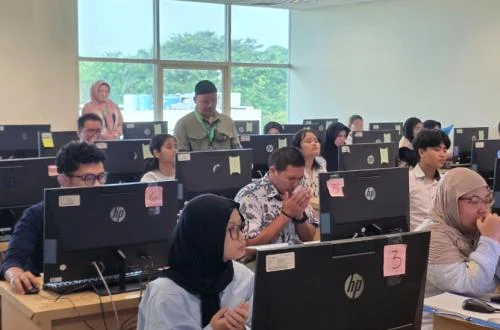
The Universitas Negeri Jakarta (UNJ) has reported a notable rise in the number of participants for its independent entrance examination, known as Penmaba Mandiri, specifically through the dedicated pathway for students with disabilities. For the 2026 academic year, the university recorded 138 applicants, marking a 9.6 percent increase from the 125 participants documented in 2025. This upward trend highlights a growing momentum in the accessibility of higher education within Indonesia and underscores UNJ’s position as a leading institution in fostering an inclusive academic environment. The selection process, which took place on Saturday, July 18, 2026, was conducted in person at the Dewi Sartika Building on the UNJ campus, involving a comprehensive support system designed to ensure equity for all candidates.
I Wayan Sugita, the Head of the UNJ Admissions Office, noted that the consistent growth in applicant numbers is a clear indicator of two primary factors: the rising aspirations of individuals with disabilities to pursue advanced degrees and the increasing public confidence in UNJ’s specialized support services. According to Sugita, the fact that 138 individuals applied this year demonstrates that the barriers to higher education are gradually being dismantled, as more prospective students view UNJ as a viable and welcoming destination for their academic journeys.
Analysis of Academic Trends and Popular Programs
The 2026 data reveals specific patterns in the academic interests of students with disabilities. Among the various options available, three faculties emerged as the most sought-after: the Faculty of Engineering, the Faculty of Education, and the Faculty of Languages and Arts. These choices reflect a diverse range of career goals, from technical expertise to pedagogical training and creative expression.
In particular, the Applied Bachelor’s Program in Culinary Arts and Food Service Management stood out as the most popular choice among applicants. This preference suggests a strategic move by students toward vocational and applied sciences, which often offer more direct pathways to entrepreneurship and employment in the hospitality sector. The popularity of the Faculty of Education also aligns with UNJ’s historical roots as a premier teacher-training institution, indicating that many students with disabilities are eager to enter the teaching profession, perhaps to eventually serve as role models or specialists in inclusive education themselves.
Chronology of the Selection Process
The Penmaba Mandiri selection for the disability pathway was a meticulously planned one-day event. The chronology of the day began early on the morning of July 18, 2026, as candidates arrived at the Dewi Sartika Building. To manage the logistics of the event, UNJ deployed a specialized task force and a large group of student volunteers.
The process began with a registration and verification phase where students were greeted by their assigned mentors. Following a brief orientation, the examination commenced. Unlike standard examinations, the schedule for the disability pathway included additional time buffers and specialized breaks to accommodate the physical and neurological needs of the participants. Throughout the day, university officials, including the Rector and Vice Rectors, conducted inspections to ensure that the infrastructure and human support systems were functioning effectively. The day concluded with a debriefing for the volunteers and a preliminary review of the examination’s administrative success.
Comprehensive Support and the Role of REDIS
One of the cornerstones of UNJ’s inclusive strategy is the Disability Volunteer group, known as REDIS (Relawan Disabilitas UNJ). For the 2026 examination, REDIS mobilized 65 volunteers drawn from various cohorts and academic programs. These volunteers are not merely assistants; they undergo specific training to understand the nuances of different disabilities, ensuring that their support is both respectful and effective.
Prila Ahdanila, the Coordinator of REDIS for the 2026 Penmaba Disabilitas, explained that the support process begins long before the exam day. The Admissions Office provides REDIS with detailed data on the participants and their specific requirements. This allows the coordinators to map out the needs of each individual. For instance, students with visual impairments (tunanetra) were provided with personal guides to navigate the campus and, where necessary, readers or specialized software. Students with autism or Attention-Deficit/Hyperactivity Disorder (ADHD) were given assistance to maintain focus and manage sensory inputs within the examination environment.
Furthermore, the university ensured that sign language interpreters were present in the examination rooms to assist students with hearing impairments. This level of logistical detail is designed to remove the "hidden hurdles" of a high-stakes testing environment, allowing the candidates to focus entirely on their academic performance.
Institutional Commitments to Equality
The Vice Rector for Academic, Student, and Alumni Affairs, Ifan Iskandar, emphasized that the disability pathway is not just a secondary admission route but a fundamental component of the university’s mission. He stated that UNJ is committed to ensuring that every citizen, regardless of their physical or neurological condition, has an equal opportunity to access quality higher education.
"UNJ strives to ensure that every prospective student has an equal opportunity to demonstrate their academic potential," Prof. Ifan remarked. He added that the university is constantly refining its support services to make the selection process both fair and accessible. This commitment extends beyond the entrance exam; it is part of a broader institutional policy to adapt the campus environment, including physical infrastructure and digital learning platforms, to be fully inclusive.
Critical Evaluations and the Path to True Equity
While the 2026 selection process was deemed a success in terms of participation and logistics, UNJ’s leadership remains critical of the current system to drive further improvements. During a visit to the examination site, Rector Komarudin expressed his appreciation for the volunteers and the admissions team but also highlighted areas for systemic evolution.
Rector Komarudin pointed out that providing physical access and human assistance is only the first step. He raised the issue of the examination content itself. Currently, the test materials for the disability pathway often mirror those used in the regular admission tracks. The Rector suggested that if the questions remain identical, there must be a significant adjustment in the evaluation criteria or the nature of the questions to account for the different ways in which students with disabilities process information or demonstrate aptitude.
"If the questions are still the same as the regular pathway, then there needs to be an adjustment in the assessment criteria so that the selection process takes place more fairly," Komarudin stated. This perspective reflects a sophisticated understanding of "equity" versus "equality"—where true fairness involves recognizing individual differences rather than treating everyone exactly the same when the starting points are not equal.
Broader Implications for Higher Education in Indonesia
The success of UNJ’s 2026 disability entrance exam has implications that resonate far beyond the campus walls. It serves as a benchmark for other State Universities (PTN) in Indonesia. The 9.6 percent increase in participants is a data point that suggests a cultural shift in Indonesian society, where disability is increasingly seen through the lens of capability and rights rather than charity.
From a policy perspective, UNJ’s model aligns with Law Number 8 of 2016 concerning Persons with Disabilities, which mandates that educational institutions provide reasonable accommodations. By actively promoting the disability pathway and seeing a year-on-year increase, UNJ is providing a proof-of-concept that inclusive policies, when backed by dedicated volunteer groups like REDIS and administrative support, can successfully increase the participation rate of marginalized groups in higher education.
However, the increase in enrollment also brings challenges. As more students with disabilities enter the university, there will be a growing demand for:
- Adaptive Curriculum: Professors and lecturers will need to be trained in universal design for learning (UDL) to ensure that classroom instruction is accessible.
- Infrastructure Investment: Continued upgrades to elevators, ramps, and tactile paving across all campus buildings.
- Employment Integration: Strengthening ties with industries to ensure that graduates from the disability pathway, such as those in the popular Culinary Arts program, find equitable opportunities in the job market.
Conclusion
The 2026 Penmaba Mandiri for the disability pathway at Universitas Negeri Jakarta represents a significant milestone in the journey toward educational inclusivity in Indonesia. With 138 participants and a robust support system involving 65 dedicated volunteers, the university has demonstrated that it is possible to create a structured, welcoming, and professional environment for students with diverse needs.
The feedback from Rector Komarudin regarding the need for more nuanced assessment criteria indicates that UNJ is not resting on its laurels. Instead, the institution is looking toward a future where the "independent pathway" is not just a door that is held open, but a path that is fundamentally redesigned to recognize and celebrate the diverse intellectual potentials of all students. As the 2026 cohort prepares to begin their studies, the focus will now shift from admission to retention and success, ensuring that the increase in numbers translates into an increase in graduates who are ready to contribute to the nation’s social and economic fabric.
