
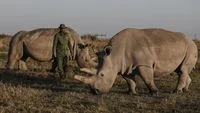
JAKARTA, CNN Indonesia — The northern white rhinoceros stands at the absolute precipice of extinction, represented today by only two surviving females sheltered under 24-hour armed guard at the Ol Pejeta Conservancy in Kenya. Najin and her daughter, Fatu, are the sole remaining living links to a distinct subspecies that once roamed vast expanses of Central and East Africa. Despite unprecedented international scientific interventions, advanced assisted reproductive technologies, and millions of dollars in dedicated funding, a successful live birth has not yet been achieved, leaving conservationists in a desperate race against time to pull the subspecies back from the point of no return.
The crisis facing the northern white rhinoceros is not merely a localized wildlife tragedy; it is a stark illustration of the catastrophic impact of unchecked human activity, poaching, and geopolitical instability on global biodiversity. As scientists race to implement cutting-edge reproductive techniques before the biological window closes entirely, the fate of the subspecies hangs on a fragile portfolio of laboratory-grown embryos and surrogate mothers.
The Scientific Battleground: In Vitro Fertilization and Surrogate Mothers
According to recent updates from international scientific literature, including reports from Space Daily, a global consortium of researchers and conservationists known as BioRescue has achieved remarkable scientific milestones in the laboratory. The collective has successfully generated 39 pure northern white rhinoceros embryos. These microscopic lifelines represent the primary hope for reversing the functional extinction of the subspecies.
The process of creating these embryos is a delicate and intricate logistical endeavor. Because neither Najin nor Fatu is physically capable of carrying a pregnancy to term—both having been diagnosed with severe, degenerative reproductive tract pathologies back in 2014—scientists must rely on a surrogate parenting model. The procedure involves harvesting oocytes (immature egg cells) directly from the ovaries of the rhinos, transporting them under strict thermal and biological controls to specialized facilities, and fertilizing them in vitro using frozen sperm collected from deceased northern white rhinoceros males.
Once fertilized, the resulting embryos are cryopreserved until they are ready for transfer. Up to April 2026, six of these valuable embryos have been transferred into closely related southern white rhinoceros surrogate mothers residing in Kenya. While these transfers represent monumental steps forward in reproductive biology, none of the attempts have resulted in a sustained, full-term pregnancy thus far.
The burden of this scientific campaign has fallen almost entirely on Fatu. Born on June 29, 2000, Fatu is now 26 years old and remains the sole active oocyte donor in the program. Since October 2021, Fatu has carried the heavy responsibility of single-handedly providing the genetic material for future generations. Her mother, Najin, who was born at a safari park in the Czech Republic on July 11, 1989, was permanently retired from oocyte retrieval procedures after undergoing three procedures that failed to yield viable embryos due to age-related cellular decline and reproductive tract complications.
The oocyte collection process itself is an invasive medical procedure requiring specialized equipment, general anesthesia, and expert veterinary teams. Fatu has undergone dozens of these rigorous sessions. By August 2025, data compiled by the BioRescue consortium showed that Fatu had completed 21 oocyte collection sessions, culminating in 38 pure embryos. An additional session in early 2026 pushed the total count to 39. Maturation and fertilization of these cells predominantly take place at the advanced facilities of the Avantea laboratory in Cremona, Italy, utilizing genetic reserves preserved from historical populations.
Historical Range and the Anatomy of a Decline
To understand how one of the Earth’s most majestic megafauna populations was reduced to a pair of captive females in Kenya, one must look back at the historical distribution and the relentless socio-political pressures that decimated the subspecies.
Historically, the northern white rhinoceros (Ceratotherium simum cottoni) occupied a broad swathe of Central and East Africa. Its historical range encompassed northwestern Uganda, southern Chad, South Sudan, the eastern part of the Central African Republic, and northeastern regions of the Democratic Republic of the Congo (DRC). In these fertile savannahs and woodland ecosystems, the northern white rhino played a vital ecological role as a mega-herbivore, shaping vegetation structures and maintaining grassland habitats that supported a wide array of other indigenous species.
The primary driver of the subspecies’ catastrophic decline was systematic, relentless poaching fueled by the illegal international trade in rhinoceros horn. Valued extensively in traditional Asian medicine markets and as a status symbol for carved dagger handles in parts of the Middle East, rhinoceros horn commanded astronomical prices on the black market—frequently outstripping the street value of gold or illicit narcotics. Armed syndicates operating across international borders deployed sophisticated tracking equipment, automatic weapons, and local networks to hunt down the remaining wild populations.
Compounding the crisis of commercial poaching was chronic geopolitical instability and armed conflict across the geographic heartland of the northern white rhinoceros. Decades of civil wars, regional insurgencies, and lawless governance in countries like South Sudan, the Central African Republic, and the eastern DRC created operational dead zones. In these areas, conservation infrastructure collapsed, wildlife rangers were targeted or forced to abandon their posts, and heavily armed militia groups utilized illegal wildlife trafficking to finance their military operations.
The tipping point for the wild population occurred in the mid-2000s. The last confirmed sighting of wild northern white rhinoceroses took place in August 2005 within the Garamba National Park in the northeastern region of the Democratic Republic of the Congo, where a meager population of just four individuals was documented. Sporadic signages and unconfirmed reports persisted through 2007, and brief rumors of three individuals surfaced in South Sudan in 2008. However, an exhaustive aerial and ground survey conducted in June 2008 failed to find any living evidence, effectively sealing the fate of the wild population and driving the subspecies into extinction in the wild.
The Chronology of Captive Conservation Efforts
Faced with impending extinction, international conservationists executed a high-stakes translocation strategy in late 2009. Recognizing that local protection mechanisms in Central Africa had failed completely, conservation groups orchestrated the transfer of the last four remaining breeding-age northern white rhinos from the Dvír Králové Zoo in the Czech Republic to the expansive, heavily guarded Ol Pejeta Conservancy in Kenya.
The relocation, completed in December 2009, brought together two males—named Suni and Sudan—and two females, Najin and Fatu. The overarching objective was to relocate the animals from a sterile European zoo environment to a climate and habitat closely mirroring their ancestral African home, thereby stimulating natural mating behaviors and social structures.
For a time, the move offered a glimmer of cautious optimism. The rhinos acclimatized well to the Kenyan savannah and were observed engaging in natural social interactions. However, biological challenges soon overshadowed the environmental benefits. In October 2014, Suni, one of the crucial male specimens, died of natural causes at the age of 34, leaving Sudan as the sole remaining adult male of reproductive age. Around the same period, comprehensive veterinary examinations revealed that both Najin and Fatu suffered from severe, irreversible pathological conditions affecting their reproductive tracts, rendering natural copulation unsuccessful despite observed mating attempts.
The situation grew even more critical on March 19, 2018, when Sudan, the patriarchal symbol of the fight against extinction and the father of Najin and grandfather of Fatu, was euthanized due to age-related complications and compounding degenerative illnesses. Sudan’s death marked a profound psychological and biological milestone: the permanent loss of all living male northern white rhinos born in the wild.
With natural reproduction completely off the table, the scientific community pivoted entirely to advanced reproductive technologies (ART) and stem cell research. Because traditional breeding was no longer physically possible, the BioRescue consortium was established, uniting leading wildlife institutes, reproductive biologists, and ethical oversight committees from Germany, Italy, the Czech Republic, and Kenya. This partnership has since worked tirelessly to advance protocols that were previously untested on rhinoceros species, turning laboratories in Europe and conservancies in Africa into the ultimate testing grounds for the survival of a lineage.
Ethical Dilemmas, Financial Realities, and Broader Implications
The desperate measures being deployed to save the northern white rhinoceros have sparked intense debate within the global conservation community, raising profound ethical, financial, and ecological questions about the prioritization of species rescue operations.
Critics of the multi-million-dollar BioRescue initiative often argue that pouring vast resources into saving a functionally extinct subspecies represents a misallocation of conservation capital. Opponents suggest that these funds could be deployed far more effectively to protect populations of critically endangered species that still maintain self-sustaining wild numbers, such as the black rhinoceros (Diceros bicornis) or the southern white rhinoceros (Ceratotherium simum simum), where systemic habitat protection and anti-poaching enforcement yield broader, systemic ecological benefits.
Furthermore, some conservation ethicists question the ultimate viability of a species brought back from genetic bottlenecks consisting of only a handful of individuals. Even if scientists successfully produce a live northern white rhinoceros calf via surrogacy, the resulting population would suffer from extreme inbreeding depression, limiting genetic diversity and potentially rendering the animals highly susceptible to novel diseases, environmental stressors, and congenital defects.
Conversely, proponents of the project emphasize that the scientific methodologies being pioneered through the northern white rhino rescue initiative have transformative applications for biodiversity conservation at large. The techniques developed for oocyte retrieval, in vitro fertilization, embryo cryopreservation, and stem cell derivation are not exclusive to northern white rhinos. They serve as a foundational technological blueprint that can be adapted and scaled to rescue dozens of other endangered mammalian species globally whose populations are similarly plummeting toward the brink.
Additionally, researchers point to the pioneering work being conducted in stem cell biology. BioRescue scientists are currently attempting to derive primordial germ cells—the precursors to sperm and eggs—from skin biopsies of deceased northern white rhinos preserved in international biobanks. If successful, this cellular reprogramming could exponentially expand the available genetic pool, bypassing the biological limitations of relying solely on Fatu’s harvested oocytes and injecting fresh genetic diversity into future generations.
As Fatu ages and the scientific timeline accelerates, the fate of the northern white rhinoceros remains suspended in a delicate balance between human ingenuity and biological inevitability. Whether the laboratories of Europe and the guarded plains of Kenya can successfully produce a new dawn for Ceratotherium simum cottoni will ultimately stand as a defining monument to modern science’s capacity to correct the ecological mistakes of the past—or as a sobering reminder of the absolute permanence of extinction once the last heartbeat fades.
