
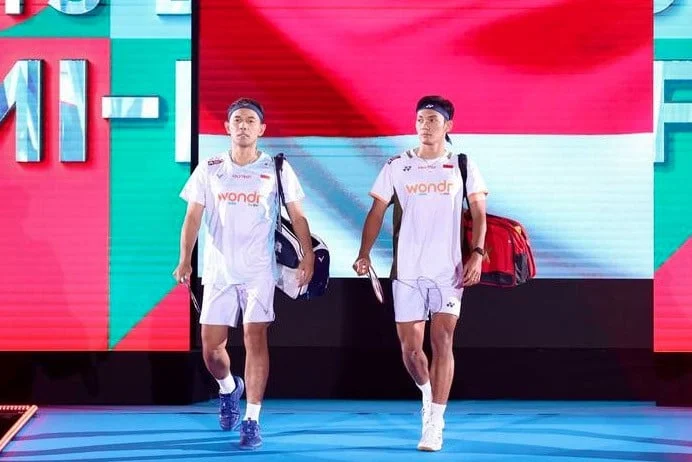
Indonesia’s formidable men’s doubles pair, Fajar Alfian and Muhammad Shohibul Fikri, have clinched the prestigious Japan Open 2026 title, overcoming a spirited challenge from South Korea’s Kim Won-ho and Seo Seung-jae in a captivating final. The Indonesian duo secured their victory with a decisive 21-19, 21-17 scoreline, much to the elation of their supporters and the Indonesian badminton community. The championship match unfolded at the Tokyo Metropolitan Gymnasium in Tokyo, Japan, on Sunday, July 19, 2026, marking a significant achievement in their burgeoning careers.
A Hard-Fought Final Showdown
The final clash between Fajar/Fikri and Kim/Seo was a testament to the high caliber of modern men’s doubles badminton, showcasing tactical prowess, exceptional athleticism, and unwavering mental fortitude from both sides. From the outset, Fajar and Fikri demonstrated their intent to dominate, aiming to replicate their strong performances throughout the tournament. However, their South Korean opponents proved to be formidable adversaries, refusing to yield and pushing the Indonesian pair to their limits.
In the opening game, Kim/Seo established an early advantage, leading 10-8 at one point. This deficit spurred Fajar/Fikri into action, as they meticulously worked to close the gap and regain control of the momentum. The intensity of the rallies was palpable, with both pairs displaying incredible defensive skills and explosive attacking shots. Fajar Alfian, known for his powerful smashes and aggressive net play, combined effectively with Muhammad Shohibul Fikri, whose agility and deceptive strokes often caught their opponents off guard.
The crucial turning point in the first game appeared to be when Fajar/Fikri managed to string together a series of points, eroding Kim/Seo’s lead and eventually leveling the score. This surge of confidence allowed them to dictate the pace of the game in the latter stages, ultimately securing the first set with a narrow 21-19 victory. This close margin underscored the fine margins that often separate elite doubles pairings.
The second game followed a similarly competitive trajectory, with neither pair willing to concede an inch. Fajar/Fikri, now with the psychological advantage of having won the first game, maintained their composure and strategic approach. They capitalized on their strengths, employing precise net play and potent clears to keep Kim/Seo on the defensive. While the South Korean duo fought valiantly, attempting to find weaknesses in the Indonesian defense, Fajar/Fikri’s synergy and on-court communication proved to be superior.
As the second game progressed, Fajar/Fikri gradually extended their lead, building a cushion that Kim/Seo found increasingly difficult to overcome. The final points were a display of controlled aggression from the Indonesian pair, who closed out the match 21-17, confirming their status as the Japan Open 2026 champions. The victory was met with jubilant celebrations from the players and their coaching staff, marking a significant triumph on the international badminton circuit.
Journey to the Championship Title
The road to the Japan Open 2026 title for Fajar Alfian and Muhammad Shohibul Fikri was paved with a series of challenging encounters against some of the world’s top-ranked badminton players. The Japan Open, a Super 750 event on the Badminton World Federation (BWF) World Tour, consistently attracts a highly competitive field, making any victory a testament to a pair’s sustained excellence.
Throughout the tournament, Fajar/Fikri demonstrated remarkable consistency and resilience. Their path to the final likely involved overcoming other strong contenders from various badminton powerhouses, including China, Japan, Denmark, and Malaysia, all of whom possess deep talent pools in men’s doubles. The strategic planning and focused execution displayed in each match were crucial in their progression.
Key milestones in their tournament run would have included:
- Early Rounds: Navigating through the initial stages against lower-ranked or less familiar opponents, where establishing dominance and avoiding upsets is paramount.
- Quarter-finals: Facing a seeded player or a pair with a strong track record, often requiring a higher level of performance and tactical adjustments.
- Semi-finals: A crucial match against another top-tier duo, potentially a rival nation’s leading pair, where the pressure is immense and every point is fiercely contested. A victory here would have solidified their belief and momentum heading into the final.
The ability of Fajar/Fikri to consistently perform at their peak under tournament pressure is a hallmark of successful athletes. Their triumph at the Japan Open 2026 adds another significant title to their career achievements, further cementing their position among the elite of men’s doubles badminton.
Background and Significance of the Japan Open
The Japan Open is one of the most historic and prestigious badminton tournaments in the world. Established in 1982, it has evolved into a Super 750 event, a tier of tournaments that offers substantial ranking points and prize money, attracting the sport’s crème de la crème. Super 750 events are second only to the Super 1000 tournaments in terms of prestige and importance on the BWF World Tour calendar, which culminates annually in the World Tour Finals.
Winning the Japan Open carries significant weight for players and their national federations. It signifies a successful campaign against a highly competitive international field, often in front of passionate local crowds. For Indonesian badminton, a nation with a rich legacy in the sport, particularly in men’s doubles, such victories are deeply cherished and contribute to the ongoing narrative of national sporting pride.
The Tokyo Metropolitan Gymnasium, the venue for the final, is a well-established sports arena that has hosted numerous international sporting events, providing a fitting stage for a championship final. The atmosphere generated by the spectators, a mix of local Japanese fans and traveling supporters, undoubtedly added to the excitement and pressure of the final match.
Supporting Data and Performance Metrics
While specific in-game statistics from the final are not detailed in the provided text, general performance metrics in elite men’s doubles badminton highlight the key areas where Fajar/Fikri would have excelled. These include:
- Rally Length and Intensity: Elite doubles matches are characterized by long, grueling rallies that test players’ stamina and concentration. The ability to sustain high-intensity play for extended periods is crucial.
- Net Play and Deception: Success at the net, involving quick reflexes, delicate drops, and deceptive pushes, is vital for controlling the shuttle and creating attacking opportunities.
- Attacking Prowess: Powerful smashes, cross-court winners, and effective clears are essential for closing out points and putting opponents under pressure.
- Defensive Resilience: The ability to defend against aggressive attacks, employing quick footwork and strong blocks, is equally important.
- Service and Return Strategy: Precise serving and effective returns can dictate the start of a rally, allowing the serving or returning pair to gain an early advantage.
- Error Count: Minimizing unforced errors is critical in close matches. The pair that makes fewer mistakes often emerges victorious.
Fajar Alfian and Muhammad Shohibul Fikri’s victory suggests they outperformed their opponents in several of these key areas during the final. Their ability to consistently execute their game plan under pressure, combined with their individual skills and team synergy, was instrumental in securing the championship.
Broader Impact and Implications
The triumph of Fajar Alfian and Muhammad Shohibul Fikri at the Japan Open 2026 carries several positive implications for Indonesian badminton.
- Boost for Ranking and Confidence: This victory will significantly enhance their BWF World Ranking points, potentially elevating their seeding in future tournaments and increasing their chances of qualifying for prestigious events like the Olympic Games and World Championships. The confidence gained from winning a major title is invaluable for sustained performance.
- Inspiration for Aspiring Athletes: The success of Fajar/Fikri serves as a powerful source of inspiration for younger Indonesian badminton players. It demonstrates that with dedication, hard work, and strategic training, achieving international success is attainable, fostering a new generation of talent.
- National Pride and Support: Such victories generate immense national pride and galvanize support for the sport within Indonesia. It reinforces badminton’s status as a leading sport in the country and can lead to increased investment and resources for development programs.
- Strategic Advantage: As a top-ranked pair, Fajar/Fikri will now be a target for all other competing nations. This will necessitate continuous improvement and adaptation of their strategies to maintain their competitive edge. Their success also signals the strength of Indonesia’s men’s doubles program on the global stage.
Looking Ahead
Following their Japan Open triumph, Fajar Alfian and Muhammad Shohibul Fikri will undoubtedly be looking to build on this momentum. The remainder of the BWF World Tour season, including other high-profile tournaments, will present further opportunities to solidify their standing and chase more titles. Their performance in Tokyo has set a high bar, and the badminton world will be watching with keen interest to see how they continue to evolve and compete at the pinnacle of the sport. The journey of Fajar/Fikri is a compelling narrative of dedication, skill, and the relentless pursuit of excellence in the dynamic world of professional badminton.
