
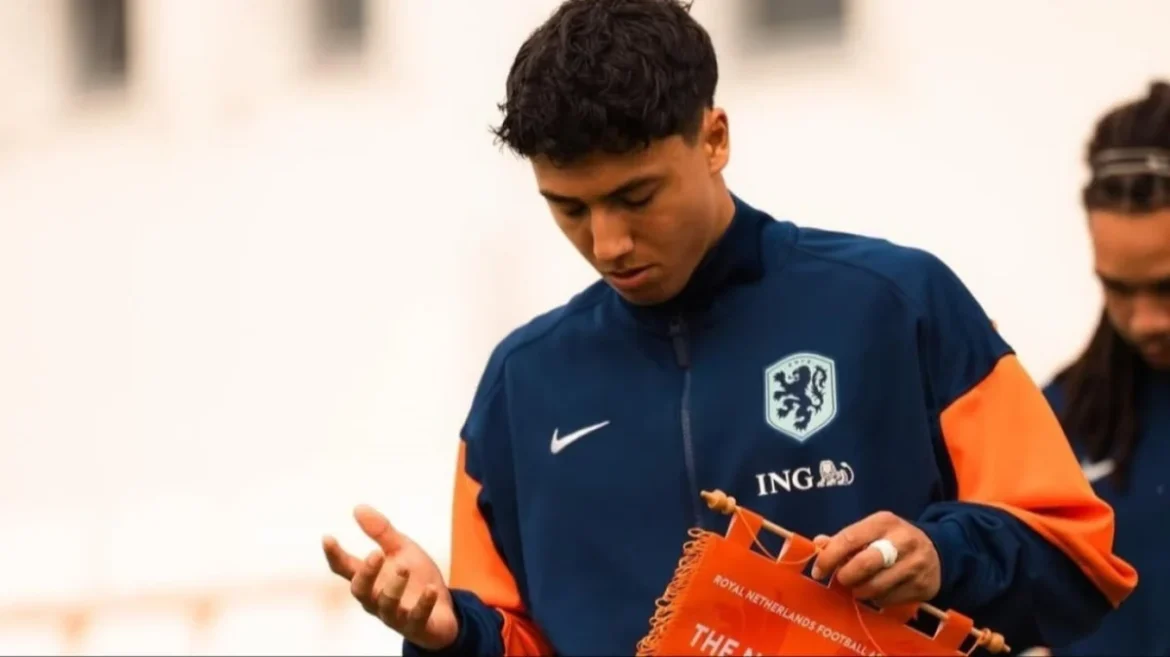
Julian Oerip, the former captain of the Netherlands U-19 squad, has once again captured the attention of Indonesian football enthusiasts. Following a previous viral moment where he was seen wearing an Indonesian national team jersey, Oerip has now showcased his connection to the archipelago by sporting football boots adorned with the Indonesian flag. This latest display of affinity has further fueled speculation and excitement regarding his potential future with the Garuda squad.
Born in Alkmaar, Netherlands, on October 26, 2006, the 19-year-old midfielder is currently a key player for AZ Alkmaar’s U-21 team, competing in the second tier of Dutch football. His burgeoning career at the prestigious AZ Alkmaar academy has been marked by rapid progression. Having honed his skills through the club’s youth ranks, Oerip was successively promoted to the U-17 and U-18 teams before earning a place in the AZ Alkmaar U-21 squad in 2024.
Oerip’s performances for AZ Alkmaar’s youth setup have been promising. In the previous season, he participated in 16 official matches, contributing one goal and four assists. His versatility as a modern midfielder is a significant asset, allowing him to operate effectively in multiple roles. He can be deployed as an attacking midfielder, a central midfielder, a defensive midfielder, or even on the left flank, offering tactical flexibility to any team.
Beyond his club commitments, Oerip possesses valuable international experience. He has accumulated 25 appearances for various youth categories of the Dutch national team, ranging from the U-16 to the U-19 levels. His leadership qualities were recognized when he was entrusted with the captain’s armband for the Netherlands U-19 team. This significant responsibility was notably evident during a friendly match against Portugal on October 15, 2024, where he led his side.
The prospect of Julian Oerip representing the Indonesian national team is a topic of considerable interest due to his ancestry. It is understood that his maternal grandparents hail from Surabaya, East Java, Indonesia. This lineage provides a potential pathway for him to represent Indonesia, provided he meets the eligibility criteria set by FIFA regulations for players with dual nationality or those eligible through descent.
Oerip’s recent public displays of affection for Indonesia, particularly his Instagram Story featuring football boots emblazoned with the Indonesian flag, have been interpreted by many as a strong indication of his willingness to embrace his heritage and potentially represent the nation. This gesture is seen as a reaffirmation of his Indonesian roots and a signal that he might be open to undergoing the naturalization process if required by the Indonesian Football Association (PSSI). This is not the first time Oerip has subtly highlighted his Indonesian identity, further solidifying the growing sentiment among fans.
Background and Eligibility for Indonesian National Team
The discussion surrounding Julian Oerip’s potential eligibility for the Indonesian national team is rooted in FIFA’s regulations concerning player nationality and representation. Players can represent a country if they hold citizenship, were born in the country, or have parents or grandparents who were born in that country. In Oerip’s case, his paternal grandparents’ origins in Surabaya, East Java, align with the latter criterion.
Indonesia has a history of naturalizing players with Indonesian heritage playing abroad to strengthen its national teams. This strategy has been employed to boost the competitiveness of both the men’s and women’s senior teams, as well as youth squads. The objective is often to bridge the gap in talent and experience with regional rivals and to qualify for major international tournaments.

The process of naturalization typically involves the player renouncing their current nationality (unless the country allows dual citizenship for athletes), undergoing a residency period, and obtaining an Indonesian passport. For players of Indonesian descent, the process can sometimes be expedited, especially if there is a strong desire from both the player and the football association.
Oerip’s Career Trajectory at AZ Alkmaar
AZ Alkmaar is renowned for its highly regarded youth academy, which has consistently produced talented players who have gone on to successful careers in top European leagues. The academy’s rigorous training methodology and competitive environment provide a fertile ground for young prospects to develop their skills and tactical understanding.
Oerip’s progression through the ranks at AZ Alkmaar demonstrates his potential and the club’s confidence in his abilities. His consistent appearances and contributions at the U-21 level suggest he is on track for potential senior team integration in the future. His ability to play multiple midfield positions further enhances his value to the team, offering tactical adaptability.
The statistics from his previous season – 16 appearances, one goal, and four assists – paint a picture of a player who is actively involved in offensive plays and contributes to the team’s scoring opportunities. These numbers, while modest, are significant for a young player in a competitive league.
International Experience with the Netherlands
Oerip’s experience with the Netherlands national youth teams is a crucial aspect of his footballing development. Playing at the international level against other European nations exposes players to diverse playing styles, high-pressure situations, and a more demanding level of competition.
His 25 caps across various age groups, culminating in captaining the U-19 squad, highlight his standing within the Dutch youth system. The captaincy, in particular, signifies that he is not only a talented player but also a leader, capable of motivating his teammates and making crucial decisions on the field. This leadership experience would be invaluable if he were to transition to representing the Indonesian national team.
The Significance of the "Red and White" Display
Julian Oerip’s decision to showcase football boots featuring the Indonesian flag is a powerful statement that resonates deeply with Indonesian football fans. In a country where national pride is closely linked to sports, such gestures are often interpreted as a genuine expression of interest and potential commitment.
This public display can be seen as a proactive move to signal his willingness to engage with Indonesian football authorities. It could be an indirect invitation to PSSI to explore his eligibility and consider him for future national team call-ups. The viral nature of social media ensures that such displays quickly gain traction and generate widespread discussion.
Potential Implications for Indonesian Football
The emergence of a player like Julian Oerip, with his European pedigree and clear affinity for Indonesia, presents several potential implications for the future of Indonesian football:

- Enhanced Squad Depth and Quality: If Oerip were to join the national team, he would bring a level of technical skill, tactical awareness, and international experience that could significantly bolster the squad. His versatility in midfield could offer coach Shin Tae-yong (or any future coach) more options in terms of formations and strategies.
- Inspiration for Local Talent: The presence of a Dutch-born player of Indonesian descent who is willing to represent the nation can serve as a powerful source of inspiration for young Indonesian footballers. It demonstrates that pathways exist for players with diverse backgrounds to contribute to the national team’s success.
- Increased Fan Engagement: The excitement surrounding Oerip’s potential inclusion can galvanize the fanbase, leading to increased support for the national team, higher viewership for matches, and greater interest in domestic football.
- Strategic Advantage in Regional Competitions: With players like Oerip, Indonesia could potentially gain a competitive edge in tournaments like the AFF Championship and the AFC Asian Cup, aiming for greater success on the regional and continental stages.
Official Stance and Next Steps
As of the latest reports, there has been no official statement from the Football Association of Indonesia (PSSI) or the national team head coach, Shin Tae-yong, regarding any concrete plans for Julian Oerip’s naturalization or potential call-up. While Oerip’s gestures are significant and have captured public attention, official procedures and assessments would need to take place.
PSSI typically has a scouting and evaluation process for potential naturalization candidates. This would likely involve assessing the player’s performance, physical attributes, mental fortitude, and compatibility with the existing squad dynamics. Furthermore, the player’s genuine commitment and willingness to adapt to Indonesian culture would be crucial factors.
The mention of John Herdman in the original article, though linked to a separate piece about Luke Vickery, highlights the ongoing efforts by PSSI to strengthen the national team, potentially through naturalized players. The inclusion of foreign-born players with Indonesian heritage has become a strategic pillar for the association in its quest to elevate Indonesian football.
Broader Context: The Global Trend of Naturalization
Julian Oerip’s situation is part of a broader global trend where national football federations actively scout and recruit players of expatriate or diasporic origin to enhance their national teams. Countries across various continents, including those in Asia, Africa, and North America, have successfully leveraged this strategy.
For instance, many European nations have benefited from players with dual nationality who choose to represent their ancestral homelands. Similarly, in Asia, countries like Qatar, the Philippines, and Malaysia have historically utilized naturalized players to boost their competitive strength.
This practice, while sometimes debated, is largely accepted within the framework of international football. It offers a unique avenue for players to represent a nation they feel a connection to, while simultaneously providing that nation with access to a wider pool of talent that might otherwise be unavailable.
Conclusion
Julian Oerip stands at a fascinating juncture in his footballing journey. His current performances for AZ Alkmaar U-21, coupled with his captaincy experience for the Netherlands U-19 and his clear displays of affinity for Indonesia, make him a compelling prospect for the Indonesian national team. While official discussions are yet to be confirmed, the anticipation among Indonesian football fans is palpable. His potential inclusion could mark another significant step in PSSI’s strategic efforts to build a stronger, more competitive Garuda squad capable of achieving greater international recognition. The coming months will be crucial in determining whether this promising young talent will indeed grace the pitches in the red and white of Indonesia.
