
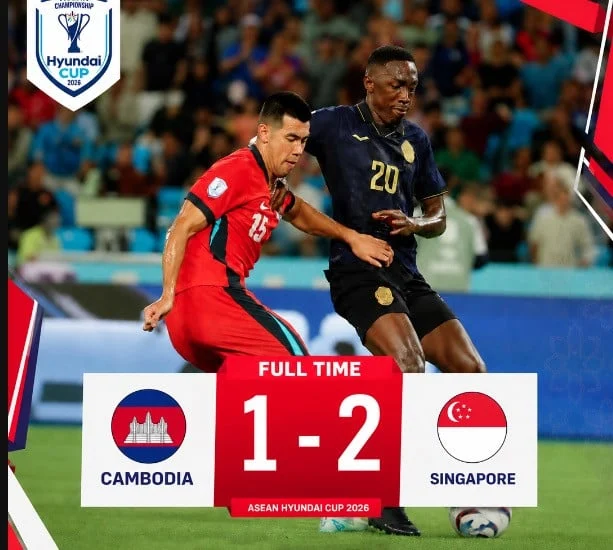
Singapore commenced their AFF Cup 2026 campaign with a nail-biting 2-1 triumph over host nation Cambodia, a victory sealed in the dying moments of injury time. The Lions, playing their opening Group A fixture at the Morodok Techo National Stadium in Phnom Penh on Friday, July 24, 2026, found their match-winner through the boot of Ilhan Fandi, whose acrobatic strike etched his name into the annals of the tournament’s early drama. The win, while hard-fought, sets a positive, albeit precarious, tone for Singapore’s ambitions in this year’s regional championship.
A Tense Encounter from the Outset
The match, played under the lights of the Cambodian capital, was characterized by periods of tactical ebb and flow, with both sides demonstrating moments of attacking intent and defensive resilience. Singapore, often perceived as a more established contender in Southeast Asian football, came into the fixture aiming to assert their authority early. Their initial breakthrough arrived in the 22nd minute, a testament to their patient build-up play and the sharp instincts of their forwards. A well-weighted through ball, originating from Lionel Tan, found Shawal Anuar in stride. Anuar, demonstrating composure under pressure, managed to evade his marker and expertly dispatched the ball past the Cambodian goalkeeper, giving the visitors a crucial lead that would hold until the halftime interval.
The opening goal provided Singapore with a psychological advantage, allowing them to dictate terms for a period. However, the Cambodian team, buoyed by the home crowd and a clear determination to make an impact in front of their supporters, refused to be disheartened. Their response after the break signaled a shift in momentum, as they emerged from the dressing room with renewed vigor and a more aggressive approach.
Cambodia’s Resurgence and the VAR Scare
The equalizer for Cambodia arrived in the 55th minute, a moment of individual brilliance that brought the stadium to its feet. Sovann Ouk, demonstrating excellent technique, unleashed a powerful right-footed shot that curled majestically into the top-left corner of the net. The stunning strike left Singapore’s goalkeeper with no chance and leveled the score at 1-1, injecting a fresh wave of anticipation and tension into the already charged atmosphere.
As the clock ticked down and the prospect of a draw loomed, the match entered its most dramatic phase. In the 88th minute, Singapore thought they had found their late winner through Ilhan Fandi. The young forward had indeed found the back of the net, sparking jubilant celebrations among the Singaporean contingent. However, the euphoria was short-lived. The referee, after a lengthy consultation with the Video Assistant Referee (VAR), deemed the goal to be offside, much to the disappointment of the players and fans alike. This decision, while adhering to the letter of the law, added another layer of narrative to the already compelling contest, highlighting the critical role of technology in modern football.
Ilhan Fandi: The Unlikely Hero in Injury Time
Despite the setback of the disallowed goal, the spirit of the Singaporean team, and particularly that of Ilhan Fandi, remained unbroken. The young forward, who had already experienced the agony of a disallowed goal, found redemption in the most spectacular fashion. In the 90th minute and 11 seconds of added time – a staggering eleven minutes of injury time, indicative of the stoppages and intensity of the match – Singapore was awarded a free-kick deep in their own half. The ball was launched forward, and a clever pass from Song Ui Young found Ilhan Fandi. With defenders closing in and the pressure immense, Fandi executed a breathtaking overhead kick, a move requiring immense skill and nerve. The ball soared into the net, a moment of pure magic that sent shockwaves through the stadium and secured an invaluable three points for Singapore. The dramatic nature of the winning goal underscored the unpredictable beauty of football and the capacity for individual brilliance to change the course of a match.
AFF Cup 2026: A Tournament of Rising Ambitions
The AFF Cup, formerly known as the Tiger Cup and Suzuki Cup, has consistently served as a platform for Southeast Asian nations to showcase their footballing prowess and vie for regional supremacy. Now in its 16th edition, the 2026 tournament promises to be another fiercely contested affair, with established powerhouses and emerging nations alike aiming to lift the coveted trophy. The expanded format, featuring a record number of participating teams, suggests an even greater level of competition and potential for upsets.
Singapore, a two-time champion (1998 and 2012), entered this tournament with aspirations of reclaiming their past glories. Their opening match against Cambodia, while seemingly a fixture they would be expected to win, represented a crucial test of their mettle and tactical readiness. Cambodia, a nation that has steadily been improving its footballing infrastructure and performance, presented a formidable challenge, especially on home soil. The recent history between the two nations in regional tournaments has often been competitive, with few easy victories.
The Significance of the Opening Win
Securing three points in their opening fixture is paramount for any team aspiring to progress from the group stages. For Singapore, this dramatic victory not only provides an immediate boost to their standings but also instills confidence in the squad. The ability to find a winner so late in the game, particularly after facing adversity, speaks volumes about the team’s resilience and fighting spirit under coach Takayuki Nishigaya.
The victory propels Singapore to the top of Group A, at least temporarily, with three points. However, the landscape of the group quickly shifted. Later in the day, Vietnam, another strong contender in the region, registered a resounding 7-0 victory over Timor Leste. This dominant performance by Vietnam saw them leapfrog Singapore into first place in the group standings, based on a superior goal difference. This development sets up an intriguing battle for qualification from Group A, with Singapore, Vietnam, and potentially other teams vying for the coveted spots in the knockout stages.
Analysis of Singapore’s Performance and Future Prospects
Singapore’s performance against Cambodia offered several key takeaways. Defensively, while they conceded a well-taken equalizer, the team largely managed to contain Cambodia’s threats for extended periods. The midfield displayed moments of creativity, particularly in the build-up to the opening goal, and the attacking unit, despite the VAR setback, demonstrated the ability to create and convert crucial chances. The impact of Ilhan Fandi, a rising star in Singaporean football, was undeniable. His persistence and the sheer audacity of his winning goal suggest he is a player capable of delivering on the big stage.
However, the extended period of injury time also raises questions about game management and the team’s ability to close out matches more decisively. While a dramatic win can be inspiring, relying on late heroics consistently can be a risky strategy. Singapore will need to analyze their performance, particularly in the second half, to identify areas for improvement, such as maintaining possession and controlling the tempo of the game more effectively to prevent opponents from gaining momentum.
The AFF Cup is a tournament where consistency and performance against varied opposition are key. Singapore’s next fixtures will provide a clearer indication of their true potential. Facing stronger opponents will test their tactical flexibility and depth. The competition for qualification from Group A is likely to be intense, and every point will be crucial. The early momentum gained from this hard-fought victory will undoubtedly be a significant factor as they navigate the challenges ahead.
Broader Implications and Tournament Context
The AFF Cup 2026, with its expanded format and growing regional interest, continues to be a vital showcase for football development in Southeast Asia. The increasing competitiveness, as evidenced by matches like Singapore versus Cambodia, reflects the dedication and investment put into the sport by various national federations. The use of VAR, while sometimes controversial, aims to ensure fairness and accuracy, a step towards aligning regional tournaments with global standards.
For Singapore, this tournament represents an opportunity to not only compete for silverware but also to further develop their national team, blood new talent, and inspire a new generation of footballers. The dramatic nature of their opening victory serves as a potent reminder that in football, the game is often not over until the final whistle, and moments of individual brilliance can etch themselves into the memories of fans for years to come. As the tournament progresses, the performances of Singapore and other nations will be closely watched, with the ultimate goal of crowning a new regional champion. The journey for the AFF Cup 2026 trophy has just begun, and the thrilling start by Singapore suggests that the path to glory will be filled with drama, passion, and unforgettable moments.
