
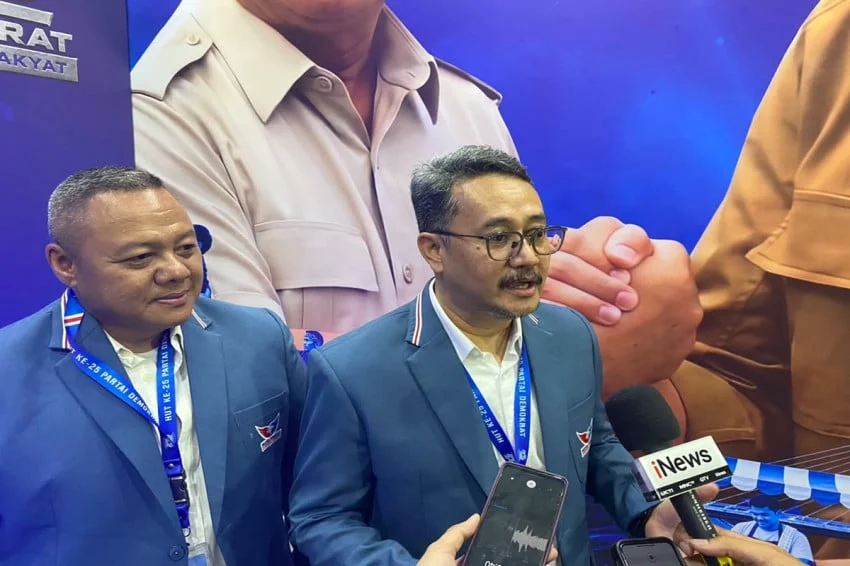
The silver jubilee of the Democratic Party of Indonesia marked a significant moment in the nation’s political landscape as the party celebrated its 25th anniversary at the Indonesia Arena in Senayan, Jakarta, on Wednesday, September 9, 2026. The event, which drew prominent political figures from various factions, served as a platform for demonstrating cross-party solidarity and outlining the future trajectory of Indonesian political cooperation. Among the notable attendees was the Secretary-General of the Central Executive Board (DPP) of the Perindo Party, Ferry Kurnia Rizkiyansyah, who represented the party’s leadership in a gesture of collaborative engagement.
The gathering underscored the evolving dynamics of Indonesia’s multi-party system. As the Democratic Party—founded in the early 2000s—entered its quarter-century milestone, the presence of representatives from other political entities like Perindo highlighted a growing emphasis on inter-party synergy aimed at addressing national challenges.
A Quarter-Century of Democratic Presence
The Democratic Party was established on September 9, 2001, and officially registered with the Ministry of Law and Human Rights on August 27, 2003. Its inception coincided with the early years of the Reformasi era, a period defined by the transition toward a more robust parliamentary democracy. Over the last 25 years, the party has played a pivotal role in the legislative and executive branches of the Indonesian government, most notably during the two-term presidency of Susilo Bambang Yudhoyono (2004–2014).
The celebration at the Indonesia Arena was more than a ceremonial anniversary; it was a strategic mobilization of the party’s base and its allies. The event featured addresses by senior party leadership, including Chairman Agus Harimurti Yudhoyono (AHY), who sought to reaffirm the party’s core identity and its continued relevance in a rapidly changing socio-political climate.
The Message of Synergy from Perindo
Ferry Kurnia Rizkiyansyah, speaking on behalf of Perindo Chairperson Angela Tanoesoedibjo, expressed his congratulations to the Democratic Party. For Perindo, a party that has consistently positioned itself as a champion of inclusive economic development and social welfare, the opportunity to engage with the Democratic Party represents a strategic alignment of vision.
"We, from the Perindo Party, representing our Chairperson, are grateful to be able to attend the 25th anniversary of the Democratic Party," Ferry stated during the event. "As part of the political landscape, we intend to continue working together in synergy."
Ferry emphasized that the core objective for both parties is to remain deeply connected to the pulse of the Indonesian citizenry. He noted that the themes resonating within the Democratic Party’s anniversary celebrations—namely, service to the people and the strengthening of institutional integrity—are inherently shared by Perindo. "We are committed to standing with the people; that is a fundamental priority. Perindo is currently focused on intensifying our grassroots activities and ensuring our cadres remain active in addressing community concerns," he added.
Political Context and the Logic of Cooperation
The decision of parties like Perindo to participate in the milestone celebrations of the Democratic Party is indicative of a broader trend in Indonesian politics. In the post-2024 election environment, the need for stable coalitions has become paramount. With the complexity of local and national legislative agendas, smaller parties and major political organizations are increasingly finding common ground to ensure policy continuity.
Analysts suggest that such gestures of goodwill—attending each other’s milestone events—serve as "soft diplomacy." These interactions help pave the way for future legislative alliances, especially as the nation approaches subsequent election cycles. By signaling a willingness to collaborate, parties are effectively signaling to the electorate that they prioritize national stability over partisan isolationism.

Chronology of the Democratic Party’s Evolution
To understand the significance of the 25th anniversary, one must look at the historical timeline of the party’s development:
- 2001: Foundation of the Democratic Party.
- 2004: The party achieves national prominence with the election of Susilo Bambang Yudhoyono as President, marking the first direct presidential election in Indonesian history.
- 2009: The party secures a significant victory in the legislative elections, further solidifying its influence in the House of Representatives (DPR RI).
- 2014–2024: A decade of navigating the opposition and adjusting to new leadership dynamics under AHY, focusing on youth engagement and digital transformation.
- 2026: The 25th-anniversary milestone, aimed at recalibrating the party’s focus toward long-term sustainability and grassroots outreach.
Addressing the "Limits of Power"
During the event, much of the discourse centered on the speech delivered by Chairman Agus Harimurti Yudhoyono regarding the nature of power. AHY’s address, which sought to clarify his previous statements on the limitations of political authority, served as a philosophical anchor for the anniversary. He articulated a vision of a party that is not merely chasing power but is instead focused on "strengthening the values and identity of the party’s struggle."
This sentiment was well-received by those in attendance, including the Perindo delegation. The acknowledgment that political power is transient—and that the ultimate mandate lies with the people—is a narrative that both Perindo and the Democratic Party appear keen to leverage as they attempt to bolster their reputations as public-interest organizations.
Implications for Future Governance
The collaboration between Perindo and the Democratic Party, while currently focused on communication and shared attendance at events, could have long-term implications for policy-making. Should the parties continue to align their legislative priorities—particularly in areas such as economic reform, social justice, and infrastructure development—it could create a formidable bloc in the parliament.
Furthermore, the emphasis on "synergy" suggests that the two parties may look to coordinate their activities in regional elections. By sharing logistical insights and policy platforms, they can optimize their reach to constituents across Indonesia’s diverse provinces.
Analyzing the Political Landscape
The political climate in Indonesia is currently characterized by a search for stability following intense election cycles. The Democratic Party, by hosting such a high-profile anniversary event, has effectively showcased its institutional longevity and its ability to maintain relationships across the political spectrum.
Perindo’s presence, as represented by Secretary-General Ferry, signifies a pragmatic approach to political survival and influence. In an era where voters are increasingly disillusioned by stagnant political rhetoric, parties that can demonstrate tangible collaboration and a focus on community-level engagement are likely to gain the most traction.
Conclusion: A Path Forward
As the Democratic Party moves into its 26th year, the lessons drawn from its 25th-anniversary celebration are clear: political longevity requires both a steadfast commitment to one’s core values and a flexible approach to inter-party cooperation. The message delivered by Ferry Kurnia Rizkiyansyah on behalf of Perindo is a testament to the fact that, despite competing for the same votes, political parties recognize the inherent value in a collective approach to national governance.
The events of September 9, 2026, at the Indonesia Arena will likely be remembered as a moment of consolidation. For the Democratic Party, it was a reaffirmation of their past and a launchpad for their future. For the Perindo Party, it was a demonstration of their commitment to working within the broader political ecosystem to drive the nation forward. As these parties continue their respective journeys, the synergy they have pledged to cultivate will be closely watched by observers and citizens alike, as it may well determine the shape of future political alliances in Indonesia.
