
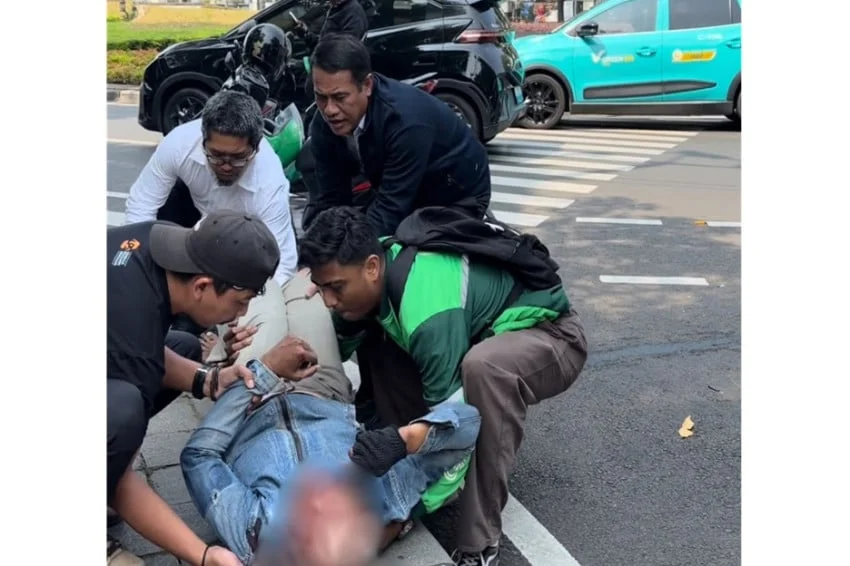
The Minister of Agriculture of the Republic of Indonesia, Andi Amran Sulaiman, demonstrated a significant humanitarian gesture on Thursday, July 23, when he ordered his official motorcade to stop to assist a victim of a traffic accident in the Menteng area of Central Jakarta. The incident occurred while the Minister was in transit to the State Palace for a scheduled high-level meeting. Amidst the tight security and rigid scheduling typical of ministerial duties, the decision to pause the convoy highlights a moment of civic responsibility and immediate crisis intervention by a high-ranking state official.
The event took place during the morning rush hour, a period characterized by heavy traffic and high congestion in the capital’s central administrative district. According to eyewitness accounts and reports from the scene, a motorcyclist—identified as a victim of a collision with a four-wheeled vehicle—was found lying on the asphalt, visibly injured and unable to move. The collision occurred directly in the path of the Minister’s approaching motorcade. Recognizing the severity of the situation and the potential delay in the arrival of emergency services due to the surrounding traffic density, Minister Amran Sulaiman instructed his driver and security detail to halt the procession immediately.
Detailed Chronology of the Incident
The chronology of the event began as the Minister’s convoy navigated the streets of Menteng, an elite neighborhood that serves as a primary artery for government officials traveling to the Presidential Palace. At approximately the mid-morning mark, a passenger car collided with a motorcycle, sending the rider to the ground. The impact was significant enough to draw the attention of bystanders and nearby commuters.
As the ministerial vehicle approached the site of the crash, Minister Amran Sulaiman observed the victim lying incapacitated on the roadside. Without hesitation, he directed his security personnel to pull over. Witnesses noted that the Minister exited his vehicle immediately, bypassing standard protocol that usually requires VIPs to remain inside the car for security reasons during unscheduled stops.
Upon reaching the victim, the Minister joined several local citizens in assessing the individual’s condition. In a move that departed from the traditional distance maintained by public figures, Amran Sulaiman was seen crouching beside the injured motorcyclist, offering verbal comfort and assisting residents in stabilizing the victim’s body to prevent further injury during the initial evacuation process.
Recognizing that waiting for a municipal ambulance might jeopardize the victim’s recovery time—often referred to in medical terms as the "Golden Hour"—the Minister made a logistical decision to repurpose his official resources. He ordered one of the vehicles from his security escort (Patwal) to be used as an emergency transport. The victim was carefully moved into the vehicle to be rushed to the nearest hospital for urgent medical attention.
Logistical Support and Civil Cooperation
In a further effort to ensure the victim was not left unattended during the transition to hospital care, Minister Amran Sulaiman engaged with the local community on-site. He requested a nearby "ojek online" (app-based motorcycle taxi) driver to accompany the victim in the escort vehicle to the hospital. This request was aimed at providing the medical staff with a witness who could relay the details of the accident and ensure the victim had a representative present until family members could be notified.
To facilitate immediate medical processing, the Minister reportedly provided the ojek driver with a sum of cash. These funds were intended to cover the initial administrative costs and emergency room deposits that are often required at private or public medical facilities before comprehensive treatment begins. This proactive approach addressed a common hurdle in the Indonesian healthcare system, where immediate financial clearance can sometimes impact the speed of non-life-threatening but urgent procedures.
Contextual Background: Road Safety in Jakarta
The incident involving Minister Amran Sulaiman brings into focus the broader issue of road safety in the Indonesian capital. Jakarta, a megacity with over 10 million residents, faces persistent challenges regarding traffic management and the safety of two-wheeled vehicle operators.
According to data from the Polda Metro Jaya (Greater Jakarta Metropolitan Regional Police), motorcycle accidents consistently account for the majority of traffic incidents in the city. In 2023, statistics indicated that motorcycles were involved in over 70% of all recorded road accidents in the Jakarta metropolitan area. The high density of vehicles, combined with the frequent mixing of heavy transport, private cars, and motorcycles in narrow corridors like those in Menteng, creates a high-risk environment for commuters.
The Menteng district, while being a high-security zone due to its proximity to embassies and government offices, is not immune to these risks. The intersection of high-speed official convoys and standard civilian traffic requires constant vigilance. The Minister’s intervention serves as a reminder of the vulnerability of motorcyclists in the urban landscape and the importance of immediate bystander intervention.
Profile of Minister Andi Amran Sulaiman
Andi Amran Sulaiman is a figure well-known for his "hands-on" approach to governance. Having served as the Minister of Agriculture in two different periods under President Joko Widodo’s administration, he has built a reputation for conducting frequent field visits—often referred to as blusukan—to monitor agricultural productivity and interact directly with farmers.
His background as a scientist and a businessman in the agricultural sector has influenced his leadership style, which many observers describe as pragmatic and action-oriented. This recent incident in Menteng is consistent with his public persona of being a leader who prioritizes direct action over bureaucratic hesitation. Within the Ministry of Agriculture, he is known for pushing for rapid mechanization and self-sufficiency in food production, often demanding quick results and accountability from his staff.
Analysis of Implications and Public Responsibility
The Minister’s actions have several implications regarding the expectations placed on public officials in Indonesia. From a sociological perspective, such gestures help to bridge the perceived gap between the ruling elite and the general citizenry. In a culture where "Bapakism" (the paternalistic role of leaders) remains a significant social construct, the image of a minister assisting a common laborer or commuter reinforces the ideal of a leader as a protector of the people.
From a legal and protocol standpoint, the decision to use a state vehicle for civilian emergency transport is an interesting case study. While official vehicles are strictly for government use, the "state of necessity" (noodtoestand) in legal theory often justifies the diversion of resources to save human life. By prioritizing a citizen’s life over the strict adherence to his schedule at the State Palace, the Minister set a precedent for humanitarian priority within the framework of state service.
The Role of the Golden Hour in Trauma Care
Medical experts emphasize that the first 60 minutes following a traumatic injury—the Golden Hour—are critical. During this window, prompt medical intervention significantly increases the chances of survival and reduces the likelihood of long-term disability. In the congested streets of Jakarta, where response times for traditional ambulances can be hindered by gridlock, the use of a police-escorted vehicle (which has the right-of-way) likely saved precious minutes for the victim.
The Minister’s decision to delegate a security vehicle ensured that the victim bypassed the usual traffic hurdles, potentially altering the medical outcome of the injuries sustained. This highlights a critical need for integrated emergency response systems in Jakarta that can navigate traffic as efficiently as official convoys.
Conclusion and Broader Impact
While the identities of the motorcyclist and the driver of the car involved in the accident have not been publicly disclosed, the Minister’s office confirmed that the victim received the necessary medical attention. The ojek online driver who assisted in the process was also commended for his willingness to step away from his livelihood to help a fellow citizen.
This incident serves as a brief but poignant pause in the high-stakes world of Indonesian politics. It reflects a growing trend where public officials are increasingly scrutinized not just for their policy decisions, but for their personal conduct and empathy in the public sphere. As the video and photos of the event circulated through social media and local news outlets, the narrative centered on the importance of human life over the formalities of office.
In the broader context of Indonesian governance, the event underscores the importance of situational leadership. Whether managing national food security or responding to a roadside emergency, the ability to assess a situation rapidly and deploy resources effectively remains a hallmark of competent administration. Minister Andi Amran Sulaiman’s detour on the way to the State Palace serves as a reminder that the duties of a public servant extend beyond the walls of the ministry and into the very streets they serve.
