
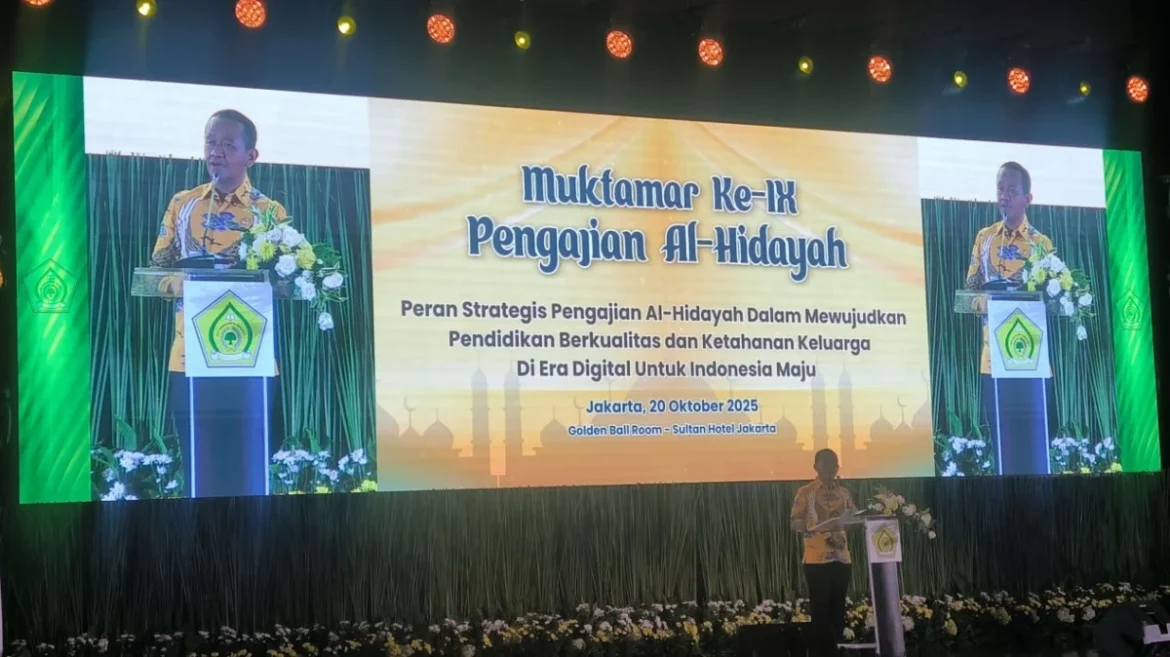
Jakarta, Indonesia — In a strategic push to consolidate political support at the grassroots level, Golkar Party Central Leadership Board (DPP) Chairman Bahlil Lahadalia has called upon female cadres of the Al-Hidayah Islamic organization to actively campaign in remote regions. Speaking at the opening of the 9th Muktamar (National Congress) of Pengajian Al Hidayah at the Sultan Hotel in Central Jakarta, Bahlil emphasized the importance of direct community engagement to position Golkar as a party dedicated to the welfare of everyday citizens.
The event, held on Monday, October 20, 2025, served as a platform for the Golkar leadership to outline organizational strategies, address contemporary socio-political challenges such as digital misinformation, and pledge operational backing to women’s wings operating across the archipelago. As Indonesia continues to navigate its complex post-election political landscape, parties are increasingly looking toward grassroots women’s organizations as pivotal agents for community mobilization and voter retention.
Strategic Directive: Reaching the Grassroots
Addressing an audience of dedicated female Islamic scholars and community leaders, Bahlil underscored the vital role that women’s organizations play in shaping public perception and electoral outcomes. He explicitly urged the members of Pengajian Al Hidayah—one of Golkar’s most influential autonomous wing organizations—to venture beyond urban centers and into remote villages, neighborhood associations (RT), and sub-districts.
"Go into the alleys, go to the village levels, go to all sub-districts to convince the public that the party that truly loves the people and continues to fight for their interests is the Golkar Party," Bahlil stated during his keynote address. He stressed that Golkar must not lag behind rival political factions in community-level outreach and urged cadres to project a unified message of pro-people policies.
To facilitate this expansive outreach, Bahlil announced that the DPP Golkar is fully prepared to provide operational support to all provincial-level Regional Leadership Boards (DPD) of Al-Hidayah. This financial and logistical backing is intended to empower local chapters to spearhead impactful community programs, enhance organizational penetration, and solidify Golkar’s electoral standing in preparation for future political contests.
Navigating Digital Disinformation and Social Media
Beyond political mobilization, Bahlil dedicated a significant portion of his address to warning attendees about the rising threats posed by unchecked digital spaces. He highlighted the proliferation of disformation, malicious slander, and deliberate hate speech—collectively referred to as DFK—across various social media platforms.
The Golkar leader cautioned the predominantly female audience against consuming and disseminating unverified news, explicitly warning them not to utilize dubious social media content as reference material for study circles or religious gatherings.
"We must not be fooled, mothers and fathers. Do not let unverified content from social media be used as study material for our religious gatherings. This is something we must actively avoid," Bahlil warned, highlighting the vulnerability of community groups to targeted misinformation campaigns in the modern digital era.
The caution reflects a broader concern among Indonesian political elites regarding the weaponization of digital platforms for political polarization. By addressing the issue directly, the Golkar leadership aims to position its network as a bastion of credible, community-focused engagement insulated from digital toxicity.
Reviewing Organizational Consolidation and Achievements
The 9th Muktamar of Pengajian Al Hidayah also marked a moment of internal reflection and celebration of organizational resilience. Hetifah Sjaifudian, the General Chairperson of Al-Hidayah, delivered an address highlighting the organization’s accomplishments throughout the 2020–2025 leadership tenure.
Hetifah noted that the outgoing leadership board successfully navigated unprecedented challenges, most notably the COVID-19 pandemic, while maintaining rigorous internal consolidation and structural strengthening.
"From internal DPP meetings, plenums, national working meetings (Rapimnas), and finally reaching the national congress, we have prioritized organizational consolidation. However, a strong organization exists solely to serve the community," Hetifah remarked.
She elaborated that Al-Hidayah’s mandate extends far beyond traditional political campaigns or religious outreach. Under her leadership, the organization has institutionalized various community service initiatives focused on educational advancement, social welfare, and economic empowerment.
"All of this is ultimately grounded in our worship and devotion as Muslim women, serving society while actively supporting the strategic programs initiated by the government," Hetifah added.
Background and Context of Pengajian Al Hidayah
Pengajian Al Hidayah holds a historic and strategic position within the broader ecosystem of the Golkar Party. Established decades ago as an Islamic women’s organization closely affiliated with Golkar, it has traditionally served as one of the party’s most reliable vote-gathering machines, particularly among female demographic blocs in rural and suburban areas.
The organization leverages religious study groups (pengajian) as a medium for social cohesion, education, and community welfare. By embedding political messaging within trusted community structures, Al-Hidayah has historically enabled Golkar to maintain a deep-rooted presence at the grassroots level, transcending standard electoral cycles.
The 9th Muktamar in Jakarta serves as a critical juncture for the organization to elect new leadership, evaluate past performance, and align its strategic roadmap with the overarching political objectives of the central party leadership under Bahlil Lahadalia.
Broader Political Implications
Bahlil’s direct appeal to Al-Hidayah highlights a broader political strategy being deployed by major Indonesian political parties: the re-emphasis on face-to-face, localized community engagement to counter the unpredictability and cynicism often generated by digital political discourse.
While digital campaigning remains a cornerstone of modern electoral strategy in Indonesia, the limitations of screen-based outreach in rural regions have prompted parties to reinvest in traditional mass organizations. Women’s wings, such as Al-Hidayah, possess an intrinsic advantage due to their high frequency of localized interaction, trust within families, and deep integration into community social structures.
By providing financial and operational backing to these regional boards, Golkar is signaling a disciplined, top-to-bottom approach to party building. The success of this initiative will likely be measured by how effectively local cadres can translate ideological messaging into tangible community benefits, thereby insulating the party’s base from shifting national political currents.
As the Muktamar progresses, delegates are expected to finalize their strategic resolutions, chart out structural improvements for the upcoming term, and formally solidify their commitment to supporting Golkar’s legislative and executive agendas in the years leading up to the next national electoral cycle.
