
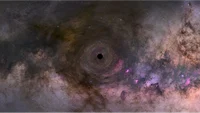
Recent astronomical research has shed light on the complex mechanics governing galaxy evolution, revealing that supermassive black holes do not merely consume surrounding material, but actively sculpt their host galaxies through a dynamic cycle of cosmic consumption and expulsion. Published in The Astrophysical Journal on September 14, a comprehensive study conducted by an international team of astronomers demonstrates how energetic shockwaves originating from galactic centers regulate star formation, providing a clearer picture of the symbiotic relationship between black holes and the galaxies that house them.
The research focuses on nine local galaxies exhibiting Active Galactic Nuclei (AGN)—luminous, highly energetic central regions powered by supermassive black holes with masses ranging from millions to billions of times that of our Sun. These gargantuan gravitational anchors continuously pull in massive quantities of ambient gas and dust. As this material spirals inward toward the event horizon, it forms a flattened structure known as an accretion disk. Intense gravitational forces and friction within these disks generate tremendous heat and light, creating the characteristic brightness of an AGN.
However, these cosmic powerhouses are notoriously inefficient consumers. Instead of swallowing all the matter drawn toward them, they redirect a significant portion of it outward toward their poles. This excess material is subsequently launched into intergalactic space as powerful plasma jets and high-velocity winds that span thousands of light-years. When this outward-flowing energy collides with surrounding interstellar gas clouds and dust reservoirs, it triggers violent, fast-moving shockwaves throughout the galactic medium. This phenomenon, widely known to astrophysicists as "AGN feedback," has long been a central focus of cosmological research.
Chronology and Observational Methodology
To map the intricate dynamics of AGN feedback and its precise impact on star formation, the research team utilized some of the world’s most advanced ground-based astronomical infrastructure. Observations were primarily conducted using the Very Large Telescope (VLT) in Chile, equipped with the Multi Unit Spectroscopic Explorer (MUSE) instrument. This cutting-edge apparatus allowed the scientists to perform a detailed three-dimensional spatial analysis of the target galaxies.
By dissecting the spectral data gathered by MUSE, the researchers were able to isolate and examine three distinct components within each AGN environment: the outward radiation flow from the active nucleus, the excitation of the surrounding interstellar medium driven by propagating shockwaves, and the localized nurseries of stellar birth.
The chronological progression of the study involved targeting nine distinct local galaxies with active central engines, mapping their interstellar gas kinematics, and tracing the propagation of energy away from their central black holes. The observational data revealed that star-forming regions—manifesting predominantly as distinct rings and stellar arcs—consistently emerge at distances ranging between 2,600 and 20,000 light-years from the galactic core. Furthermore, the analysis uncovered that rapid shockwaves propagate outward through the central regions of these galaxies, moving strictly perpendicular to the radiation cones extending from the accretion disks. This perpendicular shockwave behavior was observed consistently across all nine galaxies studied, indicating a universal physical mechanism at play in systems with active central black holes.
Expert Insights and Analytical Perspectives
The implications of the study challenge traditional astronomical assumptions regarding the lifespan of galaxies. For decades, prevailing scientific consensus largely viewed AGN feedback exclusively as a destructive force—a mechanism that heats or sweeps away cold gas reserves, thereby quenching star formation and steering a galaxy toward a dormant, passive state. While this "negative feedback" model remains valid for the suppression of stellar birth in massive ellipticals, the new findings underscore a more constructive dimension often termed "positive feedback."
Lisa Kewley of the Center for Astrophysics | Harvard & Smithsonian, a co-author of the study, emphasized the profound shift in understanding brought about by the research. "We are observing that black holes do much more than simply swallow matter at the center of a galaxy; they actively reshape their surrounding environments," Kewley noted in a statement. Her colleague, Peixin Zhu, further elaborated on the mechanics of the outflow systems, pointing out that the continuous interplay between ingestion and ejection forms the backbone of galactic regulation. "Once we broke down the data, we could clearly see that they are not just absorbing material, but actively outputting it as well," Zhu stated.
To contextualize the activity levels of these galactic engines, astronomers often compare them to our own cosmic neighborhood. Sagittarius A (Sgr A), the supermassive black hole lurking at the heart of the Milky Way, is currently in a largely quiescent state. Its consumption rate is so minimal that astrophysicists frequently characterize it as being on a strict diet, consuming matter at a pace comparable to a human eating a single grain of rice every million years. Consequently, the Milky Way does not currently exhibit the dramatic, high-energy AGN feedback seen in the galaxies targeted by the VLT and MUSE observations. In contrast, galaxies hosting active nuclei operate as high-intensity laboratories where gravitational energy is continuously converted into kinetic and radiative feedback.
Broader Astrophysical Implications
The confirmation that black hole winds and jets routinely generate perpendicular shockwaves capable of triggering star formation provides a missing puzzle piece in modern cosmological simulations. Galaxy evolution models have historically struggled to accurately replicate the observed distributions of stars and gas without incorporating some form of regulatory feedback from central black holes. By quantifying how energy is transferred from the accretion disk through the interstellar medium, this research offers empirical benchmarks that theorists can use to refine simulations of cosmic history.
Moreover, the study bridges the gap between micro-scale accretion physics—processes occurring right at the boundary of the event horizon—and macro-scale galactic morphology spanning tens of thousands of light-years. As astronomers continue to analyze data from advanced observatories, understanding the dual nature of supermassive black holes as both destroyers and creators of stellar life will remain paramount to decoding the lifecycle of galaxies across the universe.
