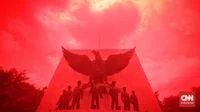
The 30th of September Movement, orchestrated by the Indonesian Communist Party—widely known as G30S/PKI—remains one of the most profound and sorrowful chapters in the modern history of the Republic of Indonesia. Every year, as the calendar flips from September to October, the nation pauses to reflect on a political crisis that shook the very foundations of the state, resulting in the tragic deaths of several high-ranking military officers. While traditional observances involve the solemn raising of the national flag at half-mast across government institutions, military bases, and public squares, contemporary remembrance has also extended to the digital realm. Citizens increasingly utilize social media platforms to share messages of tribute, national unity, and historical awareness. These reflective messages serve as a collective reminder of the high price of national sovereignty and the enduring importance of safeguarding the nation’s foundational ideology, Pancasila.
Historical Background and Origins of the Crisis
To understand the gravity of the G30S/PKI event, one must examine the socio-political landscape of Indonesia in the mid-1960s. Under the administration of President Sukarno, the political atmosphere was heavily polarized. The era was characterized by the political concept of Nasakom (Nationalism, Religion, and Communism), which legally and strategically accommodated the Indonesian Communist Party (PKI) as a legitimate and rapidly growing political force. Led by Dipa Nusantara Aidit, commonly known as D.N. Aidit, the PKI had successfully amassed millions of supporters through mass organizations, labor unions, and peasant movements, making it one of the largest communist parties outside the Soviet Union and China.
Behind the public political maneuvering, however, tensions were reaching a boiling point. Clashes between the military—specifically the Indonesian Army (TNI AD)—and the PKI intensified over ideological differences, land reform policies, and rumors regarding a potential military coup against President Sukarno. According to historical records compiled in educational curricula by the Ministry of Education and Culture, the climax of these tensions occurred between the night of September 30 and the early hours of October 1, 1965. The operation was masterminded by key figures within the PKI’s clandestine apparatus, including Syam Kamaruzaman, who headed the party’s Special Bureau, and Lieutenant Colonel Untung Syamsuri, the commander of the Cakrabirawa Regiment’s 1st Battalion, which served as the presidential bodyguard detail.
The Chronology of the Tragedy at Lubang Buaya
The operation executed in the dead of night on October 1, 1965, targeted the leadership of the Indonesian Army. Armed factions under the command of Lieutenant Colonel Untung moved swiftly across Jakarta, breaking into the residences of targeted generals. The explicit objective of the operation, as later revealed in judicial proceedings and historical documentation, was to kidnap senior military commanders and bring them to an isolated area in Pondok Gede, South Jakarta, known as Lubang Buaya.
The assault was brutal and immediate. Three of the targeted officers—Letnan Jenderal Anumerta Ahmad Yani, Major General M.T. Haryono, and Brigadier General D.I. Panjaitan—were shot and killed directly in their homes during the initial incursions. Their bodies, alongside three other captured officers who were still alive at the time of transport—Major General R. Soeprapto, Major General S. Parman, and Brigadier General Sutoyo Siswomiharjo—were taken to Lubang Buaya. There, all six officers were executed and their remains dumped into a disused well. A seventh figure, First Lieutenant Pierre Tendean, aide-de-camp to General A.H. Nasution, was also killed during the raid on Nasution’s residence after being mistaken for the general, while General Nasution himself managed to escape despite sustaining injuries. General Nasution’s young daughter, Ade Irma Suryani Nasution, tragically lost her life after being struck by gunfire during the chaos.
The Fallen Heroes of the Revolution
The sacrifice of these military leaders altered the trajectory of Indonesian governance and military command. Posthumously honored as Pahlawan Revolusi (Heroes of the Revolution), their names remain etched into the national consciousness as symbols of ultimate loyalty to the state.
- Lieutenant General Ahmad Yani: Serving as the Minister/Commander of the Army, he was a central figure in military leadership and a primary target due to his staunch opposition to communist political expansion within the armed forces.
- Major General Raden Soeprapto: Known for his diplomatic acumen and administrative capability, he played a crucial role in maintaining institutional stability during a turbulent political transition.
- Major General Mas Tirtodarmo Haryono (M.T. Haryono): Fluent in multiple languages and possessing a background in medicine, he was a key military diplomat and strategist.
- Major General Siswondo Parman (S. Parman): Serving as the Army’s Director of Military Intelligence, he held critical insights into the internal security threats facing the republic.
- Brigadier General Donald Isaac Panjaitan (D.I. Panjaitan): An experienced logistical and operational commander who had previously served in various regional military commands.
- Brigadier General Sutoyo Siswomiharjo: Operating as the Military Prosecutor General, he was responsible for maintaining military law and internal discipline.
The Sociopolitical Fallout and Long-Term Implications
The immediate aftermath of the G30S/PKI movement led to a profound structural realignment of the Indonesian state. Public outrage over the assassination of the generals galvanized anti-communist sentiment across various civilian and military factions. General Suharto, who at the time commanded the Army Strategic Reserve Command (Kostrad), stepped forward to restore security and order in the capital. Within months, the political landscape shifted dramatically, culminating in the transition from Sukarno’s "Old Order" administration to the "New Order" regime under President Suharto.
The PKI was officially declared a banned organization, and a nationwide crackdown ensued, resulting in mass casualties, political imprisonment, and the exile of thousands suspected of having ties to the communist party. This period of violence and civil unrest remains one of the darkest and most heavily debated eras in modern Indonesian historiography. Modern analysts and historians continue to examine the multifaceted causes, foreign intelligence involvement, and internal power struggles that precipitated the crisis, emphasizing the necessity of objective historical inquiry and national reconciliation.
Reflective Messages and Commemorative Expressions
In contemporary Indonesia, the annual commemoration of G30S/PKI serves not only to honor the fallen generals but also to reinforce the values of national unity, vigilance, and democracy. Across digital platforms, citizens share reflections and commemorative quotes to ensure that younger generations understand the cost of historical conflict. Below is a curated selection of reflective statements commonly shared during the commemoration period:
- Let us observe a moment of silence to remember and pray for the heroes who fell as victims of the G30S/PKI tragedy.
- May the souls of the heroes who perished in the G30S/PKI tragedy rest in eternal peace.
- Let us stand tall to pay our highest respects to the heroes who sacrificed their lives during the G30S/PKI event.
- The service of a hero is priceless and cannot be bought with wealth. Let us rise and build Indonesia together!
- The dark history of G30S/PKI serves as a crucial reminder of the importance of maintaining national unity and integrity.
- Let us offer our best prayers for the heroes who fell during the G30S/PKI events. Continue their dreams and struggles for this nation.
- The dedication of our heroes will never be forgotten. My endless gratitude goes to the Heroes of the Revolution!
- A great nation is one that respects and never forgets the sacrifices of its heroes.
- The G30S/PKI tragedy reminds us to commit firmly to preserving national unity and respecting diverse opinions.
- Continue the struggle for the upholding of democracy and justice.
- Let us remember the dark history of the G30S/PKI event with sober reflection.
- Do not let ourselves be divided or shaken. Remember, our heroes willingly sacrificed their lives for the unity of Indonesia.
- Pancasila is the foundation of the state. The threat of communism and other prohibited ideologies must be steadfastly rejected.
- History has recorded the cruelty of the night of September 30, 1965—a tragedy that claimed the lives of the nation’s finest generals.
- Stop all forms of propaganda and political maneuvers that divide the nation. Learn from the dark events of G30S/PKI.
Conclusion: Preserving Unity for Future Generations
Decades after the fateful night of September 1965, the commemoration of G30S/PKI stands as a vital institutional and cultural checkpoint for Indonesia. It serves as an enduring caution against political extremism, polarization, and the erosion of national consensus. By keeping the memory of the fallen heroes alive—not through vengeance, but through education, civic responsibility, and an unwavering commitment to the state ideology of Pancasila—the Indonesian nation strives to ensure that such a dark chapter is never repeated, fostering an inclusive and resilient society for future generations.