
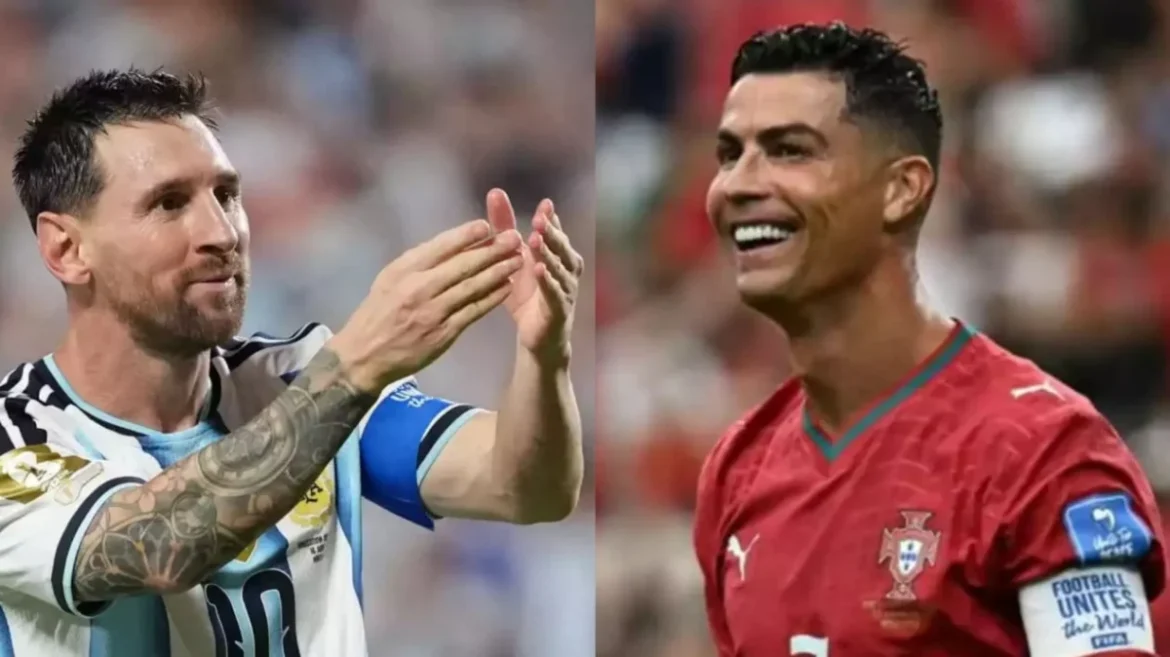
The enduring rivalry between Cristiano Ronaldo and Lionel Messi has entered an unprecedented new phase, transitioning from the pitches of El Clásico to the executive boardrooms of Spanish football. In a remarkable parallel development that has captured the attention of the global sporting community, both legendary forwards have expanded their business portfolios by securing ownership stakes in clubs competing within Spain’s Segunda División, officially known as LaLiga Hypermotion. This strategic move not only deepens their respective financial footprints in the Iberian nation but also ensures that their storied competitive dynamic will persist long after their boots are permanently hung up.
Cristiano Ronaldo, currently plying his trade in the Saudi Professional League with Al-Nassr, has officially acquired a 25 percent minority stake in UD Almería. The transaction was executed through his private investment vehicle, CR7 Sports, with the remaining majority ownership continuing to be held by the SMC Group. For Messi, the path of club ownership leads to the Valencian Community. The Inter Miami and Argentina icon has reached a foundational agreement to assume total control of CD Eldense, securing a 100 percent equity takeover without the involvement of external investment syndicates. These acquisitions represent a significant escalation in football governance for two athletes who have dominated individual accolades for nearly two decades, fundamentally reshaping the landscape of Spanish lower-tier football investment.
The Chronology of Acquisition: From On-Pitch Dominance to Boardroom Control
The trajectory toward club ownership for both players has been years in the making, accelerated by the maturation of their respective commercial empires and a shared ambition to shape the future of football administration. The groundwork for Ronaldo’s entry into Spanish club ownership was laid publicly earlier in the year. Speaking on his long-term strategic vision, the Portuguese forward articulated a desire to impact the sport beyond his playing days.
"It has long been my ambition to contribute to football beyond the boundaries of the pitch," Ronaldo stated in February 2026. This philosophical outlook materialized over the subsequent months, culminating in negotiations with the SMC Group regarding UD Almería. The Andalusian club presented an attractive proposition due to its infrastructural stability and geographical positioning within a region deeply passionate about football.
Ronaldo’s history with Almería provides a rich narrative context for his investment. During his illustrious tenure with Real Madrid, the five-time Ballon d’Or winner faced the Rojiblancos on seven separate occasions in LaLiga. His personal record against the club is formidable, tallying seven goals across those fixtures while orchestrating six victories and a single draw. Now, instead of piercing their defense, Ronaldo’s objective is to guide their ascent back to the Spanish top flight. As of September 2026, Almería sits in 12th place in the Segunda División standings with six points collected from the opening rounds of the campaign, a position the new minority stakeholder aims to improve significantly as the season progresses.
Simultaneously, Lionel Messi’s expansion into Spanish football administration reflects a broader strategy of multi-club asset accumulation. According to reports from the Spanish sports daily Marca, the World Cup winner agreed in principle to acquire full ownership of CD Eldense. The club was previously under the stewardship of an international investment consortium led by businessman Juan Carlos Trujillo, who had purchased the entity from Pascual Perez in October 2025.
Messi’s acquisition of Eldense, however, is subject to standard regulatory procedures. Before the transaction receives formal ratification from Spain’s High Council for Sports, known as the Consejo Superior de Deportes (CSD), the deal must successfully navigate a rigorous due diligence phase. Should this process conclude without regulatory impediment, Eldense will integrate into a burgeoning portfolio of club assets associated with the Messi family, which already includes a reported acquisition of UE Cornellà, a lower-division Catalan club currently competing in the fifth tier of Spanish football.
Structural Context and Comparative Analysis of the Investments
To fully understand the weight of these acquisitions, one must examine the distinct corporate structures and operational strategies chosen by each player. Ronaldo’s approach with UD Almería is characterized by a minority partnership. By taking a 25 percent stake alongside the SMC Group, the Portuguese superstar mitigates immediate operational risks while leveraging the existing administrative framework of the Andalusian outfit. Almería boasts a modern stadium, established youth academies, and recent experience in LaLiga EA Sports, having yo-yoed between the first and second divisions in recent years. This foundational strength was explicitly highlighted by Ronaldo during his introductory remarks regarding the partnership.
"UD Almería is a Spanish club with a robust foundation and clear trajectories for exponential growth," Ronaldo remarked. "I am eagerly anticipating the opportunity to collaborate directly with the leadership team to support this organization through its next evolutionary phase of development."
Conversely, Messi’s reported strategy with CD Eldense points toward complete autonomy. By pursuing a 100 percent buyout, the Argentine maestro bypasses the potential friction of shared governance, allowing his appointed executives to implement a singular, uncompromised vision. Eldense, based in Elda, Alicante, represents a traditional community club with deep historic roots in the Valencian region. Elevating a club of Eldense’s modest stature requires a different playbook compared to Almería, focusing heavily on grassroots scouting, infrastructural modernization, and commercial repositioning to secure sustained competitiveness in the fiercely contested Segunda División.
The juxtaposition of a minority strategic stake in a well-capitalized second-tier contender versus a total takeover of a traditional community club highlights contrasting philosophies in celebrity sports investment. While Ronaldo leans into a collaborative corporate model, Messi opts for absolute operational control, mirroring the diversification strategies seen across modern billionaire sports ownership groups.
Regulatory Scrutiny and the Role of the Consejo Superior de Deportes (CSD)
The entry of high-profile global icons into the lower tiers of Spanish football is not merely a commercial novelty; it is subject to the stringent legal and financial frameworks overseen by Spanish sports authorities. The most critical regulatory hurdle facing these acquisitions, particularly in Messi’s case with CD Eldense, is the oversight provided by the Consejo Superior de Deportes (CSD) and LaLiga’s financial control bodies.
Spanish football administration has historically maintained rigorous standards regarding club ownership transparency, debt management, and the prevention of conflicts of interest. Because Messi remains an active professional player—currently contracted with Major League Soccer franchise Inter Miami—regulatory bodies must ensure that his ownership of a European professional club does not breach integrity regulations concerning multi-club ownership or potential tournament conflicts, though direct sporting clashes between MLS and the Spanish Segunda División remain an impossibility.
Furthermore, the due diligence phase mandated for the Eldense takeover requires forensic accounting of the club’s financial health, liabilities inherited from the previous ownership groups under Juan Carlos Trujillo and Pascual Perez, and adherence to wage-cap regulations enforced by LaLiga. Similarly, Ronaldo’s entry via CR7 Sports underwent internal compliance checks to satisfy the governance requirements of the SMC Group and the Spanish football federation (RFEF). These bureaucratic safeguards are designed to protect historic clubs from speculative volatility, ensuring that celebrity involvement translates into sustainable institutional growth rather than short-term publicity stunts.
Economic and Strategic Implications for LaLiga Hypermotion
The involvement of Cristiano Ronaldo and Lionel Messi as club owners is poised to fundamentally transform the economic ecosystem of the Segunda División. Traditionally overshadowed by the global broadcast dominance and commercial saturation of LaLiga EA Sports, Spain’s second tier stands to gain unprecedented international visibility through this influx of superstar capital.
From a marketing perspective, the presence of Ronaldo and Messi in the boardroom introduces an immediate multiplier effect on media rights valuations, global sponsorship attraction, and merchandise distribution. Broadcasters across Asia, the Americas, and the Middle East—regions where both players command massive, dedicated fanbases—may recalibrate their interest in acquiring or sub-licensing Segunda División broadcasting packages. Matches featuring Almería or Eldense will inherently carry heightened media scrutiny, transforming routine league fixtures into globally televised spectacles.
Moreover, the influx of capital and celebrity endorsement allows these clubs to attract higher-tier managerial talent and elite young prospects who view the organizations as ideal stepping stones under the watchful eyes of football royalty. Players and coaching staff working under ownership tied to Ronaldo or Messi experience a unique psychological boost and professional validation, potentially translating into superior on-field performances.
At the same time, sports economists caution against the risks of hyper-inflation within the lower leagues. As high-net-worth individuals and global brands inject capital into specific Segunda División entities, the competitive balance of the division could become skewed, placing traditional community clubs without celebrity backers at a distinct financial disadvantage. Regulatory bodies such as LaLiga will therefore be forced to closely monitor financial fair play metrics to maintain competitive integrity across the competition.
Broader Industry Trends: Athletes as Executives
The transition of Ronaldo and Messi from elite athletes to sports industrialists is part of a broader, accelerated paradigm shift within global sports. Modern athletes, commanding unprecedented career earnings and elevated financial literacy, are increasingly bypassing traditional post-retirement media punditry roles in favor of direct equity ownership and franchise management.
In North American sports, this trend is well-established, with retired legends such as Michael Jordan and Mario Lemieux holding principal ownership stakes in professional franchises. In European football, however, the phenomenon of active or recently retired global superstars acquiring controlling or significant stakes in professional clubs represents a new frontier. David Beckham’s co-ownership of Inter Miami serves as the primary modern precedent for a global icon successfully bridging the gap between playing legacy and club administration.
By anchoring their post-playing futures in the Spanish football pyramid, Ronaldo and Messi are establishing a blueprint for the modern sports conglomerate. Their investments in Almería and Eldense are not isolated commercial ventures; they are strategic anchors designed to preserve their influence over the global game long after their names disappear from team sheets.
As the 2026–2027 Segunda División campaign unfolds, the eyes of the football world will be fixed not only on the pitch, where Almería fights for promotion and Eldense battles for stability, but also on the executive suites. The timeless rivalry between Cristiano Ronaldo and Lionel Messi has officially transcended the grass, evolving into a high-stakes institutional chess match that will shape the future of Spanish football for generations to come.
