
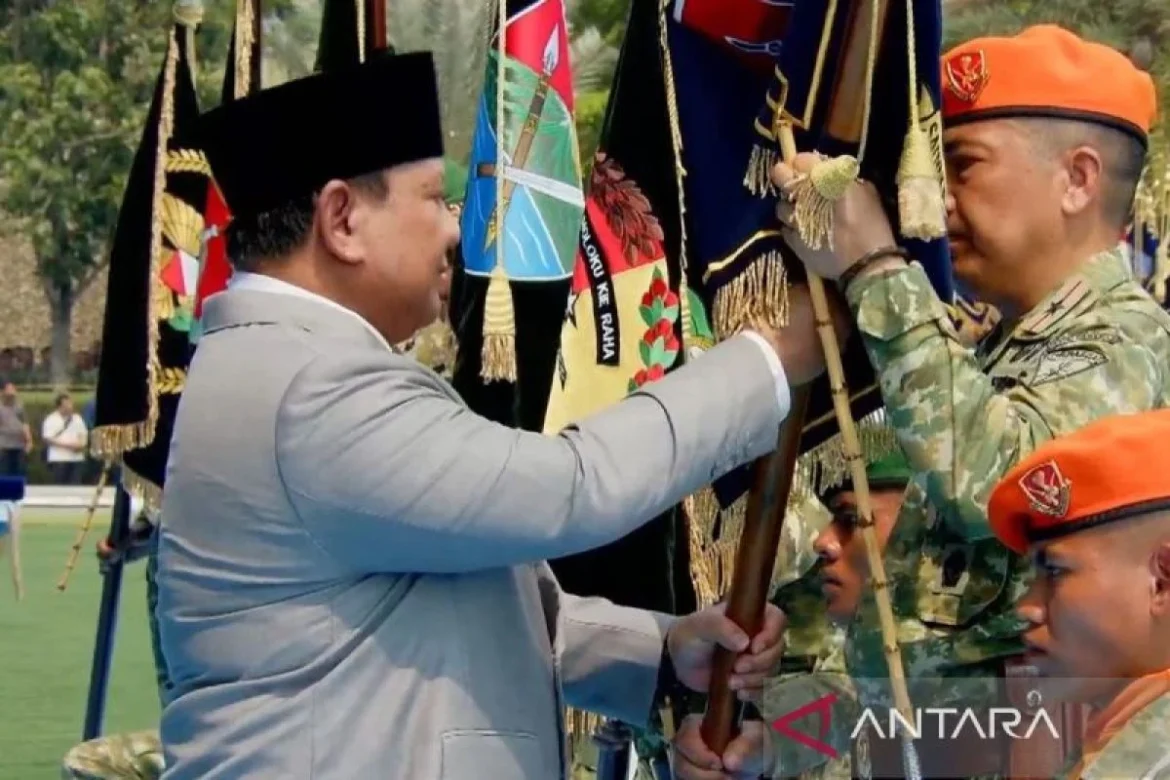
Jakarta, Indonesia – In a monumental step aimed at modernizing and expanding the archipelago’s defense architecture, Indonesian President Prabowo Subianto officially inaugurated 204 new military units across the Indonesian National Armed Forces (TNI). The historic announcement and formal commissioning took place during the grand parade commemorating the 81st anniversary of the TNI at the PRIMA Field, located at the Ministry of Defense and TNI Headquarters in Cilangkap, East Jakarta.
The sweeping expansion encompasses strategic reinforcements across all three main branches of the military: the Indonesian Army (TNI AD), the Indonesian Navy (TNI AL), and the Indonesian Air Force (TNI AU). By bolstering regional commands, combat support units, and specialized airborne and territorial forces, the administration aims to address contemporary geopolitical challenges, secure sprawling maritime and land borders, and enhance rapid-response capabilities throughout the vast archipelagic nation.
With the resounding ring of a ceremonial siren pressed by the commander-in-chief, followed by a thunderous single-gun salute fired by the Field Artillery (Armed), the restructuring initiative officially commenced. President Prabowo underscored that the massive expansion is not merely an increase in hardware and personnel, but a critical evolution in safeguarding the sovereignty, territorial integrity, and long-term security of the Republic of Indonesia.
Strategic Expansion Across the Three Military Branches
The integration of 204 new military units represents one of the largest structural expansions of Indonesia’s defense forces in recent decades. Designed to bridge strategic gaps in territorial defense and operational readiness, the additions have been meticulously distributed among the army, navy, and air force to ensure balanced, multi-dimensional operational capability.
The Indonesian Army (TNI AD) received the lion’s share of the organizational restructuring, focusing heavily on territorial command structures and rapid deployment capabilities. Most notably, the establishment of six new Military Area Commands (Kodam) serves to decentralize and optimize regional military oversight. In tandem with these new regional commands, the Army introduced 30 Territorial Development Infantry Brigades and 150 Territorial Development Infantry Battalions. These units are specifically tasked with fostering closer ties with local populations, supporting regional development, and acting as the first line of territorial deterrence.
Furthermore, to bolster frontline offensive and defensive capabilities, the Army activated three specialized Combat Support Battalions. This sub-group comprises one newly minted cavalry battalion, one field artillery battalion, and one air defense artillery battalion, significantly elevating the mobile firepower and tactical protection available to ground forces.
Meanwhile, the Indonesian Navy (TNI AL) concentrated its expansion on enhancing amphibious and littoral warfare capabilities. The naval forces welcomed the activation of one new Marine Infantry Brigade alongside four dedicated Marine Infantry Battalions. These amphibious units are strategically positioned to protect Indonesia’s extensive coastline, vital sea lanes, and outer islands, reinforcing the nation’s posture as a sovereign maritime power.
The Indonesian Air Force (TNI AU) also experienced a substantial qualitative and quantitative upgrade, particularly in its elite rapid-action and airspace surveillance sectors. Among the notable additions are the creation of the Pasgat (Air Force Special Forces) Second Parachute Commando Division (Divisi Parako II Pasgat) and a dedicated Pasgat Parachute Commando Brigade. To support these elite ground-air integration forces, the Air Force activated three Parachute Commando Battalions, two operational Air Squadrons, two strategic Air Force Radar Units—crucial for early warning and airspace monitoring—and one new Air Force Education Squadron to train the next generation of specialized aviation personnel.
The Anniversary Ceremony and Symbolic Commissioning Rituals
The 81st TNI Anniversary celebration was conducted with traditional military pomp and solemnity, serving as a powerful display of national unity and military preparedness. A staggering total of 3,378 active-duty personnel drawn from the Army, Navy, and Air Force marched in unison during the parade. They were joined by contingents representing the nation’s Reserve Component (Komponen Cadangan) and patriotic youth organizations such as the Indonesian Scout Movement (Pramuka), illustrating a unified "Total People’s Defense System."
Following the activation siren and the booming artillery salute, President Prabowo personally presided over the symbolic handover of authority for the newly established units. In a solemn ritual steeped in military tradition, the president presented commanding batons and unit colors to the newly appointed commanders of the six regional Military Area Commands (Kodam).
Additionally, formal unit insignia and flags were handed over to seven representatives of the newly formed specialized brigades and battalions. This symbolic gesture marks the legal and operational birth of the units, empowering their respective commanders to assume full responsibility for regional defense, troop readiness, and civic engagement within their designated zones of operation.
Addressing the assembled troops, government officials, and citizens, President Prabowo emphasized the foundational philosophy of the Indonesian armed forces. He reiterated that the military must forever remain a "people’s army" deeply rooted in the struggles and aspirations of the civilian population. "The honor of the nation and the prosperity of the people rest heavily on the shoulders of the TNI," Prabowo declared, reminding personnel that military strength is inextricably linked to public trust, national welfare, and social harmony.
Context and Background: Modernizing Defense for a Dynamic Era
The decision to establish 204 new units stems from years of strategic planning, military evaluations, and legislative reviews concerning Indonesia’s evolving national security landscape. As Southeast Asia’s largest economy and a pivotal maritime nexus connecting the Indian and Pacific Oceans, Indonesia faces a complex matrix of traditional and non-traditional security challenges.
In recent years, strategic analysts have repeatedly highlighted the need to decentralize military commands to better manage remote provinces, counter transnational crime, mitigate natural disasters, and project power across the nation’s 17,000-plus islands. The creation of additional Kodams and territorial battalions directly addresses the historical challenge of wide spans of control, allowing regional commanders to respond with greater agility to local emergencies and security threats.
The integration of Territorial Development Infantry Battalions reflects a shift toward proactive, community-integrated defense. Rather than maintaining a purely garrisoned posture, these units are structured to work hand-in-hand with regional governments, law enforcement, and civilian agencies to accelerate infrastructure development, maintain public order, and assist in post-disaster recovery operations—a mission profile of paramount importance in disaster-prone regions like Aceh, Papua, and other fault-line territories.
Implications and Strategic Analysis
Military observers and defense analysts have widely praised the structural expansion as a pragmatic and necessary step toward fulfilling the Minimum Essential Force (MEF) objectives, while simultaneously adapting to the strategic realities of the mid-21st century.
From an operational perspective, the creation of specialized air defense, cavalry, and artillery units within the Army addresses previous tactical bottlenecks, ensuring that ground commanders possess organic heavy support capabilities. Meanwhile, the bolstering of Marine and Pasgat forces guarantees that Indonesia retains highly mobile, strategic response forces capable of deploying rapidly to any threatened sector of the archipelago within hours.
However, analysts also point out that managing 204 new units will present logistical, budgetary, and administrative challenges for the Ministry of Defense and TNI headquarters. Ensuring adequate troop recruitment, advanced tactical training, state-of-the-art equipment maintenance, and sustainable budgetary allocations will be critical to maintaining the operational readiness of these newly commissioned bodies.
Despite these administrative hurdles, the overarching sentiment remains positive. By expanding its military footprint while reaffirming its commitment to civilian welfare and democratic governance, Indonesia signals its readiness to assert its sovereignty, contribute to regional stability, and protect its national interests in an increasingly unpredictable global arena. The 81st anniversary will thus be remembered not only as a celebration of the TNI’s storied past, but as the foundational milestone of its modern, highly responsive future.
