
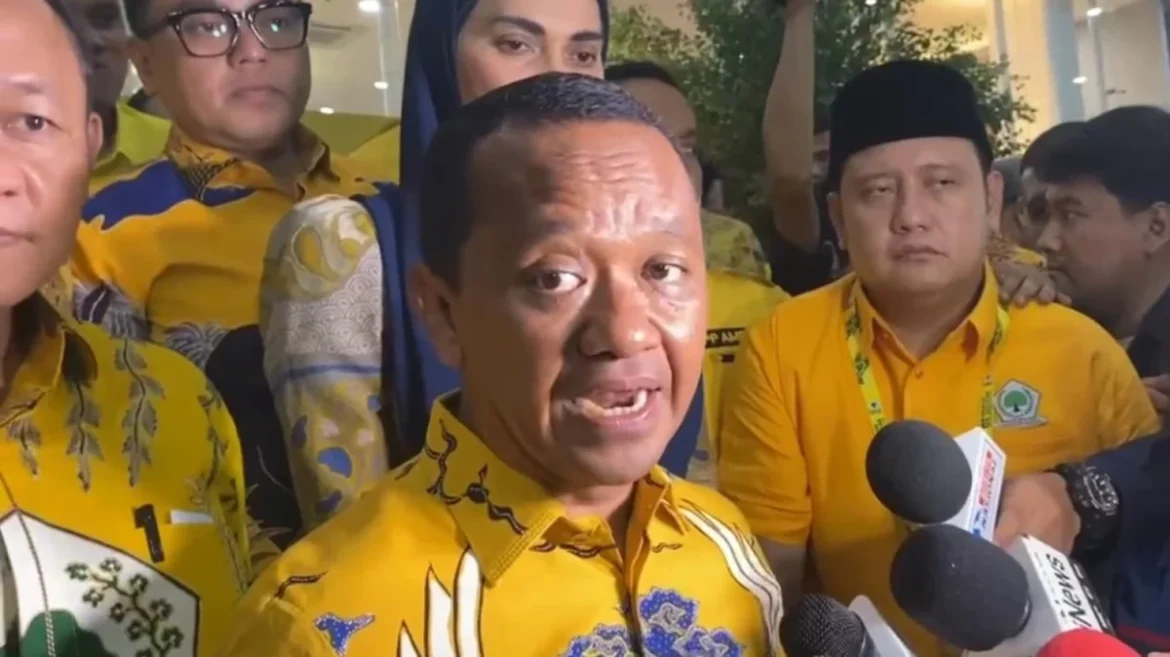
Jakarta, Indonesia – In a development that underscores the complexities of political discourse in the digital age, Bahlil Lahadalia, the Chairman of the Golkar Party, stated on Monday, October 20, 2025, that he was unaware of actions taken by several party cadres to report social media accounts allegedly responsible for creating and disseminating defamatory memes targeting him. The revelation came after a thanksgiving event commemorating the party’s 61st anniversary at the Golkar Central Executive Board (DPP) office in Slipi, West Jakarta. The incident highlights the growing tension between freedom of expression and the combating of online defamation, a persistent challenge within Indonesia’s dynamic political landscape, particularly as the nation navigates a pre-election cycle marked by intense online scrutiny and partisan rivalry.
Responding to inquiries from journalists regarding the reports, Lahadalia simply stated, "Oh, I don’t know, you can check there later," indicating a distancing from the specific actions undertaken by the party’s youth wings. This statement, delivered moments after a significant internal party celebration, immediately drew attention, sparking discussions on internal party communication, the autonomy of its various organizational layers, and the broader implications for Lahadalia’s public image and political standing. The context of a party anniversary, often a moment for unity and strategic alignment, made the unexpected news of these reports and Lahadalia’s public disavowal all the more noteworthy, suggesting potential layers of political maneuvering or genuine unawareness.
Chronology of Events and the Reports
The sequence of events unfolded rapidly on Monday, October 20, 2025. Following the conclusion of the Golkar Party’s 61st-anniversary celebration, where Lahadalia delivered a speech emphasizing party solidarity and future vision, representatives from two prominent youth organizations affiliated with Golkar initiated formal actions against alleged online defamation.
First, the Central Executive Board of the Angkatan Muda Pembaharuan Indonesia (DPP AMPI), a key youth wing of the Golkar Party, lodged a complaint with the Criminal Investigation Unit (Bareskrim) of the Indonesian National Police. Steven Izaac Risakotta, Deputy Chairman of DPP AMPI, confirmed that the complaint targeted approximately 30 social media accounts. These accounts were accused of spreading slander and hate speech against Bahlil Lahadalia, who, in addition to his role as Golkar Chairman, also serves as the Minister of Energy and Mineral Resources and is recognized as a mentor within DPP AMPI. Risakotta emphasized that the decision to report these accounts was a spontaneous act of loyalty and concern from the cadres, driven by a perception that the content had crossed the line from legitimate criticism to personal attacks and defamation. The AMPI delegation presented screenshots and other digital evidence to support their claims, aiming to deter what they described as irresponsible online behavior.
Concurrently, another influential youth organization, the Central Executive Board of Angkatan Muda Pemuda Golkar (PP AMPG), also took steps to address the issue. Led by its Deputy Chairman, Sedek Bahta, PP AMPG visited the Jakarta Metropolitan Police (Polda Metro Jaya) for consultation regarding similar reports against social media accounts that were allegedly attacking and insulting Bahlil Lahadalia personally. Sedek Bahta detailed that their consultation involved presenting several pieces of evidence, including screenshots of the offensive content. Based on their discussions with legal experts and cybercrime units, AMPG concluded that the content posted and disseminated by these social media accounts likely violated Articles 27 and 28 of the Electronic Information and Transactions (ITE) Law, as well as Article 310 of the Indonesian Criminal Code (KUHP). This dual approach by Golkar’s youth wings to two different law enforcement bodies underscores the perceived severity of the online attacks and the determination of the cadres to defend their leader.
The Allegations: Memes, Defamation, and Hate Speech
The core of the dispute revolves around "memes" and other digital content that the youth wings claim constitute defamation and hate speech. In the contemporary political landscape, memes have emerged as powerful tools for communication, capable of conveying complex messages, humor, satire, or criticism in a concise and easily shareable format. However, their informal nature and often ambiguous interpretations also make them susceptible to misuse, blurring the lines between legitimate political commentary and malicious attacks.
The specific content of the memes targeting Bahlil Lahadalia was not detailed publicly, but the accusations of "spreading slander" (fitnah) and "hate speech" (ujaran kebencian) suggest the content was deemed personally damaging, potentially misrepresenting facts, or inciting negative sentiment based on personal characteristics or affiliations. Political memes often employ caricature, exaggeration, or decontextualized images and quotes to create a narrative, which, while sometimes effective satire, can also be perceived as deeply insulting or factually incorrect, particularly when directed at public figures.
The rise of social media has amplified the reach and impact of such content, allowing it to go viral within hours, potentially shaping public opinion and eroding trust in political figures. For parties like Golkar and their leaders, who operate under constant public scrutiny, managing online narratives is critical. The decision by the youth wings to take legal action reflects a growing trend among political entities to use legal mechanisms, particularly the ITE Law, to combat what they perceive as digital defamation rather than solely relying on public relations or counter-narratives. This approach, however, often sparks broader debates about freedom of expression and the potential for legal frameworks to be used to silence dissent or criticism.
The Role of Golkar’s Youth Wings: AMPI and AMPG
The proactive stance taken by AMPI and AMPG in reporting the alleged defamation is indicative of the vital role youth wings play within Indonesian political parties. These organizations traditionally serve as a party’s grassroots mobilizers, talent pools, and, crucially, as staunch defenders of party ideology and leadership. Their actions in this instance, despite Lahadalia’s claimed unawareness, are consistent with the established function of such groups to protect the party’s image and its key figures.
Steven Izaac Risakotta of AMPI explicitly stated that their actions were not a direct command from Bahlil Lahadalia but rather a "spontaneous" response from cadres who felt compelled to act. This claim of spontaneity is often articulated in political contexts where actions are taken to demonstrate loyalty and initiative, even if indirectly aligned with the broader interests of the leadership. For youth wings, demonstrating unwavering support for the party chairman is a way to signal their commitment and strengthen their own standing within the party hierarchy. It also serves as a warning to potential detractors, both external and internal, that attacks on the leadership will not go unchallenged.
The youth wings’ motivation, as articulated by Risakotta, was to achieve a "deterrent effect" against the offending accounts, emphasizing the need for objective and wise communication on social media. This aligns with a broader concern within political parties regarding the often-unregulated nature of online discourse and the ease with which damaging information can be spread without accountability. By pursuing legal avenues, AMPI and AMPG aim to set a precedent and encourage more responsible online behavior, although such actions inevitably open up discussions about censorship and the limits of free speech in a democratic society.
Navigating Indonesia’s ITE Law: The "Dumas" Classification
A critical aspect of the reports filed by AMPI and AMPG is their initial classification as "aduan masyarakat" or "Dumas" (public complaints) rather than formal police reports. This distinction is significant and stems directly from the implementation guidelines of Indonesia’s Electronic Information and Transactions (ITE) Law, particularly the Joint Decree (SKB) on the Implementation Guidelines for the ITE Law.
The ITE Law, enacted in 2008 and amended in 2016, has been a contentious piece of legislation in Indonesia. While intended to combat cybercrime, protect personal data, and regulate electronic transactions, several of its articles, particularly those pertaining to defamation (Article 27) and hate speech (Article 28), have been widely criticized by civil society organizations and human rights advocates for being overly broad, prone to misinterpretation, and frequently used to silence critics, journalists, and activists. The law’s provisions allow for severe penalties, including imprisonment and hefty fines, for online content deemed to be defamatory or hateful.
In response to widespread public concern and calls for reform, the Indonesian government issued the Joint Decree (SKB) by the Ministry of Communication and Information Technology, the Attorney General’s Office, and the National Police in 2021. The SKB aimed to provide clearer guidelines for law enforcement in handling ITE Law cases, particularly to prevent its misuse and to ensure that freedom of expression is protected. One of the key provisions of the SKB clarifies that for certain offenses, including defamation, a formal police report (laporan polisi) can only be initiated by the direct victim of the alleged crime. If a complaint is filed by a third party, such as a political party’s youth wing acting on behalf of their leader, it is initially categorized as a "Dumas."
Under the "Dumas" classification, law enforcement agencies conduct preliminary investigations to assess the merits of the complaint. However, for the case to progress to a full criminal investigation and potential prosecution, the alleged victim – in this case, Bahlil Lahadalia – must personally file a formal police report. This requirement is designed to ensure that the victim genuinely feels aggrieved and is willing to pursue legal action, thereby reducing the potential for the ITE Law to be weaponized by proxies or for minor disagreements to escalate into criminal cases. Therefore, despite the efforts of AMPI and AMPG, the legal process against the social media accounts cannot proceed fully unless Lahadalia himself decides to personally lodge a complaint with the police. This places the ultimate decision to escalate the matter squarely on his shoulders, adding another layer of political and legal calculation to the situation.
Legal Framework: Articles 27, 28 ITE Law and Article 310 KUHP
The legal basis cited by the youth wings for their complaints refers to specific articles within Indonesia’s legal framework governing online conduct and defamation.
-
Article 27, Paragraph 3 of the ITE Law: This article pertains to "any person who knowingly and without rights distributes and/or transmits and/or makes accessible Electronic Information and/or Electronic Document with contents of affront and/or defamation." This is the primary article used in cases of online defamation. The key elements for a violation typically involve intent, the act of dissemination, and the content being demonstrably defamatory or insulting. The interpretation of "affront and/or defamation" has been a point of contention, with critics arguing it is too subjective and can be easily abused.
-
Article 28, Paragraph 2 of the ITE Law: This article addresses "any person who knowingly and without rights disseminates information intended to incite hatred or hostility among individuals and/or groups of people based on ethnicity, religion, race, and intergroup relations (SARA)." This is the core provision against hate speech. Unlike defamation, which targets individuals, hate speech targets groups and aims to create social discord. The youth wings’ inclusion of this article suggests that some of the memes might have contained elements that they perceived as inciting hatred beyond mere personal attacks.
-
Article 310 of the Indonesian Criminal Code (KUHP): This article predates the ITE Law and deals with general defamation. It states that "whoever deliberately attacks another’s honor or reputation with the intent to make it known to others, is punished for defamation." While the ITE Law specifically addresses online defamation, Article 310 KUHP provides a broader framework that can be applied, especially when the online content also satisfies the criteria for traditional defamation. Citing both the ITE Law and KUHP demonstrates a comprehensive legal approach by the complainants, leveraging both specific cybercrime legislation and the long-standing criminal code.
The combination of these articles underscores the seriousness with which the youth wings view the alleged online attacks. However, the legal process, especially under the SKB guidelines, requires more than just a complaint; it demands active participation from the alleged victim to transform a public complaint into a formal criminal investigation.
Bahlil Lahadalia’s Political Stature and Context
Bahlil Lahadalia is a prominent figure in Indonesian politics, holding significant positions both within the government and the Golkar Party. As of the stated date in the article (October 2025), he is identified as the Minister of Energy and Mineral Resources (Menteri ESDM), a critical portfolio in a resource-rich nation like Indonesia. Prior to this, Lahadalia served as the Minister of Investment/Head of the Investment Coordinating Board (BKPM), where he played a crucial role in attracting foreign and domestic investment and streamlining business regulations. His background as a successful entrepreneur before entering politics has often been highlighted as a testament to his business acumen and leadership capabilities.
His ascension to the chairmanship of the Golkar Party, one of Indonesia’s oldest and most influential political parties, further solidifies his political power. Golkar has historically been a major player in Indonesian politics, known for its extensive grassroots network and its significant representation in legislative bodies. As chairman, Lahadalia is responsible for steering the party’s direction, maintaining internal cohesion, and preparing for future electoral contests. His leadership is critical for Golkar’s continued relevance and success.
The alleged online attacks, therefore, are not merely personal affronts but carry significant political weight. Attacks on a party chairman, especially one holding a cabinet position, can be interpreted as attempts to undermine his authority, destabilize the party, or tarnish his public image ahead of crucial political periods, such as upcoming local or national elections. In Indonesia’s highly competitive political environment, reputation management is paramount, and digital attacks can have tangible consequences on a politician’s electability and influence. Lahadalia’s public denial of knowledge regarding the reports could be a strategic move to project an image of being above such petty disputes, or it could genuinely reflect a separation between his personal focus and the autonomous actions of his loyal party cadres.
Broader Implications for Political Discourse and Digital Freedom
The incident involving Bahlil Lahadalia and the reports by Golkar’s youth wings highlight a persistent tension in Indonesia between the desire to protect public figures from defamation and the fundamental right to freedom of expression. This tension is particularly acute in the digital realm, where the speed and reach of information dissemination make it challenging to regulate content effectively without risking censorship.
The use of the ITE Law to address online criticism, even when it crosses into defamation, has been a contentious issue. While proponents argue that the law is necessary to combat cyberbullying, hate speech, and the spread of misinformation, critics contend that its vague provisions and stringent penalties can have a "chilling effect" on legitimate criticism and satire. Journalists, academics, and activists have frequently raised concerns about the law being used as a tool by those in power to silence dissenting voices, thereby eroding democratic space.
In the context of political memes, the debate becomes even more nuanced. What one person considers sharp political satire, another might view as malicious defamation. Drawing the line between protected speech and illegal content is a complex legal and ethical challenge. The outcome of cases like this, should Bahlil Lahadalia choose to pursue them, will inevitably contribute to the ongoing interpretation of the ITE Law and its application to political discourse in Indonesia. It will also influence how political parties and public figures choose to engage with online criticism, balancing the need to defend their reputation with the broader commitment to democratic freedoms.
The incident also speaks to the broader issue of digital literacy and responsibility. The youth wings’ call for "objective and wise" online communication reflects a societal desire for a more civil and constructive digital environment. However, achieving this requires a multi-faceted approach, including education, platform accountability, and a legal framework that is clear, proportionate, and respects fundamental rights.
The Path Forward: Potential Legal Proceedings and Political Ramifications
The immediate future of these reports hinges entirely on Bahlil Lahadalia’s decision. As the complaints are currently classified as "Dumas," no formal criminal investigation can proceed unless he personally files a report with the police. This presents him with a strategic choice:
-
File a Personal Report: If Lahadalia chooses to formally report the accounts, it would signal a strong stance against online defamation and a willingness to use legal channels to protect his image. This could lead to a full police investigation, potential identification of the account holders, and subsequent legal proceedings. While demonstrating resolve, it could also open him up to accusations of being overly sensitive to criticism or using legal means to stifle free speech, potentially generating negative publicity.
-
Maintain Distance: If he maintains his current stance of unawareness or chooses not to file a personal report, the "Dumas" complaints will likely remain as records without escalating to criminal charges. This approach might allow him to avoid further controversy and portray an image of being focused on larger national and party issues, rather than engaging in disputes over social media memes. However, it might also be perceived by some as a failure to fully support his loyal cadres who acted on his behalf, or as tacit acceptance of the online criticism.
Politically, the incident carries several ramifications. Internally, it tests the cohesion and loyalty within Golkar, particularly between the chairman and its youth wings. Their spontaneous action, whether coordinated or truly independent, demonstrates a strong protective instinct towards their leader. Externally, it places Lahadalia and Golkar under scrutiny regarding their approach to online criticism and their commitment to democratic principles.
Furthermore, given the date of October 2025, Indonesia would be approximately a year away from the typical schedule of general elections (assuming a five-year cycle from 2024). This period is often characterized by heightened political activity, jockeying for position, and increased scrutiny of public figures. Online attacks and responses to them become even more significant in shaping public perception and influencing political trajectories. The handling of this situation by Bahlil Lahadalia and the Golkar Party will undoubtedly be observed closely by political rivals, the media, and the public, potentially setting a precedent for how future online political skirmishes are addressed in Indonesia.
In conclusion, the reports filed by Golkar’s youth wings against social media accounts targeting Chairman Bahlil Lahadalia, coupled with his stated unawareness, illuminate the complex interplay of politics, law, and digital culture in Indonesia. It underscores the challenges of navigating online defamation while upholding freedom of expression, the crucial role of political party auxiliaries, and the pivotal decision-making power of public figures in the face of digital attacks. The ultimate resolution of this matter will not only impact Lahadalia’s personal and political standing but also contribute to the evolving discourse on digital rights and responsibilities within Indonesia’s vibrant yet often contentious online public sphere.
