
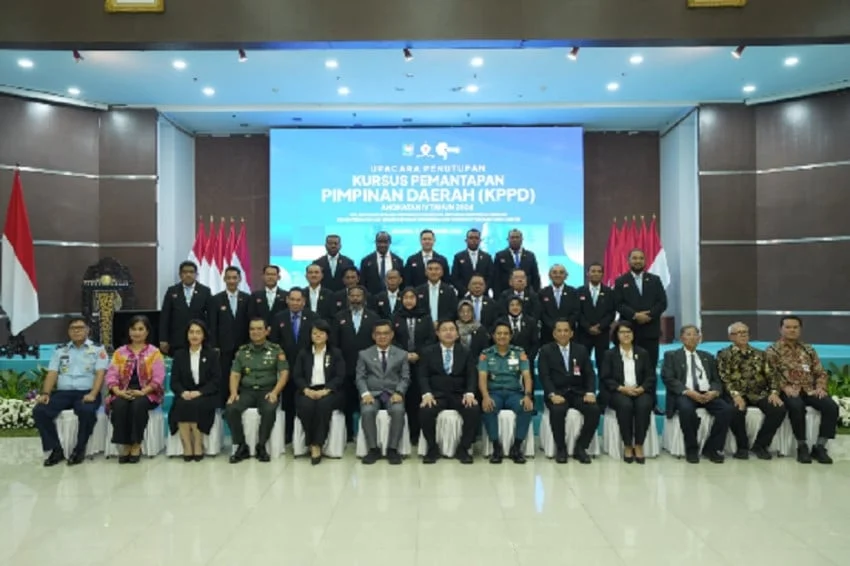
JAKARTA — In a decisive effort to elevate the standard of regional governance across the archipelago, the Human Resources Development Agency (BPSDM) of the Ministry of Home Affairs (Kemendagri) has officially reinforced its commitment to boosting the leadership capacity of regional heads. This strategic objective is being advanced through the execution of the Regional Head Leadership Program (Program Kepemimpinan Kepala Daerah – KPPD) Angkatan IV Tahun 2026.
The intensive capacity-building initiative, which spans from September 2 to September 12, 2026, has been meticulously crafted to transcend traditional administrative training. Beyond merely broadening the intellectual horizons and strategic vision of participating officials, the program functions as an incubator for practical, results-oriented action plans. These meticulously formulated blueprints are designed for immediate implementation within regional administrations, directly influencing the execution of local government policies and accelerating regional development trajectories.
Strategic Collaborative Framework for National Resilience
The execution of the KPPD Angkatan IV 2026 stands as a testament to multi-institutional synergy. BPSDM Kemendagri has intentionally partnered with premier national institutions, specifically the National Resilience Institute (Lemhannas) and the Purnomo Yusgiantoro Center (PYC). This collaborative triad brings together administrative governance expertise, national security and geopolitical strategy perspectives, and independent energy and public policy research.
By bridging these diverse domains, the program ensures that regional leaders are not only equipped to handle localized bureaucratic challenges but are also attuned to macro-level national goals, sustainable energy transitions, and systemic economic resilience. Uniquely, the participant roster has been intentionally curated to include not just regional heads—such as governors, regents, and mayors—but also the heads of Regional Development Planning Agencies (Bappeda). This dual-attendance model bridges the gap between political leadership and technocratic planning, ensuring that high-level strategic visions developed during the sessions can be seamlessly translated into actionable, funded programs within regional budgets.
Chronology and Structural Timeline of the 2026 Program
The implementation of the KPPD Angkatan IV 2026 follows a rigorous, multi-stage pedagogical framework developed over years of refining bureaucratic training in Indonesia.
Preparatory Phase and Curriculum Design (Q2 2026): Months prior to the September launch, academic boards from BPSDM Kemendagri, Lemhannas, and PYC convened to update the curriculum. Recognizing the shifting global landscape and the unique economic and environmental pressures facing Indonesian regions in 2026, the syllabus was updated to emphasize digital governance, fiscal transparency, crisis management, and sustainable infrastructure development.
The Intensive Training Window (September 2–12, 2026): Over these ten days, participants underwent a residential immersion program. The schedule combined lectures from senior cabinet ministers, geopolitical briefings from Lemhannas defense experts, policy workshops moderated by the Purnomo Yusgiantoro Center, and syndication exercises where regional leaders tackled real-world case studies involving bureaucratic gridlock, disaster mitigation, and regional revenue optimization.
Formulation of Action Plans (Mid-September 2026): The culminating milestone of the 10-day program requires every participating regional head and Bappeda chief to finalize a localized "Action Plan Memorandum." This document outlines concrete administrative reforms, infrastructure projects, or public service enhancements that the administration pledges to execute upon returning to their respective jurisdictions.
Post-Program Monitoring and Evaluation (Late 2026 and Onward): Unlike traditional ceremonial workshops, the KPPD framework incorporates a longitudinal tracking mechanism. BPSDM Kemendagri, in coordination with regional oversight inspectorates, periodically reviews the implementation status of the action plans formulated during the September sessions to ensure accountability and tangible results.
Contextual Background: The Evolution of Regional Autonomy and Leadership Needs
To fully comprehend the strategic weight of the KPPD Angkatan IV 2026, one must examine the broader evolution of Indonesia’s decentralization policies. Since the enactment of sweeping regional autonomy laws in the late 1990s and early 2000s, regional heads have wielded immense authority over local budgets, public service delivery, and natural resource management. While decentralization successfully brought governance closer to the populace, it also exposed systemic vulnerabilities: disparities in administrative competence, fragmented infrastructure planning, vulnerabilities to fiscal mismanagement, and challenges in executing nationally unified strategic priorities at the local level.
In response, the Ministry of Home Affairs has consistently utilized BPSDM as the vanguard for bureaucratic reform. Over successive administrations, the profile of the Indonesian regional head has shifted from a purely political figure to a quasi-CEO of a regional economy. The challenges of the mid-2020s—characterized by rapid digital transformation, climate change adaptation demands, post-pandemic economic realignment, and the transition toward the National Capital Region (IKN) framework—require a sophisticated breed of leadership.

The partnership with Lemhannas injects a vital dose of Wawasan Nusantara (Archipelagic Outlook) and national stability awareness into local governance. Meanwhile, the inclusion of the Purnomo Yusgiantoro Center—a prominent think tank specializing in energy, natural resources, and environmental sustainability—ensures that regional leaders confront the realities of the global green transition. Local heads must navigate how their regional policies align with Indonesia’s national commitments to carbon reduction, renewable energy adoption, and sustainable commodity management.
Official Perspectives and Institutional Stance
While specific individual quotes from the September 2026 opening ceremonies reflect a shared sense of urgency, the overarching institutional stance of BPSDM Kemendagri remains anchored in the belief that decentralized governance is only as strong as its weakest administrative link.
Representatives from BPSDM have consistently emphasized that modern regional heads cannot rely solely on political mandates. They must master the nuances of fiscal federalism, performance-based budgeting, and cross-jurisdictional collaboration. By uniting regional executives with their respective Bappeda chiefs in an immersive, high-level academic and strategic environment, the Ministry aims to eradicate the traditional disconnect where political leadership and bureaucratic planning operate in silos.
Furthermore, the integration of Lemhannas’s analytical frameworks serves to remind local leaders that their administrative decisions directly impact national security, social cohesion, and macroeconomic stability. A breakdown in regional public service delivery or localized ethnic friction is no longer contained within municipal boundaries; it reverberates nationally. Therefore, equipping leaders with advanced conflict resolution, strategic foresight, and crisis management tools is treated as a matter of national security.
Implications and Broader Economic Impacts
The long-term implications of the KPPD Angkatan IV 2026 extend far beyond the walls of the training facility. By enforcing rigorous action-planning standards, the program directly influences the quality of Regional Medium-Term Development Plans (RPJMD) and Regional Government Work Plans (RKPD).
When regional heads return to their respective provinces, regencies, and cities with standardized, high-level competencies, several direct impacts can be anticipated:
Enhanced Budgetary Efficiency: With Bappeda heads participating directly in the leadership tracks, local governments are better positioned to align capital expenditure with high-impact public needs rather than redundant administrative costs. This directly supports national efforts to curb regional fiscal waste and optimize the allocation of the General Allocation Fund (DAU) and Special Allocation Fund (DAK).
Accelerated Infrastructure and Investment Readiness: Regional competitiveness relies heavily on regulatory certainty and bureaucratic efficiency. Leaders trained under the KPPD framework are better equipped to streamline licensing procedures, eliminate counterproductive local regulations (perda), and create investor-friendly ecosystems that attract both domestic and foreign direct investment (FDI).
Improved Alignment with National Strategic Projects (PSN): Many regions across Indonesia are directly impacted by national infrastructure corridors, toll roads, new port developments, or proximity to special economic zones. The strategic foresight gained through Lemhannas modules ensures that local leadership actively facilitates, rather than inadvertently obstructs, these critical national arteries.
Data-Driven Decision Making and Digital Transformation: Modern governance demands rigorous data utilization. The program reinforces the necessity of adopting electronic government systems (E-Government) and smart-city initiatives, reducing opportunities for bureaucratic corruption and ensuring transparent public service delivery.
Conclusion
The execution of the Program Kepemimpinan Kepala Daerah (KPPD) Angkatan IV Tahun 2026 by BPSDM Kemendagri, in strategic alliance with Lemhannas and the Purnomo Yusgiantoro Center, represents a vital milestone in Indonesia’s ongoing bureaucratic maturation. By transforming regional heads and planning chiefs into visionary, strategically minded, and action-oriented administrators, the Ministry of Home Affairs is laying the groundwork for a more resilient, cohesive, and economically vibrant nation. As these leaders deploy their newly formulated action plans across the country, the ultimate beneficiaries will be the citizens of Indonesia, who stand to experience more transparent, efficient, and responsive local governance.
