
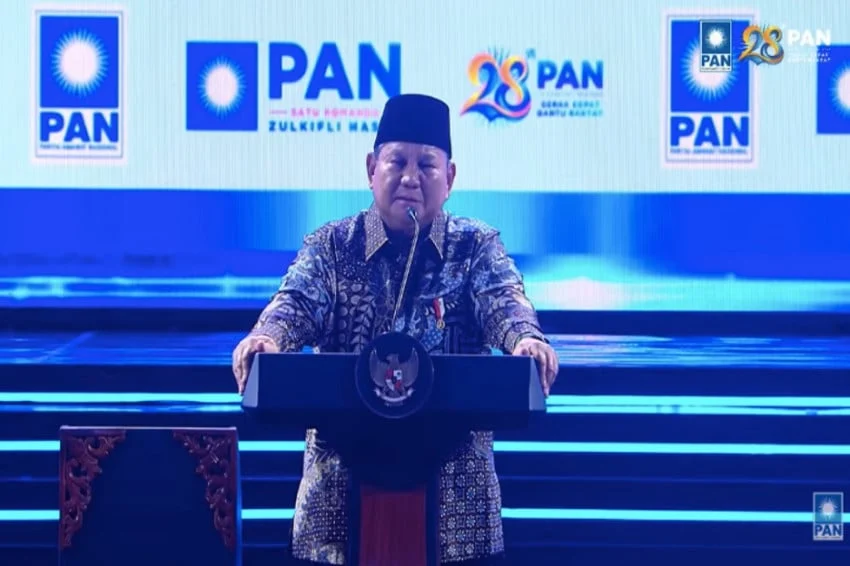
The political and academic landscape of Indonesia experienced a significant moment of introspection and tension following a strongly worded address by President Prabowo Subianto. Speaking before thousands of cadres, sympathizers, and high-ranking officials at the Jakarta International Convention Center (JICC) on Friday, September 18, 2026, the head of state levied a critical assessment against various experts and commentators who have consistently scrutinized government policies. Addressing the audience during the grand celebration of the 28th anniversary of the National Mandate Party (PAN), President Prabowo expressed deep concern that constructive academic critique has allegedly degenerated into defamation and unfounded allegations.
The speech quickly garnered widespread public attention, triggering extensive discourse across mainstream media channels, political forums, and academic institutions throughout the archipelago. By invoking both religious scripture and the fundamental principles of scholarly ethics, the President underscored the delicate balance between freedom of expression and national responsibility. As the current administration navigates complex economic reforms, large-scale infrastructural initiatives, and social welfare programs, the friction between state policymaking and expert evaluation has emerged as a central theme in contemporary Indonesian governance.
Chronology and Setting of the Address
The event took place within the spacious halls of the JICC in Senayan, Jakarta, serving as a high-profile gathering for the National Mandate Party, a key component of the ruling coalition. PAN, known for its nationalist-religious platform, provided a receptive audience for the President’s cultural and religious references. The celebration marked the 28th milestone of the party’s establishment, drawing notable political figures, ministers, regional leaders, and coalition partners.
President Prabowo took to the podium to deliver a speech that blended reflections on national history, personal military background, and contemporary political challenges. Midway through his address, the discussion shifted toward the reception of government programs by outside observers. Noting the religious foundation of PAN, the President referenced Islamic teachings, specifically citing Surah Al-Baqarah verse 191, to emphasize the gravity of spreading false accusations. He stated that certain experts, driven by their extensive credentials, had crossed the line from professional analysis into defamation.
Despite the pointed criticism, the President maintained a measured tone regarding personal retribution, noting that he chose to record the remarks rather than pursue legal or punitive action. He offered a path toward reconciliation, stating that genuine realizations and corrections would be met with forgiveness, while simultaneously issuing a stern reminder regarding the ethical obligations of intellectuals.
The Core Argument: Intellectual Honesty and Allegations of Foreign Influence
At the heart of President Prabowo’s critique was the concept of intellectual honesty. The chief executive argued that true scholarship requires not only technical proficiency and academic titles, but also an unwavering commitment to truth, objectivity, and national interest. He cautioned against scenarios where academic expertise might be co-opted or influenced by external actors, explicitly raising concerns about serving the interests of foreign entities.
"If you have intelligence, if you have expertise, do not forget that a scholar must be honest—that is called intellectual honesty, especially when you are not serving the interests of other nations," the President declared to the applauding audience.
This assertion touches upon a sensitive nerve in Indonesian political discourse, where debates regarding national sovereignty, foreign investments, international financial institutions, and global geopolitical alignments frequently intersect with domestic policymaking. Critics of government policies often argue that external pressures—ranging from global environmental standards to economic structural adjustments—harm local populations, while proponents of state policies maintain that international cooperation is vital for sustainable growth. By questioning the motivations behind certain expert critiques, the administration highlights the perceived dichotomy between theoretical opposition and the practical realities of governing a diverse, developing nation of over 270 million people.
Vision for National Prosperity and Historical Commitment
Transitioning from the critique of academic dissent, President Prabowo reiterated his foundational vision for Indonesia: a prosperous, self-reliant nation where poverty is eradicated and basic human needs are universally met. He connected his current administrative goals to the oaths and commitments he made during his decades-long military career, recalling his readiness to sacrifice his life for the country since his youth.
"We want our people to be prosperous. From when I was young, I took an oath; I was ready at that time, at 18 years old, to die for this country. I want to defend my nation, to see Indonesia respected one day, the Indonesian people prosperous, no hungry people in Indonesia, no mothers and fathers confused when their children fall ill," the President emphasized.
This rhetoric aligns closely with the central pillars of the Prabowo administration’s development agenda, which prioritizes food security, free nutritional meals for school children, universal healthcare access, and poverty alleviation programs. The administration has frequently defended its expansive fiscal policies as essential investments in human capital, arguing that immediate social interventions are necessary to lift marginalized communities out of generational poverty, regardless of short-term budgetary criticisms from fiscal conservatives or academic economists.
Contextual Background: The Relationship Between the State and Academia
The tension between Indonesian administrations and the academic community is a longstanding dynamic in the nation’s political history. Since the reformation era began in 1998, freedom of speech and academic freedom have been constitutionally protected pillars of Indonesian democracy. Universities, think tanks, and independent research institutes have historically served as critical watchdogs, evaluating government policies on taxation, environmental management, corruption eradication, and economic growth.
In recent years, however, the proliferation of digital media and social networking platforms has transformed how critiques are disseminated and consumed. While traditional academic peer review relies on empirical data, methodological rigor, and formal publication channels, modern public commentary often takes place in fast-paced digital environments where nuance can be lost. Consequently, disagreements between technocrats within the government and independent economists or policy analysts frequently escalate into public polarization.
Proponents of academic freedom argue that robust critique—even when sharp or critical of state initiatives—is indispensable for democratic accountability and helps refine public policy by exposing blind spots. Conversely, government supporters contend that partisan bias, sensationalism, and politically motivated opposition can undermine public trust in essential state programs and distract from administrative achievements.
Reactions and Political Implications
The remarks made by President Prabowo at the PAN anniversary event have prompted a spectrum of responses from political analysts, civil society organizations, and academic associations.
Representatives from political parties within the government coalition generally rallied behind the President’s message, emphasizing the need for constructive collaboration rather than destructive rhetoric. Lawmakers noted that while the administration remains open to dialogue, criticisms leveled against government initiatives should be grounded in constructive solutions rather than politically motivated opposition aimed at discrediting state programs.
On the other hand, representatives from academic federations and civil society groups have expressed nuanced concerns regarding the potential chilling effect of labeling scholarly critiques as defamation. Academics argue that intellectual honesty cuts both ways: researchers have a professional duty to present objective findings, while public officials have a civic duty to tolerate rigorous scrutiny without questioning the patriotism or integrity of independent experts.
Furthermore, legal experts have pointed out the delicate legal boundaries distinguishing protected freedom of expression, academic critique, and actionable defamation under Indonesian law, particularly provisions within the Electronic Information and Transactions (ITE) Law and the Criminal Code (KUHP). While the President noted his preference for forgiveness over legal action, the semantic shift from viewing critics as policy opponents to viewing them as purveyors of defamation highlights the persistent friction points in state-civil society relations.
Broader Economic and Social Context
The backdrop of this discourse includes significant economic challenges facing Indonesia, including global supply chain fluctuations, inflationary pressures, currency stability, and the ongoing transition toward green energy. As the government rolls out capital-intensive projects and ambitious social programs, fiscal discipline and policy efficacy remain subjects of intense debate among financial analysts.
Independent economic think tanks frequently publish assessments analyzing the debt-to-GDP ratio, the funding mechanisms for social safety nets, and the projected outcomes of industrial downstreaming policies. While these reports are standard components of a functioning market economy and democratic governance, the interpretation of data often diverges sharply between government economists and external researchers.
President Prabowo’s address serves as a reminder of the administration’s sensitivity to public perception and the high stakes involved in shaping the national narrative. As Indonesia strives to achieve its long-term development targets—including the ambitious vision of becoming a globally advanced economy by its centennial—managing the relationship between executive leadership, legislative coalitions, and intellectual institutions will remain a critical factor in political stability and policy success.
Conclusion
The statements delivered by President Prabowo Subianto during the 28th anniversary of the National Mandate Party encapsulate the ongoing ideological and practical negotiations within modern Indonesian democracy. By directly challenging what he perceives as unwarranted and defamatory criticism from the academic community, while simultaneously reaffirming his lifelong commitment to national welfare and poverty eradication, the President has set a definitive tone for his administration’s engagement with public discourse. Moving forward, the challenge for both the government and the intellectual community will be finding a constructive equilibrium that respects scholarly independence, protects democratic freedoms, and remains unified in the pursuit of national prosperity and social justice.
