
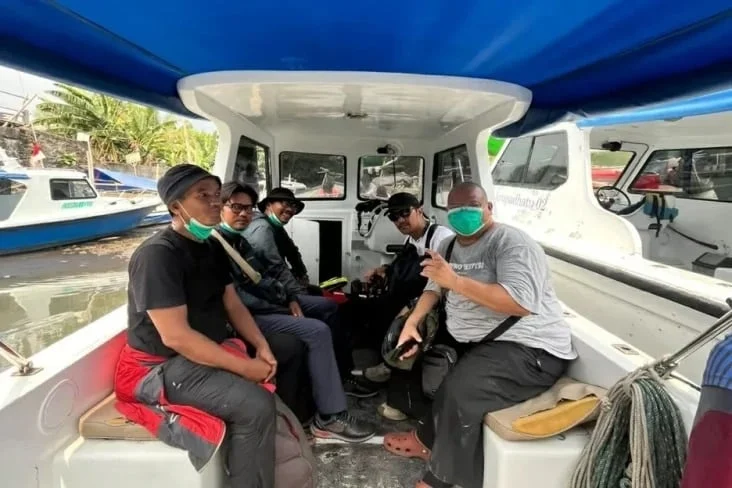
The search and rescue (SAR) operation for five journalists and three boat crew members who went missing in the Sunda Strait remains in a critical phase as authorities enter the seventh day of the mission. On Sunday, September 13, 2026, the search efforts experienced a temporary shift in tactical deployment, as two primary Indonesian Navy (TNI AL) assets, KRI Leuser and KAL Pohawang, were pulled from the immediate search grid to conduct essential logistical replenishment.
The disappearance of the vessel, which occurred during a reporting expedition covering the volcanic activity of Mount Anak Krakatau (GAK), has prompted a massive multi-agency response. As families of the missing individuals wait for updates at the Carita SAR Command Post in Banten, officials have emphasized that the withdrawal of these vessels is purely operational and does not signify an abandonment of the search mission.
Operational Status and Logistical Requirements
Addressing the media during a press briefing on Sunday, the Commander of the Banten Naval Base (Danlanal), Lieutenant Colonel (P) Wawan Subagyo Mardani, clarified the status of the naval assets. He stated that the temporary absence of KRI Leuser and KAL Pohawang was a necessary logistical step to ensure the sustainability of the ongoing search effort.
"The two Indonesian Navy assets, KRI Leuser and KAL Pohawang, are currently undergoing refueling and restocking of food supplies," Wawan explained. "This is a standard procedure in long-range maritime operations. They have not been withdrawn from the SAR mission; rather, they are preparing to return to the search sector refreshed and fully equipped. We expect them to rejoin the search grid by tomorrow morning, Monday, September 14, 2026."
The vast, volatile nature of the Sunda Strait, compounded by the environmental hazards posed by the ongoing eruptions of Mount Anak Krakatau, necessitates constant vigilance and high levels of vessel readiness. The logistics stop is considered a vital maintenance cycle to ensure the crews can remain operational in what has become a grueling, week-long effort.
Context of the Incident: The Anak Krakatau Expedition
The incident took place amidst a period of heightened geological activity from Mount Anak Krakatau. The group of eight—comprising five journalists and three crew members—had set out to document the eruption’s impact on the local ecosystem and maritime safety. The Sunda Strait is a high-traffic, geographically complex maritime corridor, often subject to unpredictable currents and sudden atmospheric changes caused by volcanic activity.
When the vessel failed to return to its port of origin, emergency protocols were triggered. The disappearance is particularly concerning due to the proximity of the search area to the volcanic island, which complicates search conditions through potential underwater seismic tremors and ashfall that can affect navigation and visibility.
Chronology of the Search Operation
The search operation, now reaching its first full week, has followed a systematic, multi-layered approach:

- Day 1 (September 8): Initial reports confirmed the vessel failed to check in. The Banten SAR office, in coordination with the Indonesian Navy and local authorities, launched the initial search sweep.
- Day 2–3: The search grid was expanded to cover a wider radius from the last known coordinates near Anak Krakatau. Aerial surveillance and sonar mapping were introduced to detect any wreckage or debris.
- Day 4–5: Weather conditions in the Sunda Strait deteriorated, hampering small-craft search efforts. Despite this, the KRI Leuser and KAL Pohawang continued to lead the maritime sweep, utilizing their specialized tracking equipment.
- Day 6 (September 13): The focus shifted toward deep-water scanning while the primary naval vessels docked for refueling. The coordination between the National Search and Rescue Agency (Basarnas) and the Navy continued through alternate patrol boats and local fishing vessels assisting in the perimeter.
- Day 7 (Expected, September 14): A full-scale resumption of the search is planned, with the return of KRI Leuser and KAL Pohawang to the core search zone.
Support Systems for Families and Stakeholders
Recognizing the immense emotional and psychological strain on the families of the missing, the Banten Provincial Government has mobilized a comprehensive support network. This initiative includes the deployment of medical professionals, counselors, and trauma psychologists to the Carita SAR Post.
The objective is to provide a dedicated environment for families to receive real-time updates while ensuring they have access to mental health support during the extended waiting period. The government has stressed that the welfare of the families remains a top priority alongside the search itself.
Furthermore, the local authorities have established communication channels to prevent the spread of misinformation, ensuring that families receive verified data directly from the official search commanders rather than through speculative news sources.
Analysis: Challenges of Maritime SAR in Volcanic Zones
The search for the missing journalists highlights the inherent risks of reporting from active geological zones. Maritime search and rescue operations in the Sunda Strait are frequently hindered by several variables:
- Volcanic Turbulence: The active nature of Anak Krakatau can create localized swells and turbidity in the water, which reduces the effectiveness of sonar and infrared detection equipment.
- Maritime Traffic Density: The Sunda Strait is one of the world’s most vital shipping lanes. Coordinating an intensive SAR operation without disrupting global commercial shipping requires high-level communication and precise spatial management.
- Hydrographic Complexity: The seabed in this region is uneven, with steep drop-offs and deep trenches that make locating small-sized wreckage an arduous task.
Experts in maritime operations note that while the first 72 hours are generally considered the "golden window" for survival, the duration of the search is often extended in cases where the vessel may have been disabled but remains afloat, or if the crew reached remote islands or islets within the strait.
Official Response and Future Outlook
The Indonesian government has reiterated its commitment to the operation. The coordination between the Indonesian Navy, Basarnas, and local police remains robust. By keeping the lines of communication open and providing daily briefings, the authorities hope to maintain transparency and public trust.
As the search enters its second week, the focus will likely shift to a broader search radius, incorporating satellite imagery analysis to identify any potential drift patterns that may have moved the vessel further from the original incident site.
The incident serves as a somber reminder of the dangers faced by members of the press who enter high-risk zones to bring public awareness to natural phenomena. The resilience of the search crews—who continue to brave the unpredictable conditions of the Sunda Strait—is a testament to the dedication of Indonesia’s emergency responders.
As the morning of September 14 approaches, the return of KRI Leuser and KAL Pohawang to the scene will mark a renewed effort in what has become a race against time. The authorities remain hopeful that the integration of these assets, combined with favorable weather forecasts for the coming days, will provide the clarity that the families and the public are desperately seeking. The search continues, and the focus remains solely on the safe recovery of the eight individuals.
