
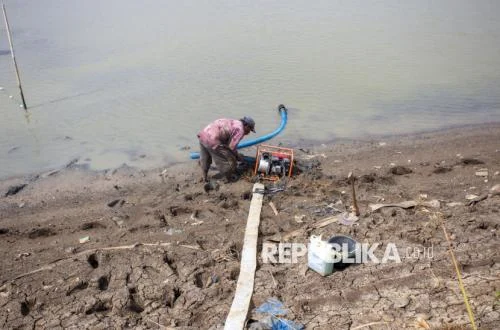
Indonesia’s vital agricultural sector is increasingly feeling the severe repercussions of a prolonged dry season, with numerous farming regions across the archipelago now reporting significant drought impacts. Mohammad Yadi Sofyan Noor, Chairman of the Indonesian Farmers and Fishermen Contact Group (KTNA), highlighted that the escalating intensity of the dry season has begun to take a tangible toll on agricultural lands, stretching from West Java to Central Java and as far as South Kalimantan. This development underscores the persistent vulnerability of food production to climatic shifts, despite ongoing governmental interventions.
The affected areas in West Java include the prominent rice-producing regencies of Indramayu and Subang, critical contributors to the national food basket. Meanwhile, in Central Java, Purworejo Regency has thus far managed to maintain a relatively secure position, primarily attributed to its robust technical irrigation systems and reliable water sources. However, the situation is more precarious in South Kalimantan, where regions such as Banjar, Tanah Laut, and Tanah Bumbu Pagatan are experiencing the initial phases of drought-induced stress. These regions collectively represent a significant portion of Indonesia’s agricultural landscape, producing staple crops that are essential for the nation’s food security. The early onset and intensifying nature of the dry season, exacerbated by the looming threat of El Niño, present a formidable challenge to farmers and policymakers alike.
Regional Snapshot of Drought Impact
The geographic spread of the drought’s impact illustrates the varied vulnerabilities and resilience across Indonesia’s diverse agricultural zones. Indramayu and Subang in West Java, known as key rice granaries, are particularly susceptible due to their extensive irrigated rice fields which demand consistent water supply. Any disruption to this supply can rapidly lead to crop stress and potential failure. Farmers in these areas are often heavily reliant on river systems and rain-fed reservoirs, which are rapidly depleting under current conditions. The historical average rainfall in these regions during the dry season typically drops significantly, but the current intensity is proving more challenging than usual.
In contrast, Purworejo’s relative safety in Central Java serves as a testament to the effectiveness of well-maintained and technologically advanced irrigation infrastructure. This includes a network of dams, weirs, and canals that can manage and distribute water more efficiently, even during periods of scarcity. The availability of diverse water sources, including groundwater reserves, further bolsters its resilience. This stark contrast highlights the importance of strategic investments in water management infrastructure as a bulwark against climate variability.
South Kalimantan, with its distinct agro-climatic conditions, is also grappling with the dry spell. Banjar, Tanah Laut, and Tanah Bumbu Pagatan, which encompass a mix of lowland rice cultivation and plantation crops, are witnessing reduced water levels in their rivers and reservoirs. The unique peatland characteristics in some parts of Kalimantan also add a layer of complexity, as prolonged dryness can increase the risk of devastating forest and land fires, further impacting agricultural productivity and environmental health.
Farmer Resilience and KTNA’s Adaptive Strategies
In the face of these escalating challenges, local farming communities, often guided by organizations like KTNA, have developed and refined a suite of adaptive strategies. Mohammad Yadi Sofyan Noor emphasized KTNA’s long-standing experience in navigating drought conditions. "To face the impacts of drought, KTNA is accustomed to adapting. If there are still water sources, we utilize the available water pump machines," Sofyan stated to Republika on Monday, July 20, 2026, reflecting a proactive and pragmatic approach from the ground up.
This initial line of defense involves the strategic deployment of water pumps to extract water from dwindling rivers, canals, or shallow wells. As surface water sources become increasingly scarce, farmers pivot to alternative solutions. Sofyan explained, "If water sources begin to be limited, farmers utilize deep wells as an alternative." This involves tapping into deeper groundwater aquifers, a more resource-intensive but often necessary measure to sustain crops. The transition from surface water to groundwater extraction marks a critical phase in drought management, requiring not only equipment but also a deeper understanding of local hydrogeology.
In the most extreme scenarios, when even deep wells fail to provide sufficient water, the community resorts to emergency measures. "If water sources completely dry up, water needs are met using tanker trucks as needed," Sofyan elaborated. This last-resort measure ensures that essential crops receive just enough water to survive, preventing total crop failure. While effective in localized, critical situations, relying on water tankers is a costly and logistically challenging solution, underscoring the severity of the drought. These multi-tiered strategies are crucial for maintaining plant hydration and mitigating losses in the midst of a prolonged dry season, showcasing the ingenuity and resilience of Indonesian farmers.
Government’s Comprehensive Mitigation Framework
Recognizing the recurrent threat of drought and the magnified danger posed by El Niño, the Ministry of Agriculture (Kementan) has laid out a comprehensive mitigation framework designed to safeguard national food production. Deputy Minister of Agriculture (Wamentan) Sudaryono highlighted the government’s multi-pronged strategy, emphasizing its critical role in maintaining national food security. The proactive measures span technological innovation, infrastructure development, and inter-agency coordination.
At the core of Kementan’s strategy is the implementation of an Early Warning Information System for Agriculture (Si-PERDITAN). This sophisticated system is designed to monitor climatic conditions, predict potential drought hotspots, and provide timely alerts to farmers and regional authorities. By leveraging data analytics and meteorological forecasts, Si-PERDITAN enables preemptive actions, allowing farmers to adjust planting schedules, select appropriate crop varieties, or prepare for irrigation interventions before the drought fully sets in. This early warning capability is a significant leap forward in reducing vulnerability to climate shocks.
Beyond early warning, Kementan is heavily investing in bolstering water infrastructure. This includes the rehabilitation and expansion of existing irrigation networks, ensuring more efficient water delivery to agricultural fields. Many of Indonesia’s irrigation systems are aging and suffer from efficiency losses due to leakages or silting. Rehabilitating these networks significantly improves water retention and distribution, maximizing the utility of available water resources. Concurrently, the government is promoting "pompanisasi," a program focused on providing and deploying water pumps to farmers, mirroring KTNA’s grassroots efforts but on a larger, government-supported scale. This initiative ensures that farmers have access to the necessary equipment for water extraction when traditional sources become limited.
Furthermore, a critical long-term strategy involves the development and dissemination of drought-resistant seeds. Research institutions under Kementan are actively engaged in breeding crop varieties that can withstand prolonged dry spells and require less water. Distributing these resilient seeds to farmers empowers them to cultivate crops that have a higher chance of survival and yield, even under adverse conditions. This biological approach complements the infrastructural and technological interventions, offering a sustainable solution to climate change adaptation.
Inter-Agency Coordination and Proven Effectiveness
The success of Kementan’s mitigation efforts relies heavily on intensive coordination with various ministries, institutions, and local governments. Addressing a challenge as complex and widespread as drought necessitates a unified approach, pooling resources and expertise from different sectors. This collaborative framework ensures that policies are harmonized, resources are efficiently allocated, and responses are swift and targeted. Local governments, in particular, play a crucial role in implementing national strategies at the community level, adapting them to specific regional contexts and needs.
The effectiveness of these concerted efforts is borne out by compelling data. Sudaryono, speaking at a working meeting with Commission IV of the House of Representatives (DPR RI) in Jakarta, proudly presented the figures: "Data shows that our mitigation efforts are effective. The area of crop failure (puso) due to El Niño up to July 2026 is around 12,000 hectares, significantly lower compared to 2015, which reached approximately 217,000 hectares." This dramatic reduction in crop failure highlights a substantial improvement in the nation’s preparedness and response capabilities. The 2015 El Niño event caused widespread agricultural losses, impacting food supply and farmer livelihoods. The current figures indicate a robust and more resilient agricultural system, capable of weathering similar climatic stresses with far less damage. "This means that government readiness is getting stronger, and we can continue to maintain national food production," Sudaryono affirmed, underscoring the tangible positive impact of the mitigation strategies.
Enhancing Productivity and Building Resilience
To further fortify the agricultural sector against the rigors of the dry season and the looming El Niño, Kementan is accelerating the provision of agricultural tools and machinery (Alsintan). This strategic investment is designed to optimize land productivity across various regions. The Alsintan program includes a range of essential equipment such as water pumps – reiterating their critical role in drought management – as well as tractors for land preparation, rice transplanters to improve planting efficiency, and other vital supporting facilities. By equipping farmers with modern machinery, Kementan aims to enhance efficiency, reduce labor costs, and most importantly, ensure that farming activities can continue optimally even under challenging environmental conditions. For instance, efficient land preparation and planting using modern machinery can reduce the time crops are exposed to dry conditions, or allow for quicker replanting if initial crops fail.
Sudaryono emphasized that these comprehensive mitigation steps are specifically aimed at "pressing the risk of crop failure while maintaining land productivity amid the threat of climate change." The overarching goal is to fortify national food security and achieve the ambitious target of food self-sufficiency (swasembada pangan). Achieving self-sufficiency in staple foods like rice, corn, and soybeans is a cornerstone of Indonesia’s economic and political stability, reducing reliance on imports and insulating the nation from global food price volatility. The government’s unwavering commitment to strengthening preparedness reflects a deep understanding of the intricate links between climate resilience, agricultural productivity, and national well-being.
The Broader Context: El Niño and Climate Change Implications
The current dry season and the anticipated El Niño phenomenon are not isolated events but rather part of a broader pattern of climate change that poses significant threats to global agriculture. El Niño, characterized by the warming of sea surface temperatures in the central and eastern tropical Pacific Ocean, typically leads to reduced rainfall and prolonged dry seasons in Southeast Asia, including Indonesia. Historical data shows that strong El Niño events, such as those in 1997-98 and 2015, have caused widespread droughts, triggering forest fires, agricultural losses, and disruptions to water supply. The current dry spell, therefore, is viewed with heightened concern, given the potential for severe and prolonged impacts.
Beyond the immediate agricultural losses, the implications of prolonged drought extend to socio-economic spheres. Farmers, particularly smallholders, are disproportionately affected, facing reduced incomes, increased debt, and potential food insecurity for their families. At a national level, widespread crop failures can lead to spikes in food prices, contributing to inflation and placing a burden on consumers. This necessitates strategic reserves and import policies to stabilize markets, though the ultimate goal remains domestic production. The economic impact can ripple through supply chains, affecting processing industries, transportation, and ultimately, national economic growth.
Moreover, the environmental consequences are severe. Prolonged dryness increases the risk of forest and land fires, particularly in peatland areas, leading to transboundary haze pollution, biodiversity loss, and significant carbon emissions, further exacerbating climate change. The cumulative effects of these environmental and economic stresses underscore the urgency of robust and sustainable climate adaptation strategies.
Future Outlook and Policy Imperatives
While Indonesia has demonstrated enhanced resilience against drought and El Niño, the challenges ahead remain substantial. The government’s commitment to continuous improvement in its mitigation strategies is paramount. Future policy imperatives will likely focus on several key areas. Firstly, continued investment in research and development for climate-resilient agriculture, including advanced drought-resistant crop varieties, precision irrigation technologies, and sustainable farming practices, will be crucial. This includes exploring innovations such as vertical farming or hydroponics in urban or peri-urban areas to supplement traditional agriculture.
Secondly, strengthening the financial safety nets for farmers, such as crop insurance schemes and access to low-interest loans, can help mitigate economic losses during periods of climate stress. This would provide a crucial buffer against livelihood disruptions and prevent farmers from falling into poverty traps. Thirdly, enhancing public awareness and education on water conservation and sustainable land management practices is vital. Community engagement and active participation are key to the successful implementation of any national strategy.
Finally, international cooperation and knowledge exchange will play an increasingly important role. Learning from global best practices in drought management, climate-smart agriculture, and early warning systems can further strengthen Indonesia’s capabilities. The ongoing dialogue between government bodies, research institutions, farmer organizations like KTNA, and international partners will be essential in charting a resilient path forward for Indonesia’s agricultural sector in an era of unpredictable climate change. The journey towards comprehensive food security and self-sufficiency is a continuous one, demanding adaptive strategies, sustained investment, and unwavering political will.
