
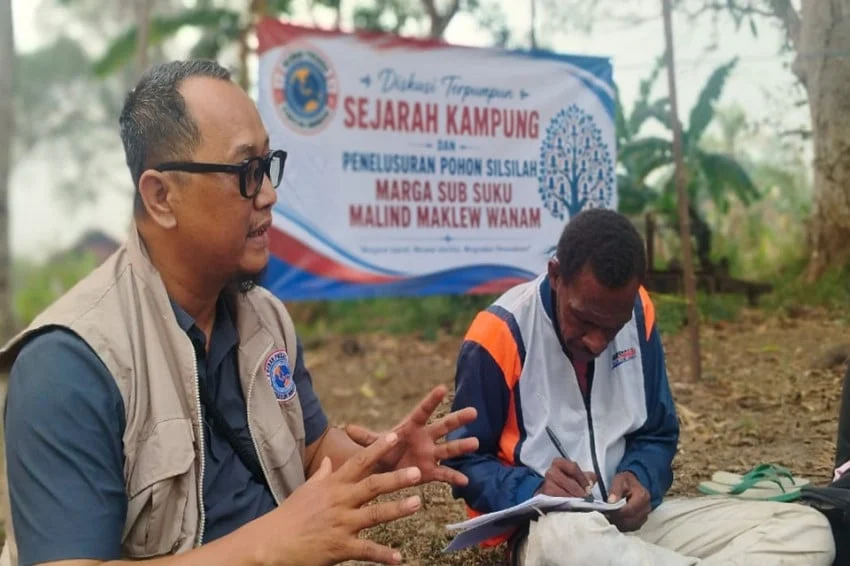
Preserving the rich cultural heritage and indigenous history of remote communities in Indonesia has taken on a renewed sense of urgency as modernization and rapid development reshape the social fabric of Papua. In an earnest effort to safeguard indigenous identity, the Strategic Heritage and Legacy Institute of Indonesia (Merah Pusaka Stratejik Indonesia, or MPSI), in collaboration with the Village Government and the indigenous residents of Wanam, has embarked on a comprehensive initiative to map, document, and preserve the historical lineage of the Malind Maklew sub-tribe.
The endeavor officially commenced with a dynamic and deeply reflective Focus Group Discussion (FGD) held in Kampung Wanam, located within the Merauke Regency of South Papua. The gathering brought together traditional elders, clan leaders, family heads, and community representatives to piece together the intricate oral histories, ancestral migrations, and clan genealogies that have been passed down through generations. By transforming spoken traditions into structured historical records, the initiative seeks to ensure that the heritage of the Malind Maklew people remains intact for future generations in the face of contemporary socio-economic shifts.
Unearthing the Past: The Methodology of Oral History Documentation
For generations, the history of the indigenous peoples of Papua has lived primarily in the memories, songs, and spoken narratives of its elders. The FGD in Wanam served as a vital bridge between this rich oral tradition and formal historical documentation. During the sessions, participants engaged in detailed discussions concerning ancestral origins, intricate kinship networks, the historical expansion of settlements, and the migratory paths taken by various communities across decades and centuries.
The task is far from simple. The indigenous landscape of the region is complex, comprising approximately 12 distinct clans under the Malind Maklew umbrella. Each clan possesses its own unique historical trajectory, specific ancestral roots, and distinct branch families. Recognizing this diversity, participants in the forum agreed that the documentation process must be conducted systematically and incrementally. Rushing the process risks conflating distinct familial histories; therefore, the initiative relies heavily on the direct testimony and deep institutional knowledge of tribal elders and senior clan figures who hold the historical keys to their respective lineages.
The Role of MPSI: Facilitation, Not Ownership
A critical element of the Wanam documentation project is the methodological approach taken by external supporting organizations. MPSI, acting as a facilitator, has drawn a clear boundary between providing technical assistance and dictating historical outcomes.
During the proceedings, MPSI Executive Director Noor Azhari emphasized that the community must remain the undisputed custodian and primary driver of the documentation process. "MPSI is here to assist in the technical process of documentation, not to determine or dictate the genealogy of the community," Azhari stated. He underscored a fundamental principle of indigenous heritage preservation: history is a living entity owned exclusively by the people who lived it. Consequently, every piece of historical data, oral testimony, and ancestral claim gathered during the FGD sessions must be rigorously cross-examined, verified, and validated by members of the respective clans before being finalized into written records.
This community-centric approach ensures that the resulting archives are both accurate and culturally authentic, protecting indigenous rights to self-representation and historical sovereignty.

Background Context: Development and Cultural Preservation in South Papua
The initiative in Kampung Wanam does not occur in a vacuum. In recent years, the Merauke Regency and the broader South Papua province have experienced significant geopolitical and economic transformations. As a designated region for strategic national infrastructure projects (Proyek Strategis Nasional or PSN), South Papua has seen rapid infrastructural expansion aimed at accelerating regional development, improving connectivity, and boosting economic output.
While these development initiatives are designed to foster regional growth and improve public welfare, they also bring profound changes to the traditional lands, resource utilization patterns, and social structures of indigenous populations. Local communities in Wanam and surrounding areas have previously expressed both aspirations for continued development and concerns regarding the preservation of their traditional socio-cultural landscapes.
In this context, the efforts by MPSI and local residents to record ancestral genealogies take on heightened significance. Establishing a clear, documented record of clan territories, historical settlements, and ancestral lineages provides indigenous communities with a stronger legal and cultural foundation as they navigate modern development pressures. Clear historical documentation reinforces land tenure security, aids in cultural preservation, and empowers indigenous groups to engage more effectively with local governments and external stakeholders.
Chronology of the Initiative
The launch of the genealogy project in Wanam represents the culmination of preparatory dialogues and community consultations that have taken place over recent months.
- Initial Assessments: Community leaders and regional observers identified a growing need to record oral histories as older generations pass away and younger generations increasingly integrate into broader modern education and lifestyle systems.
- Partnership Formation: Local government entities in Kampung Wanam aligned with MPSI to design a culturally sensitive framework for historical documentation.
- September 8, 2026: The formal Focus Group Discussion (FGD) convened in Kampung Wanam, bringing together representatives from the 12 Malind Maklew clans, village officials, and MPSI researchers to map out kinship structures and historical migration paths.
- Ongoing Verification Phase: Following the initial FGD, the project enters a decentralized phase where individual clans review, debate, and verify their genealogical trees under the guidance of traditional authorities.
Broader Implications and Future Outlook
The meticulous work being undertaken in Kampung Wanam serves as a micro-level model for indigenous heritage preservation across Indonesia’s easternmost provinces. As Papua continues to integrate into the national and global economy, the tension between modernization and cultural preservation remains a central challenge for policymakers, civil society organizations, and indigenous populations alike.
By systematically recording the history of the Malind Maklew sub-tribe, the Wanam project achieves several vital objectives:
- Safeguarding Cultural Identity: It prevents the permanent loss of historical knowledge that is currently vulnerable due to generational shifts and the fading of oral traditions.
- Strengthening Social Cohesion: By mapping kinship networks and historical relationships between the 12 clans, the initiative reinforces community solidarity and mutual understanding among families.
- Enhancing Indigenous Advocacy: Documented genealogies and historical land-use patterns provide tangible evidence that communities can utilize in social dialogues, cultural exhibitions, and administrative engagements concerning regional development.
Ultimately, the collaboration between MPSI, the Village Government of Wanam, and the indigenous residents of the Malind Maklew sub-tribe highlights a cooperative blueprint for heritage conservation. It demonstrates that when external expertise respects local autonomy and places community ownership at the forefront, historical preservation can become a powerful tool for empowerment, ensuring that ancestral legacies endure for generations to come.
