
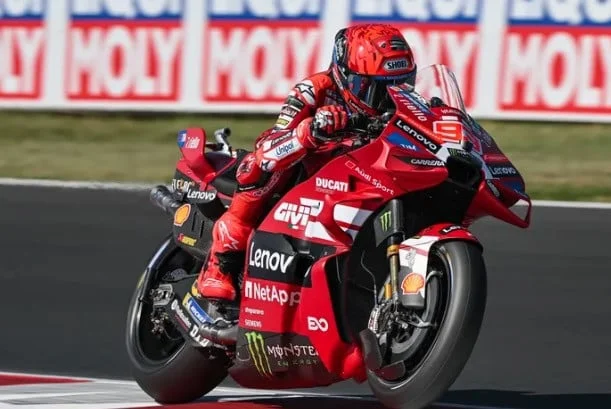
The 2026 MotoGP season reached a pivotal juncture at the Misano World Circuit Marco Simoncelli this Sunday, September 13, 2026, as Ducati Lenovo’s Marc Marquez delivered a masterclass in tactical riding to claim victory in the San Marino Grand Prix. In a race defined by high-stakes drama and early-lap attrition, Marquez navigated the technical intricacies of the Italian track to consolidate his championship standing. The race, which saw early leader Marco Bezzecchi suffer a premature exit, underscored the intense competitiveness of the current premier class grid, where marginal errors often translate into championship-altering consequences.
The Early Race Narrative and the Misfortune of Pole Position
The San Marino Grand Prix began under overcast skies with the paddock buzzing in anticipation of a duel between the local hero Marco Bezzecchi and the surging factory Ducati riders. Bezzecchi, representing Aprilia Racing, had secured pole position during Saturday’s qualifying session, displaying blistering pace that suggested he was the man to beat. However, the dynamics of the race shifted within the opening moments.
As the lights went out, the field surged into the tight Turn 1. Bezzecchi maintained his line, but a momentary loss of front-end grip at the exit of the opening chicane resulted in a low-side crash. The incident left the Aprilia machine stranded in the gravel trap, ending Bezzecchi’s race before he could complete a single lap. The retirement of the pole-sitter immediately neutralized the primary threat to the Ducati factory effort, effectively opening the door for Marc Marquez to seize control of the race trajectory.
Strategic Dominance: Marquez Takes Command
Following the early exit of Bezzecchi, Marc Marquez wasted no time in asserting his authority. By the time the pack exited the second lap, the Spaniard had already established a rhythm that his rivals found difficult to replicate. Riding with the clinical precision that has defined his illustrious career, Marquez utilized the superior traction of his Ducati Lenovo entry to open a significant gap over Jorge Martin, who was riding for the Aprilia Racing factory team.
By the fourth lap, the visual gap between Marquez and the rest of the field had grown to over 1.2 seconds—a substantial margin in modern MotoGP, where the field is often separated by mere milliseconds. Marquez focused on tire management, preserving his rubber for the final stages of the race while keeping his pace consistent enough to prevent any potential charge from Martin. The ability to maintain a sub-1:32 pace on the Misano circuit allowed Marquez to dictate the terms of the engagement, forcing his competitors to push beyond their comfort zones.
The Battle for the Podium: Acosta and Alex Marquez
While the battle for the lead appeared to be a solitary endeavor for Marquez, the fight for the remaining podium positions provided consistent action for the spectators at the Misano circuit. Pedro Acosta, representing Red Bull KTM, displayed a level of maturity that belies his relative inexperience in the premier class. Acosta, having shown consistent improvement throughout the 2026 season, held a firm grip on the third position.
Behind him, Alex Marquez of Gresini Racing applied persistent pressure. The younger Marquez brother utilized the slipstream on the back straight to keep within striking distance of the KTM rider, turning the race into a tactical chess match. As the race entered its middle phase, the gap between Acosta and Alex Marquez fluctuated, with the KTM rider proving particularly adept at defending the internal lines of the circuit’s slow-speed corners. This internal battle highlighted the broader trend of the 2026 season: the emergence of a new generation of riders capable of challenging established veterans on a weekly basis.
Technical Context: Why Misano Matters
The Misano World Circuit Marco Simoncelli is widely regarded as one of the most physically demanding tracks on the MotoGP calendar. Measuring 4.2 kilometers with 16 corners—10 right and 6 left—the track requires a motorcycle that excels in both braking stability and mid-corner agility. The surface, characterized by high-grip asphalt, places a premium on mechanical balance.
For Ducati, the 2026 configuration of their Desmosedici GP machine has proven to be the benchmark. Data from the weekend suggested that the Ducati engineers had optimized the bike’s "holeshot" devices and aerodynamics to better navigate the "Tramonto" and "Curvone" sections of the track. Marquez’s performance serves as an empirical validation of these technical updates, demonstrating that the combination of rider confidence and engineering excellence remains the golden standard in the sport.
Official Responses and Post-Race Analysis
In the post-race press conference, Marc Marquez remained characteristically understated regarding his performance. "The strategy was clear from the start: protect the tires and maintain a rhythm that would force the others to make a mistake," Marquez stated. He acknowledged the disappointment of Bezzecchi, noting that the race could have been significantly more complex had the Aprilia rider remained in the lead pack.
Representatives from Aprilia Racing expressed frustration regarding the early exit of their lead rider. "It is a bitter pill to swallow," an Aprilia spokesperson commented. "Marco had the pace to win, but in MotoGP, there is no margin for error. We will analyze the data from the telemetry to understand exactly what caused the loss of traction at the exit of turn one."
Jorge Martin, finishing in second, praised the pace of the race winner while acknowledging the progress of his own team. "Marc was in a different league today. We had the pace to hold second, but catching him would have required taking risks that might have compromised our championship points. We are satisfied with the result and look forward to the next round."
The Broader Implications for the 2026 Championship
As the 2026 MotoGP season moves into its final third, the results from San Marino have significant ramifications for the standings. Marc Marquez’s victory has effectively extended his lead, providing him with a "cushion" that allows for a more conservative tactical approach in the upcoming flyaway rounds. For his rivals, the focus now shifts to the development race. With every point becoming increasingly valuable, the margin for error is effectively non-existent.
The consistency shown by Pedro Acosta in securing a podium finish also signals a shift in the championship hierarchy. With the KTM factory increasing its support for its satellite teams and the technical development of the RC16 accelerating, Acosta has positioned himself as a legitimate title contender for the 2027 season, if not a spoiler for the current campaign.
Moreover, the performance of the Aprilia contingent, despite Bezzecchi’s crash, indicates that the Italian manufacturer is no longer a fringe competitor. Jorge Martin’s consistency has been the bedrock of their season, and if the team can eliminate the technical gremlins and rider errors that have plagued their recent outings, the battle for the constructor’s championship could extend until the final race in Valencia.
Historical Context: The Evolution of the Misano Grand Prix
The San Marino Grand Prix has a storied history in motorcycle racing, serving as a venue for some of the sport’s most legendary rivalries. Since returning to the calendar in 2007, the Misano circuit has been renovated multiple times to enhance safety and spectator experience. The 2026 edition, characterized by high temperatures and high tire degradation, mirrored the tactical requirements of the 2023 and 2024 seasons.
The victory for Marquez at this specific venue marks his third win at Misano, cementing his status as one of the most versatile riders in the history of the sport. His ability to adapt to varying track conditions—from the wet-weather mastery seen in his earlier years to the measured, strategic dominance displayed this Sunday—remains the hallmark of a rider who has successfully transitioned from an aggressive challenger to a calculated championship leader.
Looking Ahead: The Final Stretch
With the San Marino Grand Prix concluded, the paddock now prepares for the logistical challenge of the overseas rounds. The transition from European circuits to the unique demands of tracks in Asia and the Middle East will test the endurance of both the riders and the mechanical crews. The 2026 MotoGP season has been a testament to the parity of the current grid, with multiple manufacturers securing race wins and podiums throughout the year.
For fans and analysts alike, the primary takeaway from Misano is the undeniable strength of the Ducati Lenovo team. Through a combination of superior machine development and the unparalleled race craft of Marc Marquez, they have established themselves as the team to beat. However, as demonstrated by the volatility of this weekend’s racing, the championship remains fluid. With several races remaining, the pressure on Marquez to maintain this momentum will only intensify, and the ability of his rivals to exploit even the smallest crack in his armor will determine the eventual outcome of the 2026 season.
As the sun set over the Adriatic coast, the paddock began the process of packing down, but the conversation had already shifted to the next round. The 2026 San Marino Grand Prix will be remembered not just for the winner, but for the stark reality it presented: in the high-stakes world of elite motorcycle racing, success is a fleeting commodity that must be earned through every turn, every lap, and every corner of the championship trail. Marquez has done his part; now, the rest of the field must decide if they have the pace and the poise to respond before the curtain falls on this extraordinary season.
