
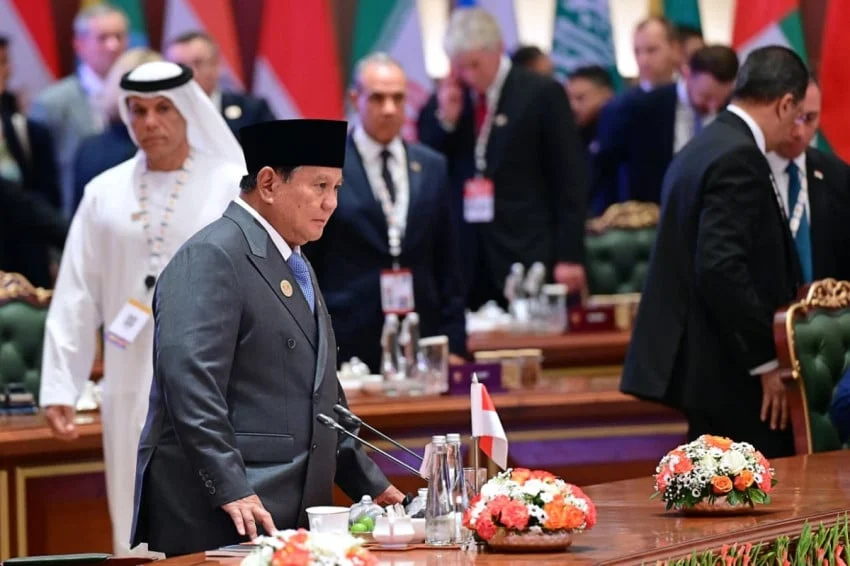
NEW DELHI – President Prabowo Subianto signaled a pivotal shift in Indonesia’s foreign policy approach on Saturday, September 12, 2026, as he addressed the 18th BRICS Summit in New Delhi, India. Emphasizing the collective strength of the Global South, the President underscored the necessity of unity as a prerequisite for navigating an increasingly fragmented geopolitical landscape. His remarks resonated with the historical legacy of the 1955 Bandung Conference, repositioning Indonesia as a key mediator and advocate for developing nations on the global stage.
The summit, which gathered leaders from the world’s most influential emerging economies, served as a platform for President Prabowo to advocate for a more equitable international order. Drawing from Indonesian cultural wisdom, he articulated a vision of collaborative resilience, stating, "There is an old saying in Indonesia: United we stand, divided we fall." This message, while rooted in national philosophy, served as a direct appeal to the BRICS bloc to move beyond bilateral interests and toward a unified strategy for economic sovereignty.
Historical Context and the Spirit of Bandung
The resonance of the President’s speech lies in its deliberate connection to the 1955 Asian-African Conference, held in Bandung, Indonesia. That landmark event established the Non-Aligned Movement and set the precedent for developing nations to assert their autonomy against the pressures of Cold War bipolarity. President Prabowo explicitly invoked this history, noting that the wisdom behind the Bandung Spirit remains the foundational pillar for the Global South today.
By referencing the struggle for self-determination, the President signaled that Indonesia’s engagement with BRICS is not merely economic but ideological. As the world faces crises ranging from food insecurity to the volatility of global financial systems, Indonesia’s proactive stance suggests a desire to leverage the BRICS platform to challenge the dominance of traditional Western-led institutions. This alignment is consistent with Indonesia’s long-standing policy of being "independent and active" (bebas aktif), ensuring that the nation remains a bridge-builder in an era of renewed systemic competition.
The Evolution of BRICS: From Acronym to Global Powerhouse
The 18th BRICS Summit in New Delhi represents a maturation of the bloc, which has expanded significantly since its inception as a loose collection of emerging market economies. Initially composed of Brazil, Russia, India, China, and South Africa, the inclusion of new members and the pursuit of a "BRICS Plus" format have shifted the gravity of global discourse.
Data from the International Monetary Fund (IMF) and the World Bank indicate that the expanded BRICS bloc now accounts for over 35% of global GDP in purchasing power parity (PPP) terms and houses roughly 45% of the world’s population. This sheer demographic and economic weight makes the bloc a critical entity for any nation seeking to diversify its diplomatic and economic portfolio. For Indonesia, which is aiming to reach "Golden Indonesia 2045" (Indonesia Emas 2045) status, integration into these markets is essential for sustained growth, infrastructure development, and technology transfer.
Chronology of Engagement: The Road to New Delhi
The journey to the New Delhi summit was marked by several high-level diplomatic engagements that paved the way for Indonesia’s current assertive stance:
- January 2026: Indonesia officially signaled its intent to deepen ties with the BRICS New Development Bank (NDB), seeking alternative funding for large-scale infrastructure projects.
- April 2026: Preliminary discussions were held between the Indonesian Ministry of Foreign Affairs and the Indian presidency of the BRICS summit to align agendas on energy security and climate finance.
- August 2026: A series of ministerial-level meetings in Moscow and Beijing solidified the consensus on trade facilitation among developing nations, setting the stage for the September summit.
- September 12, 2026: President Prabowo Subianto arrived in New Delhi, receiving a formal welcome from Prime Minister Narendra Modi, followed by the plenary sessions focusing on the expansion of local currency settlements and South-South cooperation.
Strategic Implications of Indonesia’s Stance
Analysts observe that President Prabowo’s emphasis on "unity" serves a dual purpose. Externally, it encourages the BRICS bloc to resolve internal friction, such as the ongoing border and economic disputes between some of its core members, which have previously hindered the group’s ability to act as a cohesive geopolitical bloc. Internally, it reinforces Indonesia’s position as a stable, reliable partner that is willing to champion the interests of the Global South without being tethered to the rivalries of major world powers.
The push for economic sovereignty, often championed by BRICS leaders, includes the de-dollarization of trade. Indonesia has already begun experimenting with Local Currency Settlement (LCS) agreements with several regional partners. By advocating for this on a larger scale within the BRICS framework, the President is signaling that Indonesia is looking to reduce its vulnerability to the fluctuations of the US dollar, a move that aligns with the bloc’s broader goals of financial autonomy.
Official Responses and Diplomatic Reception
The reception of President Prabowo’s message was notably positive among the summit attendees. Prime Minister Narendra Modi, in his opening remarks, praised Indonesia’s role as a bridge between the ASEAN bloc and the wider international community. Diplomatic sources present at the venue suggested that Indonesia’s emphasis on "consensus over conflict" was viewed as a stabilizing force for the summit’s proceedings.
"President Prabowo’s approach is refreshing," noted a senior representative from the BRICS Business Council. "He is not coming to the table with a list of demands, but rather with a strategic philosophy that emphasizes that the Global South must grow together or risk being sidelined by the protectionist policies emerging in the North."
However, the international community remains watchful. Western observers have expressed concerns that an expanded BRICS could undermine the existing international order, particularly the World Trade Organization (WTO) and the G20. Indonesia’s challenge, therefore, is to balance its participation in BRICS with its critical relationships with the United States and the European Union—a diplomatic high-wire act that the Prabowo administration appears ready to navigate.
Economic Analysis: The Future of the Global South
From a factual standpoint, the implications of this summit are far-reaching. The focus on infrastructure and sustainable development within the BRICS framework offers Indonesia a tangible opportunity to secure investments for its industrial downstreaming policies. By keeping its natural resources and processing them domestically, Indonesia is moving up the value chain, a goal that aligns perfectly with the BRICS agenda of reducing dependency on the export of raw materials.
Furthermore, the emphasis on digital cooperation and technology sharing during the summit suggests that member nations are looking to build a "digital infrastructure" that operates independently of Western platforms. For Indonesia’s burgeoning tech sector, this opens doors to massive markets in India and Africa, potentially fueling a new era of south-to-south digital trade.
Conclusion: A New Chapter in Diplomacy
As the 18th BRICS Summit concludes, the overarching message from New Delhi is one of collective agency. President Prabowo Subianto’s call for unity, framed by the historical weight of the Bandung Spirit, positions Indonesia as a leading voice in a changing world. By focusing on shared prosperity and mutual respect, the President has clearly articulated that Indonesia’s foreign policy is designed to serve its national interests while fostering a more balanced global environment.
The path forward for the Global South will undoubtedly be complex, filled with both economic promise and geopolitical risk. However, as President Prabowo stated, the wisdom of the past remains the best guide for the future. As Indonesia prepares for its next phase of development, its active role within the BRICS architecture will likely serve as a central pillar of its efforts to ensure that the Global South is not just a participant in the global economy, but a primary architect of its future.
The summit in New Delhi is more than just a diplomatic gathering; it is a manifestation of the shift in the global balance of power. With the President’s clear vision of unity, Indonesia is set to play an outsized role in shaping the norms and standards of the next decade, ensuring that the voices of the developing world are heard, respected, and, most importantly, acted upon.
