
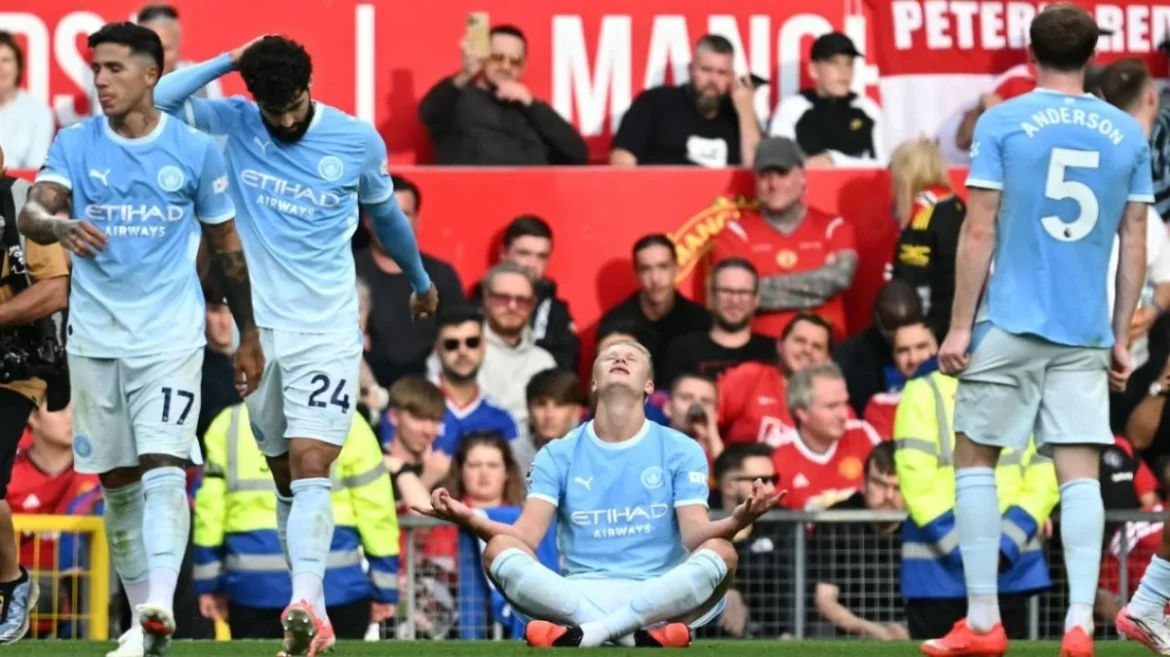
The fierce rivalry of the English Premier League added another unforgettable chapter on Sunday, September 13, 2026, as Manchester City secured a hard-fought 1-0 victory against arch-rivals Manchester United at Old Trafford. In a match filled with high drama, tactical battles, and near-misses, the defining narrative of the evening centered on Manchester City’s remarkable defensive resilience. Despite being reduced to 10 men for more than two-thirds of the match following a straight red card to influential midfielder Phil Foden in the 23rd minute, the visitors demonstrated championship mettle. A clinical second-half strike by prolific Norwegian striker Erling Haaland ultimately proved to be the decisive factor, silencing a packed and expectant Old Trafford crowd and cementing City’s status as early-season pacesetters in the 2026/2027 campaign.
Pre-Match Context and Tactical Setup
Entering this high-stakes Manchester Derby, both clubs carried distinct ambitions for the 2026/2027 Premier League season. Manchester United, under the continuous pressure to reclaim their former glory and establish dominance under their current tactical framework, deployed an aggressive line-up designed to exploit the wings and press high up the pitch. Key offensive threats such as Marcus Rashford, Matheus Cunha, and captain Bruno Fernandes were given the mandate to test a revamped Manchester City backline guarded by newly acquired Italian goalkeeper Gianluigi Donnarumma.
On the other side, Pep Guardiola’s Manchester City arrived in enemy territory with their trademark possession-based philosophy, though forced into strategic adaptations due to injuries and tactical rotations. The stage was set for a classic tactical chess match, but the early flow of the game was abruptly altered by a moment of intense competitive friction that transformed the afternoon from a standard fixture into a grueling test of survival for the visitors.
Chronology of the Match: From Open Exchanges to Early Red Card
The opening exchanges of the 2026 derby lived up to the billing, with both teams refusing to sit back. The pace was frenetic from the opening whistle, as Manchester United immediately signaled their intent. Diogo Dalot and Matheus Cunha orchestrated several dangerous moves down the flanks, putting early pressure on the City defense. Marcus Rashford also probed for openings, utilizing his pace to stretch the center-backs, yet Donnarumma stood firm, diffusing the initial waves of attack.
However, the definitive turning point of the first half occurred in the 23rd minute. In a fiercely contested fifty-ball near the touchline, Phil Foden lunged into a challenge with Bruno Fernandes. The referee justifiably judged the challenge to be dangerous, flashing a straight red card toward the England international. The dismissal forced Manchester City into an immediate tactical retreat, stripping them of one of their primary creative outlets and leaving them vulnerable to a rampant Manchester United side for the remainder of the fixture.

Despite the numerical disadvantage, Guardiola’s tactical discipline shone through. Instead of collapsing into a purely defensive block, City adapted by tightening their midfield triangles and prioritizing positional discipline over high-pressing intensity. They managed to absorb waves of pressure while intermittently retaining possession to frustrate their opponents.
As the first half drew to a close, Manchester United came agonizingly close to capitalizing on their extra man. In the 45th minute, Marcus Rashford stepped up to take a direct free-kick from a promising central position. His curling effort beat the defensive wall and left Donnarumma beaten, only to crash flush against the crossbar, letting City off the hook as the referee blew the whistle for halftime with the score deadlocked at 0-0.
Second-Half Drama, VAR Intervention, and the Decisive Goal
The second half commenced with the home side intensifying their offensive pressure. Manchester United recognized that playing against 10 men presented a golden opportunity to break their derby slump. Just five minutes after the restart, young midfielder Kobbie Mainoo unleashed a ferocious, goal-bound strike from outside the box that once again beat the City defense only to rattle the woodwork, hitting the post and bouncing away to safety. Further attempts from Rashford and Cunha kept the pressure firmly on the visitors’ goal, but the finishing touch remained elusive.
Football matches are frequently decided by fine margins and clinical efficiency, and Manchester City demonstrated precisely why they remain among Europe’s elite in the 60th minute. Left-back Josko Gvardiol advanced down the left flank, evading a challenge before delivering a pinpoint cross into the penalty area. Erling Haaland peeled away from his marker with trademark intelligence and slotted the ball past the United goalkeeper.
The celebrations were temporarily halted as the assistant referee raised his flag for offside. However, a lengthy and tense VAR review ensued at Stockley Park. Replays ultimately confirmed that Haaland had timed his run to perfection, remaining onside by a matter of inches. The goal was officially validated, stunning the Old Trafford faithful and putting the 10 men of City 1-0 ahead.
United’s Late Onslaught and Defensive Heroics
Trailing by a goal, Manchester United threw caution to the wind, committing more men forward in search of an equalizer. In the 68th minute, substitute Enzo Fernandez unleashed a spectacular long-range drive that had Old Trafford holding its breath, only for the ball to agonizingly strike the goalframe for a third time in the match, capping off a remarkably unfortunate afternoon for United’s attacking unit.

As the clock wound down, Bruno Fernandes and Bryan Mbeumo engineered several half-chances inside the final third, testing Donnarumma with sharp efforts and crosses into a crowded box. Yet, the Italian international proved his worth between the posts, commanding his area with authority and expertly dealing with every aerial and ground threat thrown his way.
Even with their numerical disadvantage, Manchester City retained a potent counter-attacking threat. Haaland continued to isolate United center-backs, creating opportunities to double the lead that ultimately went unconverted. Despite six minutes of stoppage time, the scoreline remained unchanged. When the final whistle blew, it confirmed a hard-earned 1-0 triumph for the visitors.
Statistical Breakdown and Tactical Implications
The post-match statistics highlight the unique nature of this derby encounter. Despite playing with 10 men for nearly 70 minutes, Manchester City managed to control key phases of the game through disciplined possession retention, neutralizing United’s attempts to overwhelm them. Manchester United will undoubtedly reflect on a match of what-ifs; hitting the woodwork on three separate occasions and dominating shot counts in certain phases will serve as a source of immense frustration for their coaching staff.
From a broader league perspective, this result carries significant implications for the 2026/2027 Premier League title race. Securing an away victory against a direct rival under such adverse conditions demonstrates the mental fortitude and tactical flexibility that define elite championship contenders. For Manchester City, this win solidifies their early momentum, injecting immense confidence into the squad as they navigate a demanding fixture schedule across domestic and European competitions.
Conversely, Manchester United faces critical questions regarding their clinical edge in the final third. While the performance showcased moments of fluid attacking play and high-intensity pressing—particularly in capitalizing on the red card—the inability to convert clear-cut chances and capitalize on the woodwork opportunities highlights areas requiring urgent attention if they are to sustain a top-four challenge. As the season progresses, this dramatic Sunday afternoon at Old Trafford will likely be remembered not just for the solitary goal by Erling Haaland, but as a masterclass in defensive resilience under extreme pressure.
