
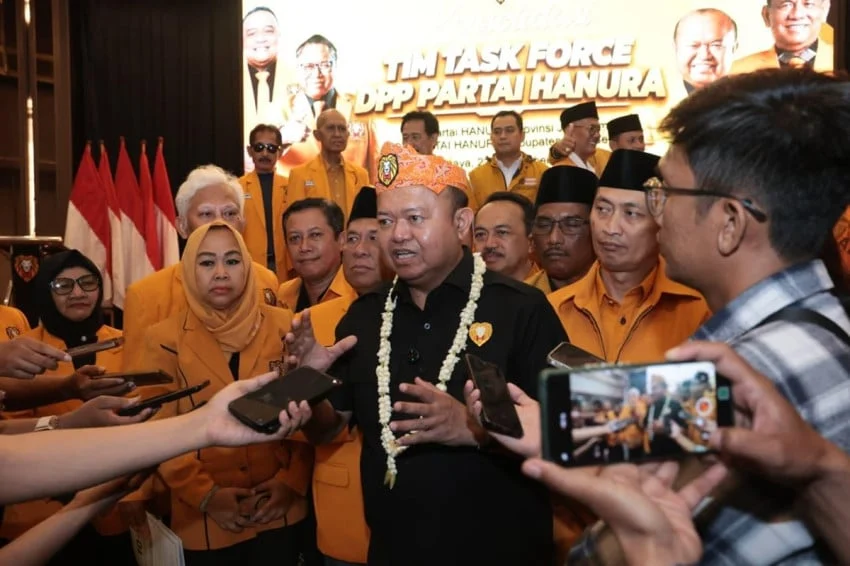
The political landscape in Indonesia is currently witnessing a significant debate regarding the mechanisms of presidential nomination, following the assertion by the Hanura Party that any attempt to restrict candidate eligibility through parliamentary support thresholds is legally flawed and democratically regressive. During a consolidation meeting of the Hanura Task Force for East Java, held at the Hotel Platinum Tunjungan, Surabaya, on Tuesday, September 22, 2026, the party’s Deputy Chairman, Patrice Rio Capella, explicitly rejected the burgeoning discourse suggesting that presidential and vice-presidential candidates must be supported by at least two factions within the House of Representatives (DPR).
This rejection stems from a fundamental disagreement over the interpretation of constitutional law, particularly concerning the legacy of the Constitutional Court’s (Mahkamah Konstitusi or MK) landmark rulings on presidential thresholds. As the nation prepares for upcoming electoral cycles, the friction between legislative proposals and judicial precedents has once again brought the integrity of the democratic process into the spotlight.
The Constitutional Basis of the Dispute
The core of the controversy lies in the interpretation of Law Number 7 of 2017 regarding General Elections. While the law has historically been the bedrock of electoral procedure in Indonesia, recent judicial activism by the Constitutional Court has fundamentally altered the terrain. The court has previously ruled that the presidential threshold (PT) should effectively be 0 percent, ensuring that every political party participating in the general election possesses the inherent right to nominate a presidential and vice-presidential pair.
Patrice Rio Capella argued that the introduction of a "two-faction requirement" is not merely an administrative hurdle but a potential violation of the spirit of the Constitutional Court’s mandate. By requiring support from two separate factions, proponents of the new discourse are effectively attempting to reintroduce a barrier to entry under a different guise. Capella labeled the suggestion as "unintelligent," emphasizing that the legal reality post-MK ruling is that parties function as independent legal entities capable of exercising their constitutional rights without being tethered to the political endorsements of other factions in the legislature.
Understanding the Role of Factions vs. Political Parties
To fully comprehend the gravity of the Hanura Party’s stance, one must distinguish between a political party and a parliamentary faction. In the Indonesian legislative system, a political party is the institutional vehicle for political expression, while a faction is a collection of members within the DPR who align themselves for legislative coordination.
The Hanura leadership argues that the right to nominate candidates is vested in the political party itself, as mandated by the constitution and affirmed by the judiciary. By shifting the requirement to "two factions," the discourse risks blurring the lines between the executive and the legislative branches. If a single party—which has met the requirements to participate in a national election—is denied the right to field a candidate simply because they cannot secure a second factional partner, the principle of political plurality is severely undermined.
Chronology of Electoral Reform Efforts
The debate over presidential thresholds has been a persistent theme in Indonesian politics for over a decade. Since the enactment of Law Number 7 of 2017, numerous stakeholders have challenged the threshold mechanisms, arguing that they favor established oligarchic structures and limit the emergence of alternative candidates.
- 2017: The passage of Law No. 7 of 2017 solidified a presidential threshold, requiring parties to have a certain percentage of seats in the DPR or a percentage of the popular vote in the previous legislative election to nominate candidates.
- 2023-2025: A series of judicial reviews were filed by various civil society organizations and political actors, urging the Constitutional Court to abolish the threshold entirely, citing its tendency to stifle competition and limit voter choice.
- Late 2025: The Constitutional Court delivered a series of rulings that effectively dismantled the rigid threshold requirements, signaling a shift toward a 0 percent threshold in practice.
- September 2026: Following these shifts, proponents within the legislature began floating the "two-faction" rule as a way to maintain some level of "order" or "coalescence" in the nomination process, leading to the current pushback from parties like Hanura.
Implications for the 2026-2027 Electoral Cycle
The implications of this debate are far-reaching. If the "two-faction" requirement were to gain traction, it would essentially institutionalize a "coalition-first" culture before the public even sees a candidate’s platform. This could lead to a scenario where minor parties are forced into subservient roles within larger coalitions, or where fringe parties are barred from participating entirely if they are deemed unpalatable by the parliamentary majority.

Political analysts suggest that such a move would be a setback for the "Reformasi" movement, which seeks to decentralize power and encourage greater public participation. If the legislative branch continues to attempt to circumvent judicial rulings by creating new, restrictive thresholds, it risks a constitutional crisis that could erode public trust in the electoral system.
Reactions from the Broader Political Spectrum
The stance taken by Hanura reflects a broader sentiment among smaller to mid-sized political parties that have felt sidelined by the traditional "big tent" coalitions. While some larger parties might favor the two-faction rule as a means to streamline the ballot and avoid an overcrowded field, smaller parties view it as an existential threat.
Meanwhile, other stakeholders, including civil society groups and legal experts, have echoed Hanura’s concerns. They argue that the focus should be on the quality of candidates and the clarity of platforms rather than the procedural barriers to entry. The push for "reform" within the DPR, as recently highlighted by leaders such as Puan Maharani, suggests that there is a growing recognition that the current legislative process is in need of a serious overhaul to regain public confidence. However, the definition of "reform" remains contested; for some, it means tightening rules to ensure stability, while for others, like Hanura, it means stripping away barriers to ensure democratic competition.
Analysis: The Path Forward
The conflict between the legislature and the Constitutional Court regarding presidential nomination rules is a defining feature of Indonesia’s maturing democracy. The primary argument in favor of a threshold is the prevention of political fragmentation and the promotion of stable government. However, the counter-argument, championed by Hanura, is that true stability comes from the legitimacy provided by open, fair, and inclusive elections.
By mandating a two-faction support system, the legislature would be effectively delegating the gatekeeping power of the state to the parties themselves, rather than to the voters. This creates a feedback loop where established parties decide who is eligible to run, potentially locking out new political movements and ideological alternatives.
As the government and the DPR continue to deliberate on the finer points of the election law, the pressure is mounting to reach a consensus that satisfies both the desire for an orderly election and the fundamental constitutional rights of the participants. For the Hanura Party, the path is clear: the law must reflect the 0 percent threshold spirit of the Constitutional Court, and any attempt to bypass this through "factional requirements" will be met with staunch opposition.
Conclusion
The controversy surrounding the potential "two-faction" rule for presidential nominations serves as a microcosm of the ongoing struggle to define the rules of the game in Indonesian politics. As Patrice Rio Capella noted in his address to the Hanura Task Force, the primary objective of any election law should be to facilitate the expression of the people’s will, not to act as a barrier to political participation.
With the next electoral cycle looming, the outcome of this dispute will likely influence the composition of the field of candidates and the overall health of the nation’s democratic institutions. Whether the legislature bows to the constitutional mandate or continues to seek creative ways to manage the electoral landscape remains to be seen. What is certain, however, is that the debate has brought to the forefront the critical need for a transparent, legally consistent, and inclusive framework that honors the judicial precedents set to safeguard the democratic rights of all Indonesian citizens.
