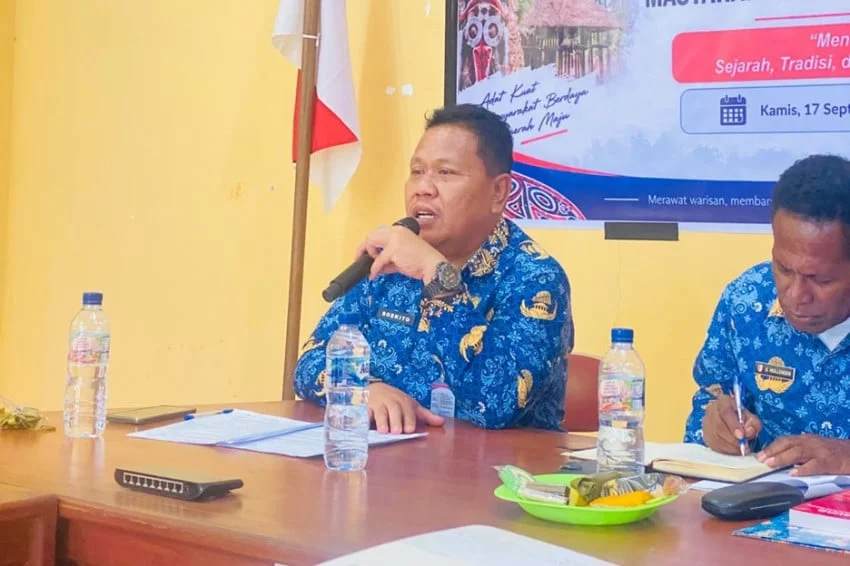
The administration of Merauke Regency, through the National Unity and Politics Agency (Badan Kesatuan Bangsa dan Politik/Kesbangpol), has initiated a strategic shift in its approach to regional governance by formalizing the role of customary institutions as primary partners in development and social stability. This policy shift was formally articulated during a discussion forum titled "Strengthening, Protection, and Participation of Customary Law Communities in Regional Development," held at the Merauke Kesbangpol headquarters on Thursday, September 17, 2026. By moving beyond the reactive practice of involving customary leaders only during times of crisis, the government aims to integrate traditional authorities into the proactive development planning process.
The Strategic Shift in Governance
The discourse surrounding the empowerment of customary institutions in Merauke is not merely a localized administrative decision; it reflects a broader national trend in Indonesia to reconcile modern governance with indigenous socio-political structures. Historically, in many parts of Papua, customary institutions (Lembaga Adat) have functioned as the primary custodians of land rights, social morality, and dispute resolution. However, these entities have frequently been sidelined in official government policy cycles, appearing only when administrative interventions fail to address inter-communal friction.
Sukito, the Head of the Merauke Kesbangpol, emphasized that the social capital inherent in traditional leadership is an underutilized asset. "Customary leaders possess an innate authority that is often more effective than formal legal mandates in maintaining peace at the grassroots level," Sukito stated. According to the government’s new roadmap, these leaders are to be treated as essential bridges between the state and the populace, facilitating a two-way flow of information that can preemptively address social grievances before they escalate into significant disturbances.
Chronology of Engagement
The recent forum organized by the Yayasan Merah Pusaka Stratejik Indonesia (MPSI) serves as a milestone in this policy transition. The event followed a series of smaller, community-level dialogues that began in early 2026, aimed at assessing the readiness of local customary structures to participate in government policy implementation.
- January–March 2026: Initial assessments conducted by the Kesbangpol regarding the capacity of local customary councils in the Merauke periphery.
- May 2026: Identification of potential friction points, including land tenure disputes and socio-economic disparities resulting from rapid regional infrastructure development.
- August 2026: Drafting of a framework for the "Strategic Partnership Program" with the assistance of local NGOs and civil society organizations like MPSI.
- September 17, 2026: Formal convening of the discussion forum to align government objectives with the traditional protocols of the local indigenous communities.
Data-Driven Governance and Social Stability
Merauke, as a significant agricultural and administrative hub in South Papua, faces unique socio-economic pressures. The regional government has been working to optimize land use for food security, a move that requires substantial cooperation from indigenous landowners. Data from the Regional Statistics Agency (BPS) indicates that the "peace index" in Merauke remains relatively high compared to other regions in Papua; however, the potential for land-use conflicts remains a persistent variable.
The integration of customary leaders into the planning process is, in part, a mechanism to mitigate the risks associated with large-scale development projects. By ensuring that traditional stakeholders are consulted during the feasibility stages of public works, the government hopes to avoid the legal and social delays that have historically plagued development in remote areas.
The Role of Multilateral Forums
The government’s strategy is not limited to customary institutions alone. The Kesbangpol has expanded its engagement architecture to include several key pillars:
- Forum Kerukunan Umat Beragama (FKUB): Dedicated to inter-religious harmony and dialogue.
- Forum Kewaspadaan Dini Masyarakat (FKDM): Focused on early detection of social threats and security risks.
- Forum Pembauran Kebangsaan (FPK): Aimed at fostering national unity among diverse ethnic groups residing within Merauke.
These forums form an integrated safety net. Sukito argued that the strength of this network lies in its ability to facilitate communication without relying on traditional bureaucratic hierarchies. "When we discuss security, we are not just talking about physical presence or policing. We are talking about the capability to read early warning signs—be it economic anxiety or social alienation—and addressing them through sustained dialogue," he explained.
Expert Analysis: Implications for Development
Political analysts observe that empowering customary institutions in Merauke could serve as a model for other regions in the newly formed autonomous provinces of Papua. The primary challenge, however, lies in the institutionalization of these partnerships. For the initiative to succeed, the influence of customary leaders must be codified in a way that respects their traditional mandates while ensuring accountability within the framework of national law.
The move to treat indigenous leaders as "strategic partners" rather than "consultants" shifts the burden of responsibility. It creates a collaborative environment where customary leaders are effectively co-owners of regional development outcomes. If effective, this could lead to a significant reduction in the costs associated with conflict management, allowing the government to reallocate resources toward sustainable economic initiatives, such as the ongoing agricultural optimization programs led by the local Department of Agriculture.
Addressing Future Challenges
Despite the optimistic outlook, the implementation phase will require navigating complex legal landscapes, particularly regarding the intersection of customary law (adat) and positive Indonesian law. Critics of similar programs in other regions have often pointed to the potential for "elite capture," where only a small segment of the traditional leadership benefits from government interaction.
To mitigate this, the Merauke government has committed to a transparent selection process for representatives in these forums, ensuring that participation is not limited to a select few, but represents the diverse interests of the various indigenous groups in the regency. The focus remains on "preventative diplomacy." By prioritizing the establishment of open channels of communication, the government aims to ensure that the current atmosphere of stability is not just maintained, but leveraged to improve the overall quality of life for the residents of Merauke.
Conclusion: A Sustainable Model for Papua
The initiative in Merauke represents a pragmatic evolution in governance. By acknowledging that administrative efficiency is insufficient without social legitimacy, the Merauke administration is positioning itself to be more resilient against the challenges of modern development. The success of this policy will ultimately depend on the consistency of the government’s engagement and the willingness of the customary institutions to adapt their traditional influence to the requirements of 21st-century regional governance.
As the Merauke government moves forward with this partnership, the eyes of other regional administrations will be on the efficacy of this collaborative model. If the integration of traditional authority into the formal planning cycle proves successful, it may offer a blueprint for reconciling the diverse socio-cultural landscape of Indonesia with the centralized requirements of regional progress, ultimately ensuring that development in Papua is not just economically viable, but socially inclusive and culturally respectful.