
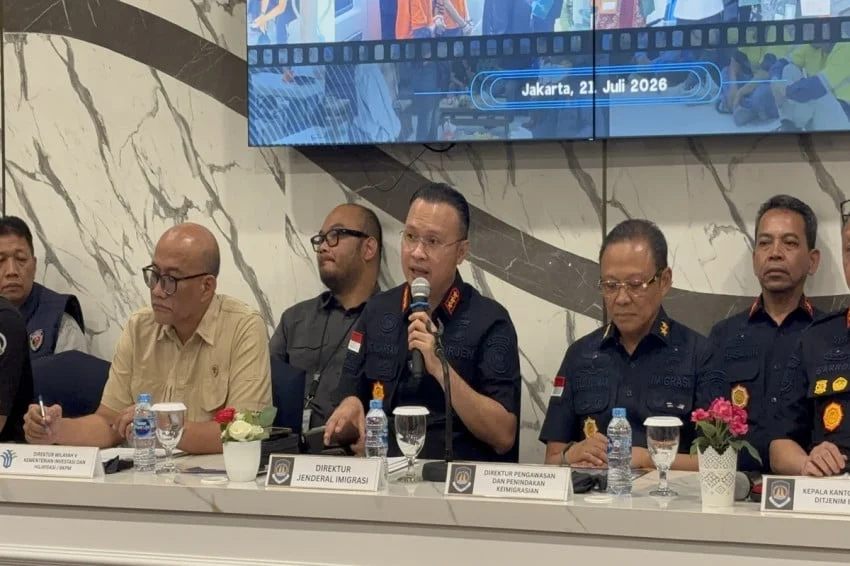
The Indonesian Directorate General of Immigration has successfully dismantled a sophisticated fraudulent investment ring involving ten foreign nationals who allegedly utilized fictitious corporate structures to secure residency permits. The suspects, hailing from Pakistan and Iran, were apprehended following an extensive investigation into their activities, which were found to be inconsistent with their declared status as high-value investors. Director General of Immigration Hendarsam Marantoko confirmed the arrests during a high-profile press conference held at the Directorate General of Immigration office in South Jakarta on Tuesday, July 21, 2026. This enforcement action underscores the government’s commitment to purging the country of foreign elements who exploit the national legal system to conduct illicit activities under the guise of legitimate business.
The group of foreign nationals is accused of committing serious immigration crimes by manipulating the requirements for the Limited Stay Permit (ITAS) for investors. Under Indonesian law, an investor visa is granted to individuals who contribute significantly to the national economy through capital injection and job creation. However, the investigation revealed that these ten individuals lacked the financial capacity and the genuine intent to operate businesses in Indonesia, effectively functioning as "fictitious investors." Their arrest marks a significant victory for immigration authorities in their ongoing efforts to maintain the integrity of Indonesia’s borders and its investment climate.
The Genesis of the Investigation: Anomalies in Tangerang
The investigation into the ten suspects began in November 2025, when intelligence officers from the immigration office noted significant irregularities regarding a group of foreign nationals residing in the Great Western Apartment complex in Tangerang. While the individuals possessed valid ITAS documentation categorized for investors, their lifestyle and choice of residence raised immediate red flags for field officers. Typically, foreign investors with the capital required to secure such permits—which often involves a minimum investment of billions of Indonesian Rupiah—reside in high-end districts or maintain corporate offices that reflect their purported economic status.
"The initial suspicion arose from a clear anomaly," Director General Hendarsam Marantoko explained during the press briefing. "They were residing in an apartment complex and maintaining a lifestyle that did not align with the profile of a legitimate large-scale investor. Our officers are trained to spot these discrepancies between the documentation provided and the reality on the ground."
Following the initial observations in late 2025, the Directorate General of Immigration initiated a comprehensive surveillance and audit operation. This "lidik" (investigation) and subsequent "penyidikan" (full investigation) involved cross-referencing the suspects’ financial records, corporate filings, and travel history. The goal was to determine whether the businesses they claimed to lead actually existed and whether the mandatory capital requirements had been met through legitimate banking channels.
Modus Operandi: Fraudulent Notary Deeds and Shell Companies
As the investigation deepened, authorities uncovered a complex web of deceit involving the fabrication of legal documents. One of the most damning pieces of evidence involved the creation of notary deeds for the establishment of their purported companies. Upon rigorous verification, immigration investigators discovered that several of the suspects were not even physically present in Indonesia on the dates the legal documents were allegedly signed in the presence of a notary.
"After conducting a detailed investigation, we found concrete evidence that these ten individuals had engaged in criminal acts as fictitious investors," Hendarsam stated. "A critical discovery was the misuse of notary deeds. We found that these documents were processed on dates when, according to our border crossing records, the foreign nationals were outside the country. This is a clear violation of legal procedures and indicates a deliberate attempt to circumvent Indonesian law."
This tactic is a common hallmark of "investasi bodong" or fraudulent investment schemes. By creating shell companies with fake capital declarations, foreign nationals can obtain long-term residency permits without actually contributing to the Indonesian economy. This not only undermines the immigration system but also poses a security risk, as it allows individuals with unknown backgrounds to remain in the country for extended periods under false pretenses. The suspects from Pakistan and Iran are believed to have coordinated this scheme to bypass the stringent vetting processes usually reserved for legitimate foreign workers and business owners.
Legal Framework and Immigration Violations
The ten suspects are currently facing charges under the Law No. 6 of 2011 concerning Immigration. Specifically, the misuse of a stay permit and the provision of false information to obtain immigration documents are severe offenses that carry penalties of imprisonment and heavy fines, followed by mandatory deportation and blacklisting from the country.
In Indonesia, the Investor ITAS (Index C313 or C314) is designed to attract foreign direct investment (FDI). To qualify, an individual must typically be a shareholder in a company (PT PMA) with a significant amount of paid-up capital. The Directorate General of Immigration works closely with the Ministry of Investment (BKPM) to ensure that these investors are genuine. However, the case of the ten Pakistani and Iranian nationals highlights a loophole where "paper companies" are used to satisfy the bureaucratic requirements without any actual business operations taking place.
The Director General emphasized that this case serves as a warning to other foreign nationals who might consider similar schemes. "We are not only looking at the validity of the passport or the visa sticker. We are looking at the substance of the stay. If you claim to be an investor, you must act as one, invest as one, and comply with all corporate and immigration regulations," Hendarsam added.
Broader Implications for Indonesia’s Investment Climate
The arrest of these ten individuals comes at a time when Indonesia is aggressively promoting its "Golden Visa" program and other initiatives to attract global talent and capital. While the government is eager to welcome legitimate investors, the rise of fictitious investment schemes threatens to tarnish the country’s reputation and could lead to more restrictive policies that might inadvertently affect genuine businesses.
From an economic perspective, fraudulent investors do not contribute to the Gross Domestic Product (GDP) or provide employment for Indonesian citizens. Instead, they often engage in the "grey economy," which can involve money laundering or other illicit financial flows. By weeding out these actors, the Directorate General of Immigration is protecting the interests of the state and the legitimate business community.
Industry analysts suggest that the use of "fictitious investors" is often a gateway for other organized crimes. When individuals can easily bypass residency laws, it creates a vacuum where unregulated activities can flourish. The swift action by Hendarsam Marantoko’s team is seen as a proactive measure to prevent such a vacuum from expanding.
Chronology of Events
To provide clarity on the timeline of this enforcement action, the following chronology has been established based on official statements:
- November 2025: Immigration officers in Tangerang identify suspicious activity at the Great Western Apartment involving several foreign nationals from Pakistan and Iran holding investor visas.
- December 2025 – March 2026: A period of covert surveillance and intelligence gathering. Authorities monitor the movements and financial activities of the suspects.
- April 2026: The Directorate General of Immigration coordinates with the Ministry of Law and Human Rights and the Ministry of Investment to audit the corporate filings associated with the suspects.
- May 2026: Discrepancies are found between travel records and the dates of notary deed signatures. Evidence of "absentee" company formation is secured.
- June 2026: Finalization of the case files and coordination with the prosecutor’s office regarding the criminal elements of the immigration violations.
- July 2026: The ten suspects are taken into custody during a coordinated raid.
- July 21, 2026: Director General Hendarsam Marantoko holds a press conference to announce the arrests and detail the fraudulent modus operandi.
Official Reactions and Future Preventive Measures
The announcement has prompted reactions from various sectors of the Indonesian government. Members of Commission III of the House of Representatives (DPR), which oversees legal and security affairs, have praised the Immigration Department for its vigilance. There are growing calls for a digital integration between the Directorate General of Immigration, the Ministry of Law and Human Rights’ AHU (General Legal Administration) database, and the Notary Association to prevent the backdating or fraudulent signing of corporate documents.
"We need a system where a notary cannot finalize a deed involving a foreign national unless the system verifies that the individual is currently within Indonesian territory," said a spokesperson for the Ministry of Law and Human Rights. "This case in Tangerang is a wake-up call that physical presence must be strictly verified against digital immigration records."
Director General Hendarsam Marantoko has signaled that his office will increase the frequency of "spot checks" and field audits for holders of Investor ITAS. The Directorate is also planning to deploy more specialized task forces to residential areas known to house large numbers of expatriates to ensure that stay permits are being used for their intended purposes.
Conclusion: A Commitment to Legal Integrity
The apprehension of the ten Pakistani and Iranian nationals serves as a definitive statement by the Indonesian government: the country remains open for business, but it is closed to those who seek to exploit its hospitality through deception. The "investasi bodong" scheme, while sophisticated in its use of legal documentation, was ultimately undone by the fundamental "anomaly" of the suspects’ lifestyles—a testament to the importance of traditional boots-on-the-ground intelligence in an increasingly digital world.
As the legal proceedings against the ten suspects move forward, the Directorate General of Immigration continues to refine its strategies to identify and neutralize similar threats. The focus remains on ensuring that every foreign national in Indonesia contributes positively to the nation’s growth and adheres strictly to the rule of law. For the ten individuals currently in custody, the path forward likely involves the full weight of Indonesian justice, followed by a permanent departure from the archipelago they attempted to defraud.
