
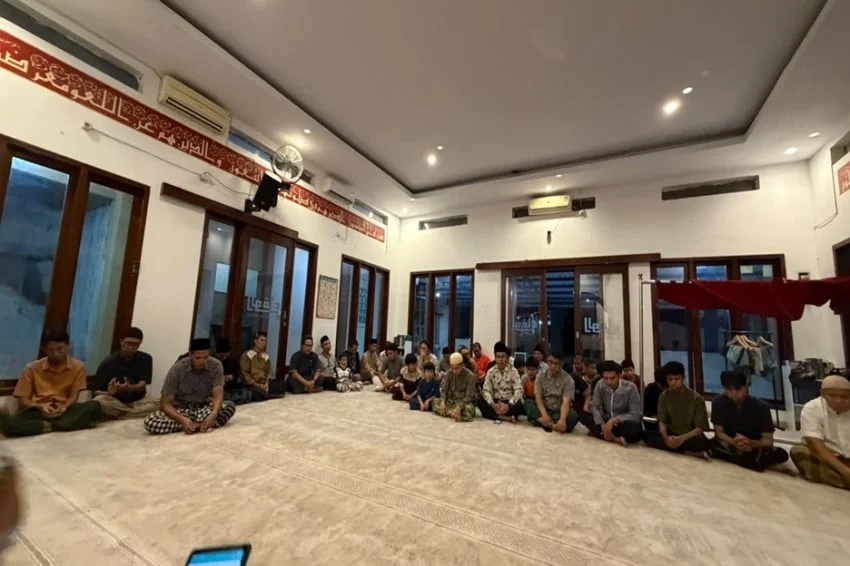
JAKARTA — An atmosphere of profound anxiety and collective hope enveloped the Nuansa Asri residential complex in Cinangka, Depok, West Java, as local residents, friends, and family members gathered to conduct a special prayer session. The religious gathering, held on Thursday evening, September 10, 2026, was dedicated to the safe return of Yudistiro Pranoto, a dedicated photojournalist with iNews Media Group, alongside the crew members of the speed boat who remain missing in the waters of the Sunda Strait.
The event took place at the Al-Wafa Mosque immediately following the Isya prayers. Participants filled the carpeted halls of the mosque, sitting in quiet contemplation with open hands raised in supplication. The collective sentiment among the attendees was unified and singular: a fervent hope that Yudistiro—affectionately known by neighbors as a dedicated professional—and his colleagues would be found safe and sound. Beyond personal appeals for Yudistiro, the prayers also extended to encompass the safety of fellow journalists and all maritime crew members who lost contact while on assignment covering the volcanic activities of Mount Anak Krakatau.
A Spontaneous Outpouring of Community Solidarity
The prayer service and istigosah—a traditional Islamic ritual of seeking divine help during times of distress—was organized on short notice as news of the maritime incident reverberated across the community. Hanes, the local neighborhood association (RT) head, noted that the community felt a moral obligation to rally behind the missing journalist’s family during this agonizing period of uncertainty.
"We invited all residents of this housing complex to hold a joint prayer and istigosah," Hanes stated, reflecting the heavy mood within the neighborhood. The spontaneous turnout underscored the high regard in which Yudistiro is held within his local community, where he is recognized not only as a diligent media worker but also as an active and valued neighbor.
The disappearance of the media crew has sent shockwaves through Indonesia’s journalistic community and the general public alike. As search and rescue operations enter critical phases, families of the missing individuals are left navigating an excruciating waiting game, sustained primarily by community solidarity and faith.
Background and Context of the Sunda Strait Incident
The unfolding tragedy traces back to a routine yet inherently hazardous journalistic assignment. Yudistiro Pranoto and a team of media personnel were deployed to cover the evolving geological activity of Mount Anak Krakatau, one of Indonesia’s most active and closely monitored volcanoes, situated in the Sunda Strait between the islands of Java and Sumatra.
Mount Anak Krakatau has historically posed significant navigational and environmental challenges. Eruptive phases often generate sudden maritime hazards, including localized tsunami waves, dense ash plumes, and extreme weather turbulence that can severely compromise maritime transport. The decision to deploy reporters to the region underscores the relentless commitment of media workers to document high-risk natural phenomena, often placing themselves in precarious environments to keep the public informed.
However, the maritime conditions in the Sunda Strait can deteriorate rapidly. On the fateful day of the incident, the vessel carrying the journalists and crew encountered severe difficulties, ultimately resulting in the vessel going missing and triggering a massive multi-agency search and rescue (SAR) operation.
Chronology of the Search and Rescue Operations
The search effort for the missing journalists and boat crew has involved a coordinated deployment of national assets, including the National Search and Rescue Agency (Basarnas), the Indonesian Navy, the Water Police, and marine conservation authorities.

According to preliminary timelines released by disaster management authorities, the alert was raised after the vessel failed to make scheduled check-ins following its departure into the Sunda Strait waters. Initial efforts to ping communication devices yielded no results, prompting an immediate deployment of patrol vessels and aerial surveillance teams to sweep the last known coordinates of the speed boat.
As the search widened across vast oceanic sectors influenced by strong currents and shifting winds, search teams encountered critical physical evidence. Among the most notable developments in the ongoing operation was the discovery of life jackets belonging to or associated with the missing personnel. The recovery of these items has become a focal point of forensic and tactical analysis for SAR teams, helping officials map potential drift patterns influenced by underwater currents in the Sunda Strait.
Despite the recovery of specific maritime gear, exhaustive sweeps by rescue boats and helicopters have yet to locate the main hull of the vessel or account for the whereabouts of the five journalists and crew members still listed as missing. Authorities have emphasized that search grids are continuously expanding based on oceanographic modeling, ensuring that every plausible drift scenario is thoroughly investigated.
Official Responses and Institutional Support
In the wake of the incident, executives and representatives from iNews Media Group, alongside broader journalistic umbrella organizations such the Alliance of Independent Journalists (AJI) and the Indonesian Journalists Association (PWI), have mobilized to support the affected families.
Institutional support has focused on maintaining open lines of communication with search and rescue coordinators, ensuring that families receive real-time updates regarding the progress of the operation. Psychological support services have also been made available to the families of Yudistiro Pranoto and his colleagues, who are enduring unprecedented emotional strain.
In official statements, media management has expressed deep concern and solidarity with the families, emphasizing that the safety and well-being of media personnel remain an overriding priority. Industry leaders have also called for heightened safety protocols and risk assessments for reporters assigned to high-hazard zones, particularly maritime environments prone to unpredictable meteorological and geological shifts.
Broader Impact and Implications for Media Safety
The unfolding crisis in the Sunda Strait has reignited a critical national discourse regarding the occupational hazards faced by field journalists in Indonesia. While military personnel, disaster mitigation teams, and scientific researchers routinely undergo rigorous safety training and operate under strict standard operating procedures (SOPs) in hazardous zones, media workers frequently find themselves navigating similar perils with varying degrees of maritime and tactical support.
Industry analysts and safety advocates point out that covering natural disasters—such as volcanic eruptions, earthquakes, and extreme weather events—requires specialized survival training, advanced communication gear, and reliable, seaworthy transport vessels equipped with real-time tracking systems. The disappearance of the iNews crew serves as a stark reminder of the physical tolls and risks embedded in frontline reporting.
Furthermore, the incident highlights the vital role of community resilience in supporting the families of frontline workers. While state-backed search and rescue operations provide the logistical muscle required to comb vast oceanic expanses, grassroots initiatives—such as the prayer gatherings held at the Al-Wafa Mosque in Depok—provide the emotional and spiritual anchoring necessary for families to endure moments of acute crisis.
As the search and rescue teams continue their relentless sweep of the Sunda Strait, the nation watches with bated breath. The collective prayers of neighbors, colleagues, and citizens across the archipelago reflect a shared yearning for a positive resolution, while simultaneously honoring the dedication of media professionals who risk their lives to document the forces shaping the natural world.
