
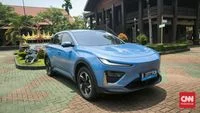
The global electric vehicle landscape has witnessed a dramatic restructuring as Hozon New Energy Automobile Company—the parent company of the struggling Neta Auto brand—prepares for a massive corporate rescue. According to financial disclosures and automotive industry reports, Zhejiang Taiyi Shanglian Enterprise Management Partnership has stepped forward to inject 3 billion yuan (approximately $425 million or Rp7.9 trillion) into the distressed automaker. This strategic acquisition is designed to settle long-standing debts, resurrect stalled production lines, and pivot the brand toward a streamlined future centered primarily on sport utility vehicles (SUVs).
The reorganization plan materialized during Hozon’s fourth online creditor meeting, following months of intense financial turbulence that had halted manufacturing and sparked profound uncertainty across international markets, including Southeast Asia. Under the terms of the draft reorganization agreement, Taiyi Shanglian will secure a controlling 70.6 percent stake in Hozon New Energy Automobile Company.
Background and Chronology of the Crisis
Hozon Auto’s path to insolvency was accelerated by fierce price wars within China’s domestic electric vehicle market, aggressive discounting by larger competitors, and overextended international expansion strategies. As cash reserves dwindled and liabilities mounted, the company was forced to suspend regular operations, leaving suppliers unpaid, assembly lines silent, and hundreds of thousands of vehicle owners wondering about the future of their warranties and software support.
The timeline of the restructuring process highlights the urgency with which creditors and investors sought a viable resolution:
- Early 2025: Zhejiang Shanzi Holdings Company and Zhejiang Shanzi Yuxu Technology Company established Zhejiang Taiyi Shanglian Enterprise Management Partnership specifically as a specialized management vehicle to evaluate distressed manufacturing assets.
- Mid-2025: Hozon’s financial distress peaked, prompting formal creditor meetings and temporary production halts at various manufacturing facilities.
- September 2025: During the fourth online creditor meeting, the comprehensive draft reorganization plan involving Taiyi Shanglian was formally unveiled to the public via industry publications such as Just Auto.
- January 2026: Neta Indonesia issued a public statement via social media channels anticipating that the parent company would finalize its complex restructuring framework by mid-2026.
Financial Breakdown of the Restructuring Package
The financial infusion of 3 billion yuan is meticulously partitioned to address both legacy obligations and future operational capabilities. Financial analysts tracking the transaction note that the capital allocation reflects a calculated attempt to balance creditor appeasement with aggressive business turnaround strategies:
- Debt Settlement and Bankruptcy Management (1.17 Billion Yuan / Rp3.1 Trillion): A significant portion of the incoming funds will be directed toward clearing old debts. This includes compensating creditors for retained core assets, covering administrative bankruptcy expenses, and managing the various legal and operational costs associated with the corporate restructuring process.
- Working Capital and Supply Chain Revival (1.83 Billion Yuan / Rp4.8 Trillion): The lion’s share of the investment will be funneled directly into Hozon as operational liquidity. This capital is earmarked for restarting manufacturing plants, procuring components to rebuild fractured supply chains, re-establishing comprehensive purnajual (after-sales) networks, and funding day-to-day corporate administration.
Strategic Pivot: Prioritizing SUVs and Core Assets
One of the most consequential elements of the Taiyi Shanglian reorganization draft is the surgical pruning of Hozon’s product portfolio and manufacturing equipment. To optimize capital efficiency and maximize market appeal, the company is shifting its manufacturing focus almost exclusively toward SUVs.
Equipment dedicated to the production of the Neta L and Neta X electric SUVs has been officially categorized as essential, core assets that will be fully retained and updated. Conversely, machinery and tooling utilized for building the Neta S and Neta GT sedans have been classified as non-core assets. These production lines are slated to be handled separately, effectively signaling Neta’s retreat from the high-performance sedan segment in the near term to concentrate its resources where consumer demand remains strongest.
The Three-Phase Recovery Roadmap
To ensure a methodical and sustainable revival, the reorganization plan outlines an ambitious three-phase operational roadmap:
- Phase One (Immediate Restart and Warranty Support): The primary objective of the initial phase is to resume baseline manufacturing operations with an initial annual sales target of 10,000 units, focusing heavily on the Neta X model. Simultaneously, the company will reactivate its domestic and international supply chains while restoring after-sales service frameworks to honor warranty claims for approximately 400,000 existing Neta vehicle owners globally.
- Phase Two (Scaling and Emerging Market Expansion): The second phase targets a dramatic ramp-up in production capacity, aiming for an output of 300,000 units per year. During this stage, Neta intends to engineer and deploy specialized electric vehicle models tailored explicitly for emerging markets across Asia, Africa, Latin America, and other high-growth regions.
- Phase Three (Global Smart EVs and Public Listing): The final phase involves the development of next-generation smart electric vehicles designed for worldwide distribution. Management projects that this mature stage will generate an annual output value of 40 billion yuan (Rp105.8 trillion) and lay the groundwork for an initial public offering (IPO).
Operational Implications and Status in Indonesia
The ripple effects of Hozon’s financial restructuring have been acutely felt in overseas markets, most notably in Indonesia, where Neta had established a notable commercial footprint by introducing models such as the Neta V, Neta V-II, and Neta X.
While the Neta X has been secured as part of the core manufacturing assets under the new ownership structure, the specific production future for the Neta V and V-II models remains omitted from the primary restructuring disclosures, raising questions about their long-term viability in overseas markets.
Local Indonesian operations underwent significant structural adjustments during the parent company’s insolvency crisis. Earlier in the year, Neta Indonesia announced strategic operational shifts, which included transferring its localized after-sales and maintenance services to third-party automotive service providers Otoklix and Anma Mobil, alongside the closure of several physical dealerships to curtail overhead expenses.
Manufacturing partnerships have also faced unavoidable disruptions. Jongkie D Sugiarto, Commissioner of Handal Indonesia Motor (HIM)—the local contract assembly partner responsible for producing Neta vehicles in Indonesia—confirmed that assembly activities at their facilities had been paused for approximately six months.
Jongkie, who also serves as Chairman I of the Association of Indonesian Automotive Industries (Gaikindo), emphasized that ultimate authority regarding the resumption of local production rests squarely with the brand’s authorized holder (APM). Despite the extended manufacturing pause, Jongkie noted that Neta maintains its official membership status within Gaikindo, indicating that industry stakeholders are maintaining a watchful eye on the brand’s revitalization process.
Broader Industry Implications
The acquisition of Hozon New Energy by Taiyi Shanglian serves as a textbook example of the ongoing consolidation within the global electric vehicle sector. As venture capital funding tightens and legacy automotive standards catch up to EV innovation, weaker market entrants are increasingly forced into bankruptcy, restructuring, or acquisition by deep-pocketed asset management firms and industrial conglomerates.
For consumers and industry observers, the successful injection of 3 billion yuan offers a vital lifeline to hundreds of thousands of existing vehicle owners who previously faced the prospect of orphaned technology and unfulfilled warranties. However, the true test for Neta Auto under its new management will lie in its ability to execute the three-phase turnaround strategy, rebuild consumer trust in competitive export markets, and carve out a profitable niche in an intensely crowded global automotive market.
