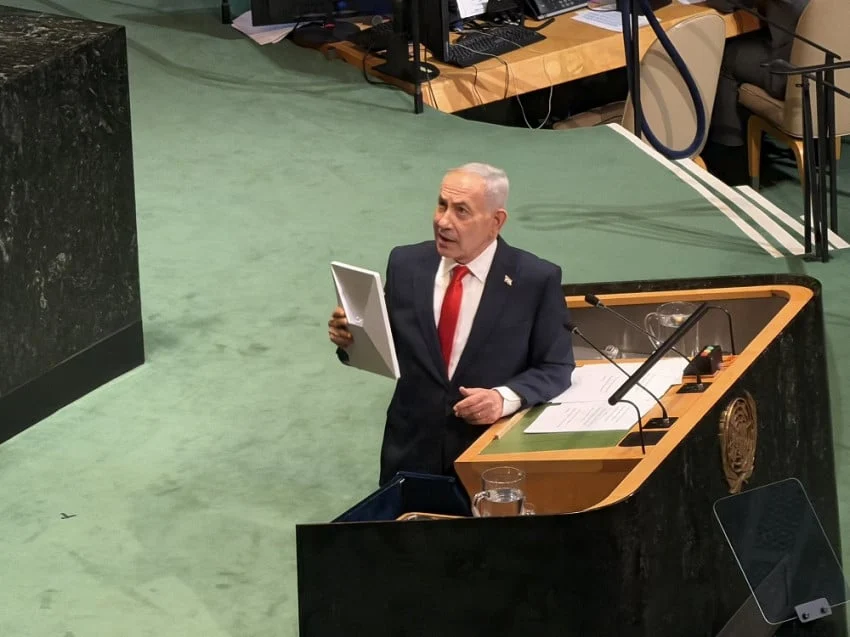
In a striking display of diplomatic defiance, nearly 70 delegations staged a mass walkout or deliberately left their seats vacant as Israeli Prime Minister Benjamin Netanyahu approached the podium at the 81st session of the United Nations General Assembly in New York. The protest, which occurred on Thursday, served as a potent visual rejection of Israel’s ongoing military operations in the Gaza Strip and the widening regional instability involving Lebanon and Syria. While the chamber was significantly depopulated as the Israeli leader began his address, the event underscored a profound fracture in international consensus regarding the Israeli government’s current security policies.
A Chronology of Diplomatic Tension
The atmosphere inside the UN General Assembly Hall was visibly charged as the session approached the time for the Israeli delegation’s address. The precedent for such protests at the United Nations is rare but not unprecedented; however, the scale of this specific walkout—involving dozens of nations across multiple continents—signifies a hardening of international positions.
As Prime Minister Netanyahu walked toward the podium, representatives from a diverse array of countries, including Turkey, Saudi Arabia, Indonesia, Iran, and Malaysia, stood up in unison and exited the hall. The exodus was not limited to Muslim-majority nations; delegates from Latin American countries like Brazil and Cuba, as well as representatives from several African and European states, also vacated their seats. In many instances, nations opted to leave only a junior diplomat or a low-ranking attaché in the seat to maintain the minimum presence required for diplomatic record-keeping, while the chairs of ambassadors and heads of state remained pointedly empty.
This act of protest follows a year of escalating military engagement that began with the October 7, 2023, attacks in Israel and has since evolved into a devastating conflict in Gaza, which the United Nations and various international human rights organizations have frequently characterized through the lens of humanitarian catastrophe.
Supporting Data and the Human Cost of Conflict
The diplomatic snub at the United Nations is deeply rooted in the staggering statistics emerging from the Gaza Strip. According to data provided by the Gaza Ministry of Health and corroborated by various UN agencies, the death toll in Gaza has surpassed 40,000 individuals, the vast majority of whom are women and children. The infrastructure of the enclave has been decimated, with reports indicating that over 70% of residential buildings have been destroyed or rendered uninhabitable.
Furthermore, the humanitarian crisis is compounded by the systemic collapse of healthcare and sanitation. The World Health Organization (WHO) has reported that only a fraction of Gaza’s hospitals remain partially functional, leaving hundreds of thousands of displaced persons without access to basic medical care. Beyond the immediate death toll, the threat of famine and the rapid spread of infectious diseases have drawn intense scrutiny from the UN Security Council and the General Assembly.
The regional implications have also intensified in recent weeks. Israel’s military focus has expanded to include intense airstrikes in Lebanon, targeting Hezbollah positions, which has displaced tens of thousands of civilians and raised fears of a full-scale regional war. These developments have alienated long-standing international partners and intensified the isolation of the current Israeli administration on the global stage.
The Voices of Dissent: Regional Perspectives
The coalition of nations participating in the walkout represents a wide spectrum of geopolitical interests, yet they were united by a shared critique of the Israeli government’s military strategy.
Turkey, which has been one of the most vocal critics of Israel’s actions in Gaza, issued a statement following the event, emphasizing that the walkout was a necessary response to what it termed "a disregard for international law." Similarly, the Arab League issued a collective sentiment through its member states, noting that the continued military campaign is incompatible with the prospect of a two-state solution.
Iran, a perennial adversary of Israel, characterized the protest as an inevitable outcome of "genocidal policies." Meanwhile, Indonesia and Malaysia, two nations with significant Muslim populations that have consistently advocated for Palestinian statehood, reiterated that their absence from the hall during the speech was a deliberate message to the international community that the status quo is no longer tolerable.
It is worth noting that while the walkout was extensive, it was not universal. Several Western nations, including the United States, remained in their seats, reflecting the enduring diplomatic alliance between Washington and Tel Aviv. This polarization highlights the growing divide between the "Global South," which has increasingly leveraged UN platforms to champion the Palestinian cause, and traditional Western power structures.
Analysis: The Implications for International Diplomacy
The diplomatic message delivered on Thursday carries significant implications for the future of the United Nations as a mediator of global conflict. By engaging in a mass walkout, the participating nations have essentially signaled that they no longer view the platform of the UN General Assembly as a space for dialogue with the current Israeli administration.
From a geopolitical perspective, this isolation could have long-term consequences for Israel’s standing in multilateral institutions. When nearly a third of the UN membership openly refuses to hear a head of state, the normative power of that leader is significantly diminished. This does not necessarily translate into immediate policy changes on the ground in Gaza, but it does erode the "soft power" that Israel relies upon to maintain its legitimacy in international forums.
Moreover, the event places the United Nations in a difficult position. The UN is designed to be a venue for negotiation, even between bitter adversaries. When the assembly effectively boycotts a member state, it challenges the organization’s core mandate of universality. Some analysts suggest that this event marks a shift toward a more confrontational era of multilateralism, where countries are increasingly willing to use symbolic protest to force issues of human rights and international law to the forefront of the global agenda.
The Path Forward: Challenges to Peace
As the 81st session of the General Assembly continues, the focus remains on whether the international community can pivot from symbolic gestures to substantive action. The primary challenge remains the lack of a viable ceasefire agreement. While negotiators from the U.S., Egypt, and Qatar have spent months attempting to bridge the gap between Israel and Hamas, the trust deficit remains insurmountable.
The Israeli government, for its part, maintains that its actions are necessary for the defense of its citizens and the eradication of threats posed by militant groups. Prime Minister Netanyahu’s speech was intended to defend these security objectives, yet the empty chairs in the hall provided a stark rebuttal to the narrative being presented.
As the conflict in the Middle East continues to evolve, the international community finds itself at a crossroads. The walkout was a manifestation of deep-seated frustration, but it also highlighted the failure of traditional diplomacy to resolve one of the world’s most intractable conflicts. Moving forward, the pressure on the UN to act as a more decisive arbiter will likely increase, as the divergence between national security strategies and global humanitarian standards continues to widen.
In conclusion, the events at the UN General Assembly on Thursday serve as a historic snapshot of a world increasingly divided by the conflict in Gaza. Whether this act of collective protest will lead to a shift in policy or further entrenchment remains to be seen. However, one thing is certain: the diplomatic landscape has been irrevocably altered by the images of empty seats, signaling a profound shift in the way the international community interacts with the ongoing crisis in the Middle East. As the global spotlight remains fixed on the region, the demand for accountability and a sustainable path to peace will only continue to grow, forcing a reckoning that the world’s leaders can no longer afford to ignore.