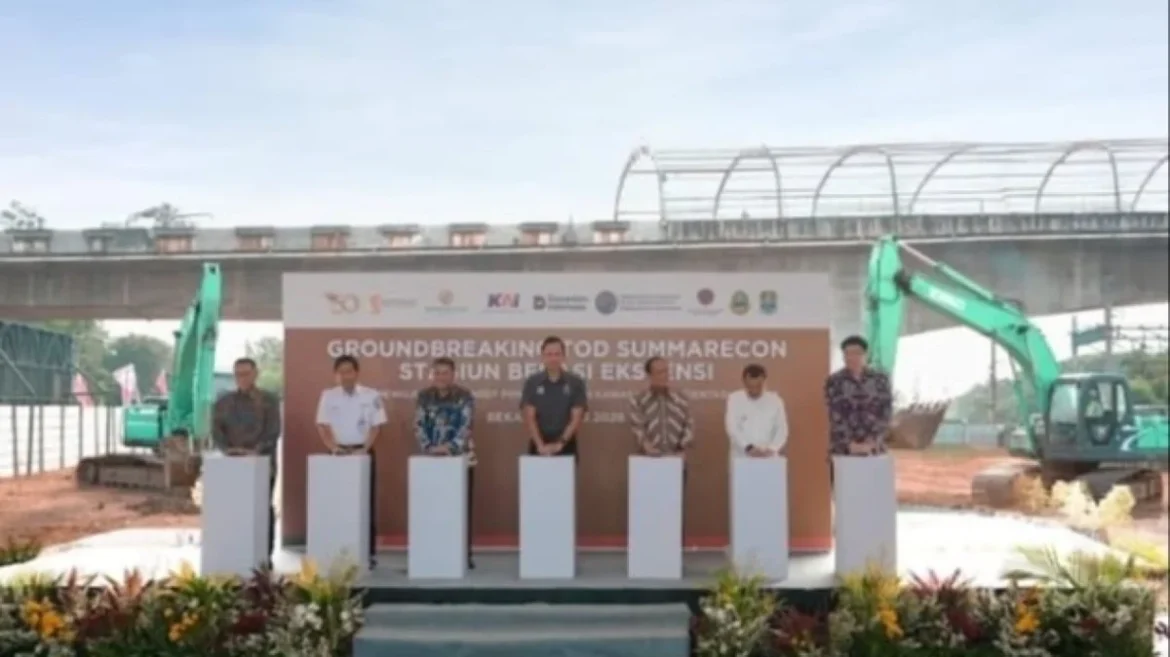
Bekasi, Indonesia – In a significant stride towards modernizing urban infrastructure and promoting sustainable urban growth, the Coordinating Minister for Infrastructure and Regional Development, Agus Harimurti Yudhoyono (AHY), presided over the groundbreaking ceremony for the Stasiun Bekasi Ekstensi on Saturday, July 25, 2026, at 16:05 WIB. This pivotal project is an integral component of the Transit-Oriented Development (TOD) initiative spearheaded by Summarecon, a prominent Indonesian property developer, marking a collaborative effort between the public and private sectors to redefine urban living and mobility in one of Greater Jakarta’s rapidly expanding satellite cities.
The ceremony, held amidst an air of optimism and anticipation, officially commenced the construction of the extended station facilities, designed to significantly enhance public transportation accessibility and efficiency for millions of commuters in and around Bekasi. Minister AHY underscored the strategic importance of this development, emphasizing that the Stasiun Bekasi Ekstensi transcends mere physical infrastructure. "We wholeheartedly welcome this initiative," AHY stated in his address, "because the development of Stasiun Bekasi Ekstensi is not just about building physical infrastructure. Our hope is that it will also become an increasingly productive area, supporting mobility, easing community activities, and its development aligning perfectly with the principles of Transit-Oriented Development (TOD) Indonesia." His remarks highlighted the government’s commitment to fostering urban environments that are not only well-connected but also economically vibrant and socially inclusive.
The Vision of Transit-Oriented Development in Jabodetabek
Transit-Oriented Development (TOD) represents a comprehensive urban planning strategy that concentrates residential, business, and leisure spaces around public transport hubs. The goal is to maximize the use of public transport, reduce reliance on private vehicles, and create walkable, mixed-use communities. In the context of Indonesia’s bustling Jabodetabek (Jakarta, Bogor, Depok, Tangerang, Bekasi) megalopolis, where traffic congestion is a perennial challenge, TODs are seen as a critical solution to enhance urban liveability, promote economic growth, and mitigate environmental impact. The Jabodetabek area, home to over 30 million people, faces immense pressure on its infrastructure, with daily commutes often consuming hours of residents’ time. Projects like the Stasiun Bekasi Ekstensi are crucial steps towards alleviating this burden by making public transportation more attractive and efficient.
The Stasiun Bekasi Ekstensi project within the Summarecon TOD framework is poised to serve as a model for future urban developments across the archipelago. It seeks to integrate residential zones, commercial centers, and public amenities seamlessly with the extended railway station, creating a vibrant ecosystem where people can live, work, and recreate without excessive travel. This integrated approach is expected to not only boost the local economy but also significantly improve the quality of life for Bekasi residents by offering convenient access to essential services and reducing their carbon footprint.
A History of Collaboration and Infrastructure Development by Summarecon
The partnership between the government and PT Summarecon Agung Tbk in this ambitious undertaking is not a new phenomenon. Summarecon has a well-established track record of contributing to Bekasi’s infrastructure development, demonstrating a long-term commitment to the city’s growth. Adrianto P. Adhi, President Director of PT Summarecon Agung Tbk, highlighted this legacy, stating that the Stasiun Bekasi Ekstensi project is a tangible manifestation of the synergy between the private sector and government in realizing transit-oriented development concepts.
Adhi recalled a significant prior contribution: "Previously, when we started the development of Summarecon Bekasi in 2010, Summarecon built the K.H. Noer Ali Summarecon Bekasi Flyover, spanning 1 kilometer." This crucial piece of infrastructure, built over the railway tracks, dramatically improved connectivity for residents on both the northern and southern sides of the railway, effectively alleviating persistent traffic congestion along Jalan Perjuangan. This earlier project demonstrated Summarecon’s capability and willingness to invest in large-scale infrastructure that benefits the wider community, setting a precedent for the current collaboration.
"We are grateful that today Summarecon has once again been given the opportunity to play a role in addressing the needs of the Indonesian people, particularly in the Bekasi region," Adrianto P. Adhi remarked. He further emphasized Summarecon’s dedication to collaborating with the government to enhance accessibility services, ensuring that the public enjoys greater ease and comfort in accessing mass transportation, specifically the railway system. This commitment underscores a shared vision for a more connected and efficient urban landscape.
Addressing Congestion and Enhancing Passenger Experience
One of the primary objectives of the Stasiun Bekasi Ekstensi is to mitigate the issue of passenger concentration and overcrowding at the existing Bekasi Station. Bekasi Station is one of the busiest commuter rail stations in the Jabodetabek network, serving hundreds of thousands of passengers daily. Its strategic location makes it a crucial interchange point for KRL Commuter Line services, connecting Bekasi to Jakarta and other satellite cities. However, with the rapid population growth in Bekasi and its surrounding areas, the existing infrastructure has been increasingly strained, leading to significant bottlenecks during peak hours.
Adrianto P. Adhi articulated how the new extension will address this challenge: "With the presence of Stasiun Bekasi Ekstensi as part of the Summarecon TOD, I believe that the people of Bekasi will be spared from passenger concentration and accumulation. Because Stasiun Bekasi Ekstensi, according to him, will serve passengers coming from the west and south, and the existing Bekasi Station will largely serve people from the north and east." This strategic division of passenger flow is expected to dramatically reduce waiting times, improve platform safety, and enhance the overall commuter experience. By decentralizing entry and exit points and optimizing passenger distribution, the project aims to create a more streamlined and comfortable journey for all users.
The enhanced capacity and improved operational efficiency brought about by the extension are critical for supporting the burgeoning population of Bekasi, which has seen substantial growth over the past two decades. According to recent demographic data, Bekasi City’s population has surpassed 2.5 million, with its metropolitan area reaching close to 10 million. This growth trajectory necessitates proactive infrastructure development to prevent future gridlock and ensure sustainable urban development.
Broader Implications and Stakeholder Reactions
The groundbreaking ceremony was not only attended by Minister AHY and the leadership of Summarecon but also by other key government officials, signifying the broad inter-agency support for the project. Among the dignitaries present were Wakil Menteri Perhubungan (Vice Minister of Transportation) Suntana, Wakil Gubernur Jawa Barat (Vice Governor of West Java) H. Erwan Setiawan, and Wakil Wali Kota Bekasi (Vice Mayor of Bekasi) Dr. H. Abdul Harris Bobihoe. Their presence underscored the multi-layered commitment from central, provincial, and local governments to this infrastructure initiative.
While specific statements from these officials were not detailed in the initial report, their participation at such a high-profile event allows for logical inference regarding their perspectives. Vice Minister of Transportation Suntana would likely emphasize how the Stasiun Bekasi Ekstensi aligns with the Ministry’s national transportation master plan, focusing on enhancing connectivity, integrating various modes of transport, and promoting public transit as a backbone for urban mobility. The Ministry of Transportation has long advocated for expanding railway networks and improving station capacities to cope with increasing demand, especially in the Jabodetabek area. This project would be seen as a crucial step in achieving those goals, contributing to a more robust and resilient national transportation system.
Vice Governor of West Java H. Erwan Setiawan would likely highlight the project’s significance for regional development within West Java. Bekasi is a key economic engine for the province, and improved infrastructure directly contributes to regional economic growth, attracts investment, and enhances the welfare of its residents. He would probably stress the provincial government’s support for initiatives that foster sustainable urbanization and improve inter-city connectivity, linking Bekasi more effectively to other parts of West Java and the wider Jabodetabek region.
Similarly, Vice Mayor of Bekasi Dr. H. Abdul Harris Bobihoe would undoubtedly focus on the immediate benefits for Bekasi City residents. He would emphasize how the extended station will directly address local traffic woes, improve daily commutes, and enhance access to employment, education, and healthcare facilities for the city’s populace. From a municipal perspective, the project represents a significant upgrade to local infrastructure, contributing to Bekasi’s vision of becoming a smart, green, and liveable city. The integration with the Summarecon TOD also suggests a forward-thinking approach to urban planning that maximizes land use and creates vibrant community spaces.
Economic, Social, and Environmental Impact
The Stasiun Bekasi Ekstensi and the broader Summarecon TOD project are expected to generate substantial positive impacts across multiple dimensions:
-
Economic Impact: The construction phase alone will create numerous job opportunities, stimulating local economies. Once operational, the enhanced connectivity and attractive urban environment will likely boost property values in the vicinity, attract new businesses, and encourage commercial activity around the station area. This will lead to increased local government revenue through taxes and contribute to the overall economic vitality of Bekasi. The improved efficiency in commuting can also translate into higher productivity for businesses and individuals.
-
Social Impact: The most direct social benefit will be the significant reduction in commuting times and an improvement in the overall quality of life for millions of residents. Less time spent in traffic means more time for family, leisure, and personal development. The TOD concept inherently fosters stronger community ties by creating walkable neighborhoods with integrated public spaces and amenities. Access to efficient public transport also promotes social equity, providing affordable and reliable mobility options for all segments of society, reducing reliance on expensive private vehicles.
-
Environmental Impact: By encouraging a shift from private cars to public transportation, the project is expected to lead to a noticeable reduction in traffic congestion, air pollution, and carbon emissions. This aligns with Indonesia’s national commitments to climate action and sustainable development goals. The compact, mixed-use nature of TODs also promotes more efficient land use, reducing urban sprawl and preserving natural areas. The integration of green spaces and pedestrian-friendly infrastructure within the Summarecon TOD further contributes to a healthier urban environment.
Adrianto P. Adhi encapsulated these multifaceted benefits, stating, "This initiative will support more efficient community mobility, improve regional connectivity, and create a more sustainable urban environment." His words underscore the holistic vision behind the project, aiming for a future where urban development is harmonized with environmental stewardship and social well-being.
The Path Forward
The groundbreaking ceremony, marked by the ceremonial pressing of a siren by the attending dignitaries, signifies the formal commencement of a complex yet transformative project. The successful execution of the Stasiun Bekasi Ekstensi and the Summarecon TOD will require sustained collaboration, meticulous planning, and efficient resource management. As construction progresses, various challenges, from land acquisition to complex engineering logistics, will need to be navigated. However, the strong political will and the proven track record of the private sector partner suggest a high likelihood of successful delivery.
This project is a testament to Indonesia’s ongoing commitment to modernizing its infrastructure and building smart, sustainable cities. It sets a precedent for how public-private partnerships can effectively address the complexities of rapid urbanization, providing a blueprint for future developments across the nation. The Stasiun Bekasi Ekstensi is more than just an expansion of a railway station; it is a vital component in the evolution of Bekasi into a more connected, productive, and liveable urban center, ready to meet the demands of the 21st century. As the steel rises and the tracks extend, the promise of a more efficient and integrated urban future for Bekasi draws ever closer.