
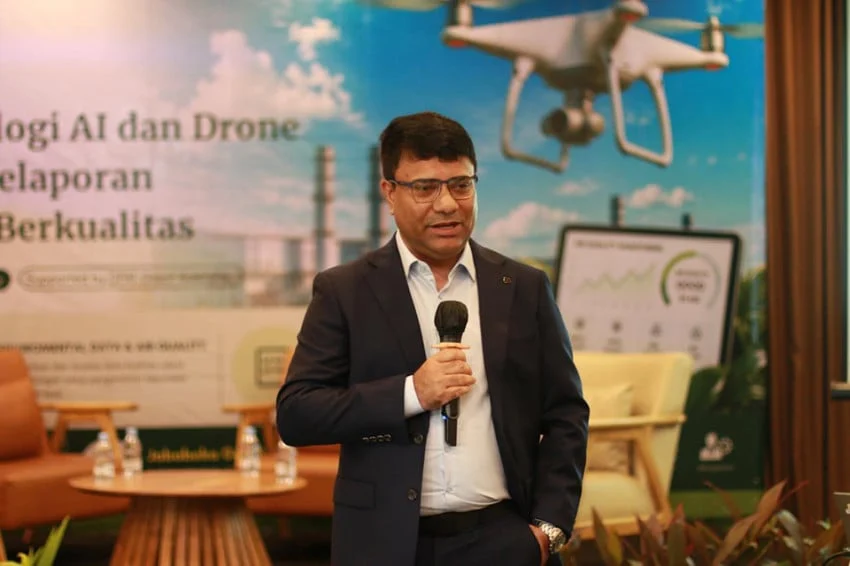
The intersection of academic research, industrial application, and technological innovation has become increasingly vital as global regulatory frameworks demand higher standards of corporate accountability. In a decisive move to address these mounting requirements, President University, the University of Southern Queensland (UniSQ) from Australia, and industrial township developer Jababeka have formally united to urge the broader industrial sector to bolster its sustainability management and corporate reporting frameworks. This collaborative initiative places a heavy emphasis on cutting-edge technological tools, specifically Artificial Intelligence (AI) and unmanned aerial vehicles, commonly known as drones, to ensure precision, reliability, and transparency in environmental data collection.
The strategic partnership is heavily bolstered by a prestigious Indonesia-Australia collaborative grant valued at approximately AUD 42,000. This financial backing was awarded by the Government of Australia through its Department of Foreign Affairs and Trade (DFAT). The allocation of these funds reflects the shared commitment of both nations to foster sustainable development, bilateral academic exchange, and industrial modernization within the Southeast Asian region. By combining Australian academic expertise with Indonesia’s rapidly expanding industrial landscape, the project seeks to bridge the gap between theoretical environmental science and practical, ground-level implementation.
Running officially from July through September 2026, this multi-phased program is meticulously designed to create a synergistic ecosystem where higher education institutions, technological developers, and industrial practitioners can collaborate. The ultimate objective is to drive environmental management toward a system that is not only compliance-ready but also deeply measurable and scientifically verifiable. As industrial zones like Jababeka continue to expand their manufacturing and operational capacities, the integration of smart technologies serves as a crucial catalyst for reducing ecological footprints while simultaneously enhancing long-term operational efficiency.
Beyond Traditional Compliance: The Two-Way Relationship Between Business and Environment
For decades, corporate sustainability was largely interpreted through a narrow lens—primarily viewed as a defensive strategy focused strictly on minimizing the negative environmental impacts generated by a company’s direct business activities. Corporate social responsibility initiatives and basic waste management protocols often constituted the entirety of an organization’s sustainability portfolio. However, modern environmental economics and corporate governance experts argue that this traditional paradigm is no longer sufficient to navigate the complex socio-ecological challenges of the twenty-first century.
Modern industrial operations must recognize that environmental sustainability is a two-way street characterized by a dynamic, reciprocal relationship between a corporation and its surrounding ecosystem. On one hand, companies alter landscapes, consume natural resources, and emit pollutants. On the other hand, rapid environmental changes, shifting weather patterns, and local ecological degradations directly impact business continuity. External environmental conditions can severely compromise worker health and safety, disrupt supply chains, cause operational downtime, invite regulatory penalties, and damage corporate reputation.
Consequently, modern enterprises must adopt a holistic risk-management approach that treats environmental factors as core business variables rather than peripheral concerns. By integrating advanced technological systems such as AI and drones into their daily oversight, industrial facilities can continuously monitor air quality, water discharge, soil integrity, and energy consumption in real time. This proactive stance allows management teams to anticipate environmental vulnerabilities before they escalate into costly operational crises, thereby safeguarding both local ecosystems and the financial health of the enterprise.
The Evolving Landscape of Sustainability Reporting in Indonesia
The push toward technological integration in environmental management is not merely a proactive choice for corporate excellence; it is rapidly becoming a legal and financial necessity driven by regulatory evolution in Indonesia. As global markets transition toward mandatory environmental, social, and governance (ESG) disclosures, domestic regulatory bodies are aligning national reporting standards with internationally recognized frameworks.
To prepare industrial players for these sweeping regulatory shifts, President University hosted a comprehensive specialized workshop on September 3, 2026. The event convened industry leaders, compliance officers, sustainability directors, and academic researchers to dissect the latest developments in sustainability reporting and explore how emerging technologies can streamline data collection and verification processes. A primary focal point of the workshop sessions was the detailed breakdown of PSPK 1 and PSPK 2. These represent the newly established standards for sustainability reporting in Indonesia, which explicitly adopt the globally standardized frameworks of IFRS S1 (General Requirements for Disclosure of Sustainability-related Financial Information) and IFRS S2 (Climate-related Disclosures).
The adoption of these rigorous reporting standards signifies a monumental shift in how Indonesian corporations must communicate their non-financial performance to investors, regulators, and the public. Under the upcoming mandates, environmental disclosures can no longer rely on anecdotal evidence, generalized estimates, or manually compiled spreadsheets that are prone to human error and potential greenwashing. Instead, companies must produce verifiable, highly granular, and scientifically sound environmental data that can withstand independent auditing.
This requirement for absolute data accountability creates an immediate technological bottleneck for many traditional manufacturing and industrial firms. Manual monitoring of vast industrial estates, such as those managed by Jababeka, is labor-intensive, time-consuming, and frequently inaccurate. Herein lies the core thesis of the President University-UniSQ-Jababeka collaboration: advanced technologies like AI and drones are no longer luxury additions for tech-heavy conglomerates, but foundational infrastructure required to generate audit-ready sustainability data ahead of the strict implementation deadlines slated for 2027.
Academic Insights: The Direct Correlation Between Disclosure and Corporate Value
The economic imperative for transparent and technologically backed sustainability reporting was further underscored by prominent academics involved in the bilateral partnership. Prof. Syed Shams from the University of Southern Queensland offered deep insights into how global capital markets evaluate corporate environmental disclosures. Speaking during the collaborative program’s engagements, Prof. Shams emphasized that transparency in environmental and sustainability matters is no longer a charitable endeavor or a secondary public relations exercise, but a primary driver of corporate valuation and financial resilience.
Drawing upon extensive empirical research within corporate finance and accounting, Prof. Shams explained that previous academic studies consistently demonstrate a powerful positive correlation between credible environmental disclosures and a firm’s overall market standing. When companies provide stakeholders with verified, transparent data regarding their resource management and climate risk mitigation strategies, financial markets respond favorably.
Specifically, credible environmental disclosures are clinically linked to three major financial advantages:
- Higher overall corporate valuation, as investors increasingly factor ESG readiness into their long-term equity pricing models.
- Lower costs of capital and financing, because institutional lenders, commercial banks, and international bond markets view transparent, sustainably managed firms as lower-risk borrowers. Consequently, these companies frequently secure more favorable interest rates and credit terms.
- Stronger expectations of future operational performance, signaling to the market that the management team possesses advanced foresight, efficient resource utilization practices, and robust risk-mitigation strategies capable of withstanding future market shocks.
Prof. Shams’s analysis highlights the reality that modern investors are actively reallocating capital away from opaque, high-risk industries toward transparent, technologically empowered enterprises. For Indonesian manufacturers operating within competitive global supply chains, failing to adopt rigorous, AI-driven sustainability reporting risks not only regulatory non-compliance but also severe capital starvation as international financiers tighten their lending criteria.
The Technological Arsenal: How AI and Drones Transform Environmental Management
To meet the stringent demands of IFRS S1 and S2 frameworks, industrial sectors must overhaul their data collection methodologies. The collaborative initiative championed by President University, UniSQ, and Jababeka specifically champions the deployment of artificial intelligence and unmanned aerial vehicles to automate and optimize environmental auditing.
Drones equipped with multispectral, thermal, and high-resolution optical cameras provide unprecedented aerial visibility over massive industrial complexes. Instead of relying on ground teams to manually inspect sprawling factory perimeters, waste treatment facilities, and surrounding watersheds, industrial operators can deploy autonomous drones to conduct regular aerial surveys. These devices can capture precise topographical data, detect unauthorized emissions, monitor vegetation health surrounding industrial zones, and map thermal anomalies indicative of energy inefficiencies or equipment overheating.
Once these vast quantities of spatial and visual data are captured, artificial intelligence steps in as the analytical engine. Machine learning algorithms can rapidly process terabytes of raw drone footage and sensor data, identifying subtle environmental patterns and anomalies that human analysts might easily overlook. AI-driven predictive models can forecast the dispersion patterns of industrial emissions under varying meteorological conditions, optimize waste-to-energy conversion processes, and ensure that water discharge parameters remain strictly within legal limits.
By automating the data pipeline from collection to analysis, companies eliminate the vulnerabilities associated with manual data entry. The resulting reports are robust, traceable, and entirely defensible against external regulatory scrutiny. This technological synergy transforms environmental management from a reactive, compliance-driven chore into an agile, data-driven operational strategy.
Broader Implications and the Road to 2027
As the collaborative program between President University, UniSQ, and Jababeka progresses through the third quarter of 2026, its broader implications for the Indonesian industrial sector are becoming increasingly pronounced. With the mandatory implementation of sustainability-based accounting standards scheduled for 2027, the window for industrial adaptation is rapidly closing.
The partnership serves as a vital blueprint for how higher education institutions can directly support national economic development by transferring advanced technological knowledge to the commercial sector. By leveraging international grants provided by the Australian Government through DFAT, the coalition has successfully established a platform for cross-border knowledge sharing, capacity building, and technological deployment.
Ultimately, the initiative proves that the future of Indonesian industry lies in the harmonious integration of advanced technology, rigorous academic research, and proactive corporate governance. As industrial giants and manufacturing hubs adopt AI-driven monitoring and drone surveillance, they are not merely ticking regulatory boxes to satisfy government mandates. Instead, they are future-proofing their operations, securing preferential access to international capital, protecting local ecosystems, and establishing a new benchmark for sustainable industrial development across the region.
