
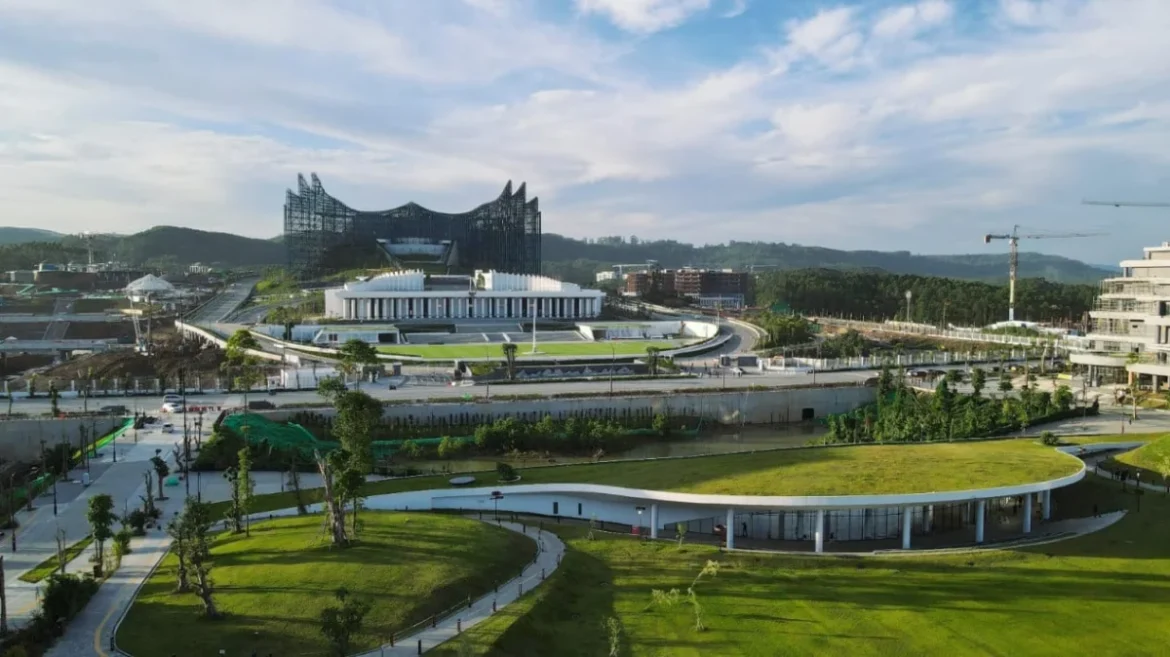
Jakarta, VIVA – The ambitious development of Ibu Kota Nusantara (IKN), Indonesia’s future capital, is demonstrating significant momentum, particularly as it advances into its critical Phase II. With an unwavering commitment to its strategic timeline, the Nusantara Capital City Authority (Otorita IKN) is intensifying efforts across a multitude of strategic projects, firmly aiming to establish IKN as Indonesia’s new political capital by 2028. This accelerated pace is a direct response to the mandate outlined in Presidential Regulation Number 79 of 2025, which sets out the comprehensive roadmap for the capital’s relocation and operationalization.
The commitment to this transformative national project is evident in the increasingly massive scale of infrastructure work currently underway. This vast undertaking involves a concerted effort from the government, state-owned enterprises, and a growing number of private investors. To ensure that every project adheres to its designated targets and quality standards, Otorita IKN conducts rigorous and routine evaluations, collaborating closely with relevant ministries, investors, and construction service providers. These coordination meetings are crucial for identifying and addressing potential bottlenecks, ensuring seamless progress in a project of unprecedented scale.
A recent pivotal evaluation meeting was convened on Tuesday, July 14, 2026, at the Multifunction Hall, Kemenko 1 Building, within the Core Government Area (KIPP) of IKN. This forum served as a vital platform for strategic coordination, allowing key stakeholders to align on various critical issues, review progress, and collectively devise solutions for any emerging challenges throughout the extensive construction process. Such regular assessments underscore the meticulous planning and adaptive management approach adopted by the Otorita IKN to navigate the complexities inherent in building a new capital from the ground up.
The Vision Behind Nusantara: A Smart, Green, and Sustainable Metropolis
The decision to relocate Indonesia’s capital from Jakarta to East Kalimantan stems from a multi-faceted strategy aimed at addressing the pressing issues facing the current capital and fostering more equitable national development. Jakarta, a megacity grappling with severe overpopulation, chronic traffic congestion, air pollution, and the existential threat of land subsidence exacerbated by rising sea levels, has long reached its carrying capacity. The move to Nusantara, meaning "archipelago" in Indonesian, symbolizes a national rebalancing, shifting the center of gravity towards the geographical heart of Indonesia and promoting development beyond Java.
Nusantara is envisioned not merely as a new administrative center but as a global model for a "smart, green, and sustainable forest city." Its master plan prioritizes environmental stewardship, aiming for 80% of its area to remain green space, integrating advanced urban technologies, and fostering a high quality of life for its future residents. The city is designed to be carbon-neutral by 2045, relying heavily on renewable energy sources, efficient public transportation, and smart infrastructure for waste management, water conservation, and digital governance. This ambitious vision aligns with Indonesia’s commitments to the Paris Agreement and its broader sustainable development goals. The legislative framework, particularly Law No. 3/2022 on the State Capital, provides the legal foundation for this monumental undertaking, establishing IKN as a special administrative region directly under the President, ensuring streamlined decision-making and implementation.
Decades of Discussion, Years of Action: A Brief Chronology
The idea of moving Indonesia’s capital has been discussed intermittently since the nation’s independence, with figures like Sukarno and Suharto considering various locations. However, it was under President Joko Widodo’s administration that the plan gained concrete traction.
- April 2019: President Joko Widodo officially announces the plan to relocate the capital.
- August 2019: The location in East Kalimantan is publicly identified.
- January 2022: The Law on the State Capital (Law No. 3/2022) is passed, legally establishing IKN and its special status.
- February 2022: The name "Nusantara" is officially announced.
- Mid-2022: Initial groundbreaking ceremonies commence for foundational infrastructure, marking the start of Phase I development.
- 2025 (as per Presidential Regulation No. 79/2025): The official target for a significant portion of core government functions to begin relocating.
- July 14, 2026: Latest high-level evaluation meeting by Otorita IKN to review Phase II progress.
- 2028: The critical target year for IKN to officially function as Indonesia’s political capital, with presidential offices, ministerial complexes, and basic residential facilities operational.
- 2045: The long-term vision for IKN to become a fully developed, smart, green, and globally competitive metropolis, coinciding with Indonesia’s centennial independence.
This detailed timeline underscores the rapid pace at which the project is being executed, reflecting a strong political will to realize the vision within a constrained timeframe.
Accelerating Development Through Diverse Funding Schemes
The acceleration of IKN’s development is facilitated by a robust financial strategy that leverages three primary funding schemes: the State Budget (Anggaran Pendapatan dan Belanja Negara – APBN), Public-Private Partnerships (Kerja Sama Pemerintah dengan Badan Usaha – KPBU), and direct private investment. This multi-pronged approach is essential for mobilizing the massive capital required for a project estimated to cost upwards of IDR 466 trillion (approximately USD 30 billion).
The APBN plays a crucial role in funding core government infrastructure, such as presidential palaces, ministerial offices, basic utilities, and essential access roads. This ensures that critical public services and administrative functions can be established without undue reliance on external financing.
The KPBU scheme is designed to attract private sector expertise and capital for projects with a clear commercial viability or public service mandate, such as certain transportation networks, social infrastructure like hospitals and schools, and public housing. This model shares risks and rewards between the government and private entities, fostering efficiency and innovation.
Crucially, direct private investment is being actively pursued for commercial developments, residential complexes, hotels, entertainment facilities, and technology parks. The Otorita IKN has been aggressively promoting IKN to both domestic and international investors, highlighting its strategic location, government backing, and the potential for significant long-term returns in a rapidly growing economic hub. Incentives, including tax breaks and simplified licensing procedures, are being offered to make IKN an attractive investment destination.
A Flurry of Projects: Otorita IKN and Ministerial Contributions
The scope of work at IKN is extensive, involving multiple government bodies coordinating their efforts under the overarching guidance of Otorita IKN. Currently, Otorita IKN is directly managing a total of 40 physical work packages. From this substantial number, 16 packages are actively being prepared to enter the crucial bidding and auction process, indicating a continuous pipeline of new construction activities.
Significant progress has already been made, with nine work packages successfully completed throughout 2025, demonstrating early achievements in the initial phases of development. Furthermore, 15 other packages are currently in various stages of construction, with their completion being vigorously expedited to meet the demanding deadlines. These ongoing projects encompass a wide array of vital infrastructure necessary to support the operationalization of the new capital, including:
- Government Core Buildings: Presidential palace, vice presidential palace, ministerial offices, parliament complex.
- Residential Facilities: Apartments and housing for civil servants, military, police, and general public.
- Essential Utilities: Water treatment plants, waste management facilities, power grids (with a focus on renewable energy).
- Road Networks: Internal city roads, connecting arteries, and pedestrian pathways designed for walkability and bikeability.
- Digital Infrastructure: Fiber optic networks, data centers, and smart city control centers to enable advanced urban management.
- Public Service Facilities: Early-stage schools, healthcare clinics, and markets to cater to the initial influx of residents.
These diverse projects form the fundamental bedrock upon which IKN will function as a national governmental center, aligning with the meticulously defined targets.
Beyond Otorita IKN’s direct purview, other key ministries are also contributing significantly to the overall development. The Ministry of Public Works and Public Housing (Kementerian Pekerjaan Umum dan Perumahan Rakyat – PUPR), a central player in national infrastructure development, is managing an impressive total of 90 work packages specifically for IKN. As of the latest reports, 78 of these packages have already been successfully completed, showcasing the ministry’s efficiency and capacity. The remaining 12 packages are actively under construction and are being prioritized for swift completion.
Among the strategic projects being handled by the Ministry of Public Works, some critical components include:
- IKN Toll Road: This vital artery will connect IKN to the existing national road network and major logistical hubs, significantly reducing travel time and facilitating the flow of goods and people. Its completion is paramount for accessibility.
- Duplication of Pulau Balang Bridge (Short Span): This project enhances a crucial access point to the new capital region, improving connectivity and capacity, especially for heavy vehicle traffic and logistical support during construction and beyond.
- Water Supply Infrastructure: Construction of reservoirs, dams, and distribution networks to ensure a sustainable and reliable water supply for the burgeoning city.
- Flood Control Systems: Implementation of advanced drainage and mitigation systems to protect the urban areas from potential flooding, a critical consideration in any major urban development.
In parallel, the Ministry of Housing and Settlement Areas (Kementerian Perumahan dan Kawasan Permukiman) is actively supporting the residential component of IKN, managing 12 specific work packages. These packages primarily focus on constructing diverse housing options, from high-rise apartments for government employees to various forms of public and private housing, ensuring that the necessary residential infrastructure is in place to accommodate the incoming population. Their efforts are crucial for creating livable communities and supporting the social fabric of the new capital.
Implications and Broader Impact
The rapid progression of IKN has far-reaching implications across economic, social, and environmental spheres.
Economic Implications:
- Job Creation: The construction phase alone is generating tens of thousands of jobs, providing significant economic stimulus to East Kalimantan and surrounding regions.
- Investment Hub: IKN is envisioned as a magnet for both domestic and foreign investment, not just in construction but also in technology, green industries, tourism, and services, creating a new economic growth pole.
- Regional Equity: By shifting the capital, Indonesia aims to decentralize economic activity from Java, fostering more balanced growth across the archipelago and reducing regional disparities.
- GDP Contribution: Once operational, IKN is expected to contribute significantly to Indonesia’s GDP through increased economic activity and innovation.
Social Implications:
- New Community Formation: The relocation will necessitate the creation of entirely new communities, requiring careful planning for social amenities, cultural integration, and public services.
- Quality of Life: The smart, green city concept promises a higher quality of life for residents, with access to clean air, green spaces, efficient public transport, and advanced digital services.
- Government Efficiency: A purpose-built capital can enhance governmental efficiency through integrated facilities and advanced communication systems.
Environmental Implications:
- Biodiversity Challenge: Building a city in a biodiverse forest area presents inherent environmental challenges, requiring stringent mitigation measures and a genuine commitment to the "forest city" principle.
- Sustainability Model: If successful, IKN could serve as a global benchmark for sustainable urban development, demonstrating how a large city can be built in harmony with nature.
- Renewable Energy Focus: The emphasis on renewable energy and eco-friendly infrastructure positions IKN at the forefront of climate-resilient urban planning.
Challenges and the Path Forward
Despite the significant progress, the IKN project is not without its challenges. Attracting sufficient private investment remains a key focus, as the government aims to minimize reliance on the state budget. Land acquisition, while largely completed, always carries sensitivities. Furthermore, ensuring the ecological integrity of the surrounding environment while construction proceeds at pace requires constant vigilance and innovative solutions. Experts from various fields, including urban planners and environmental scientists, consistently emphasize the need for robust oversight and adaptive strategies to overcome these hurdles.
The Head of Otorita IKN has consistently reiterated the unwavering commitment to the 2028 target, emphasizing the project’s national importance. "Our focus is not just on erecting buildings, but on crafting a living, breathing city that embodies Indonesia’s future aspirations," an official remarked recently, underscoring the holistic approach. "The continuous coordination with all stakeholders – from ministries to private sector partners – is paramount to ensure we not only meet our deadlines but also build a truly sustainable and smart capital for generations to come."
As July 2026 unfolds, the construction sites of IKN hum with activity, a testament to the nation’s resolve to build its future. With Phase II in full swing and critical deadlines approaching, the eyes of Indonesia, and indeed the world, are watching as Nusantara takes shape, poised to become a beacon of modern, sustainable urbanism and the proud new political heart of the archipelago by 2028, and a fully realized smart forest city by 2045.
