
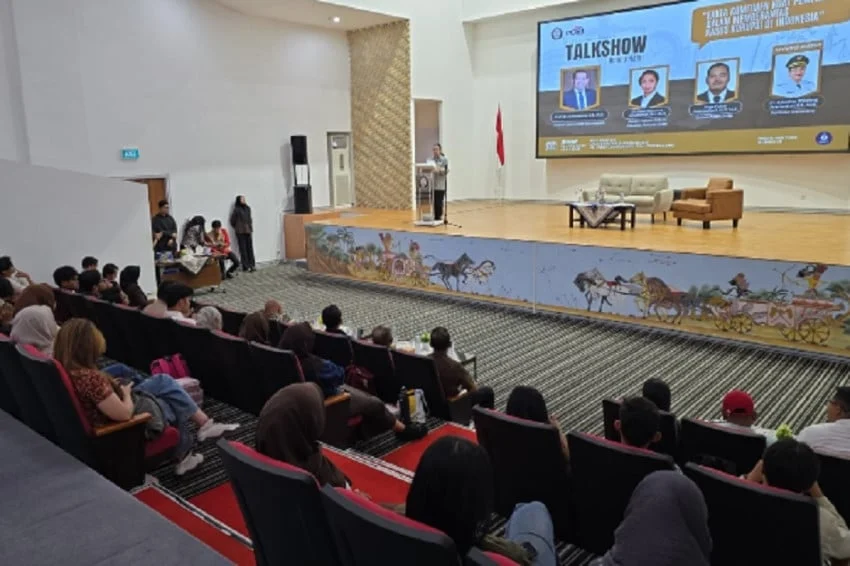
Addressing a pivotal discussion on the future of governance, Semarang Mayor Agustina Wilujeng Pramestuti issued a stern warning that corruption poses a significant impediment to human resource development and erodes the quality of public services. Her remarks, delivered during the "Ruang Nalar" talk show titled "Fakta Komitmen Kuat Pemerintah dalam Memberantas Kasus Korupsi di Indonesia" (Facts of Strong Government Commitment in Eradicating Corruption Cases in Indonesia) on Friday, July 24, 2026, at the Art Center Auditorium of Universitas Diponegoro (Undip), Semarang, underscored the urgent need for a unified front against graft. Mayor Pramestuti emphasized that effective anti-corruption efforts necessitate a shared commitment, underpinned by the principles of clean, transparent, and accountable public administration. This stance reflects a growing national resolve to tackle corruption, which continues to be a major challenge for Indonesia’s socio-economic progress.
Mayor Pramestuti’s Call for Integrated Anti-Corruption Strategies
Mayor Agustina Wilujeng Pramestuti articulated a comprehensive vision for combating corruption within the Semarang City administration. She detailed the proactive measures being implemented to strengthen prevention mechanisms. These include rigorous internal supervision, collaborative initiatives with national anti-graft bodies such as the Corruption Eradication Commission (KPK) and the Inspectorate, and a concerted push towards the digitalization of public services. The strategic pivot to digital platforms is designed to minimize opportunities for malfeasance by streamlining processes, enhancing transparency, and reducing direct human interaction where discretion can lead to corrupt practices. The Mayor’s emphasis on a multi-pronged approach — combining oversight, partnership, and technological innovation — illustrates a modern understanding of corruption prevention that moves beyond mere punitive measures to address systemic vulnerabilities. This proactive strategy is crucial for a rapidly developing urban center like Semarang, which serves as a vital economic and administrative hub in Central Java.
The Academic Perspective: Pillars of a Robust Anti-Corruption Framework
Echoing the Mayor’s sentiments, Gaza Carumna Iskadrenda, an esteemed academic from the Faculty of Law at Undip, provided an insightful analytical framework for effective corruption eradication. Iskadrenda posited that the fight against corruption rests on three fundamental pillars: robust legal and regulatory frameworks, efficient and independent law enforcement institutions, and a societal culture that unequivocally upholds integrity and ethical conduct. This tripartite model highlights that laws alone are insufficient without strong institutions to enforce them and a public ethos that rejects corruption.
Furthermore, Iskadrenda stressed the critical importance of consistency and seamless synergy among key law enforcement agencies, including the National Police, the Prosecutor’s Office, and the KPK, alongside active participation from civil society. He argued that such concerted efforts are indispensable for ensuring that justice is administered fairly and without prejudice, irrespective of an individual’s status or position. A crucial element often overlooked, according to Iskadrenda, is the robust protection of whistleblowers. He underscored the necessity of continuously strengthening mechanisms that safeguard individuals who report suspected corruption, recognizing them as vital allies in uncovering illicit activities and holding perpetrators accountable. Without adequate protection, potential whistleblowers may be deterred by fear of reprisal, thereby allowing corruption to fester in secrecy.
Indonesia’s Enduring Battle Against Corruption: A Historical Context
Indonesia’s journey in combating corruption is a long and complex one, deeply intertwined with its post-independence history and democratic transition. While efforts to curb corruption existed previously, the modern anti-corruption movement gained significant momentum following the fall of the New Order regime in 1998, a period often referred to as the Reformation Era. The public outcry against widespread corruption, collusion, and nepotism (KKN) led to fundamental institutional reforms. A landmark achievement was the establishment of the Corruption Eradication Commission (KPK) in 2002 through Law No. 30/2002. The KPK was conceived as an independent, ad-hoc body with broad powers to investigate, prosecute, and prevent corruption, particularly in cases involving high-ranking officials and significant state losses, which often eluded conventional law enforcement agencies.
Over the past two decades, the KPK has earned a reputation for its relentless pursuit of corrupt officials, leading to numerous high-profile arrests and convictions. However, its existence has not been without challenges, including legislative attempts to curtail its powers and budget, and internal pressures. Despite these hurdles, the KPK remains a cornerstone of Indonesia’s anti-corruption architecture, symbolizing the nation’s commitment to clean governance. Beyond the KPK, various government ministries and agencies have established internal integrity units and adopted measures to enhance transparency, reflecting a broader governmental commitment to institutional reform.
The Economic and Social Costs of Corruption in Indonesia
The impact of corruption on Indonesia’s development is profound and far-reaching. Economically, corruption siphons off vast amounts of public funds that could otherwise be allocated to critical sectors like infrastructure, education, and healthcare. Transparency International’s Corruption Perception Index (CPI) consistently places Indonesia in the lower half globally, indicating persistent challenges. For instance, in recent years, Indonesia’s CPI score has hovered around 34-38 out of 100 (where 100 is very clean), a stark reminder that significant work remains. This perception directly affects foreign direct investment (FDI), as investors are often wary of environments where red tape, bribery, and legal uncertainties inflate operational costs and risks. The World Bank and other international organizations have repeatedly highlighted that corruption can shave off several percentage points from a country’s annual GDP growth, hindering job creation and poverty reduction efforts.
Socially, corruption exacerbates inequality, as illicit gains often concentrate wealth in the hands of a few, while essential public services for the majority remain underfunded and inefficient. The very quality of human resources, as Mayor Pramestuti noted, is undermined when educational institutions are compromised by graft, or when healthcare systems are plagued by procurement irregularities and illicit fees. Public trust in government institutions, a vital component of a functioning democracy, erodes significantly when citizens perceive their leaders and public servants as corrupt. This erosion of trust can lead to civic apathy, reduced tax compliance, and even social unrest, ultimately destabilizing the fabric of society. The long-term implications include a brain drain as talented individuals seek opportunities in more transparent environments, further hindering national development.
Semarang’s Anti-Corruption Initiatives: A Local Model for National Aspirations
The Semarang City Government’s commitment to strengthening anti-corruption measures serves as a localized example of the broader national aspiration for good governance. The digitalization of public services, mentioned by Mayor Pramestuti, is a particularly potent tool. Initiatives such as e-licensing, e-procurement, and online grievance mechanisms not only reduce opportunities for face-to-face transactions that are vulnerable to bribery but also enhance efficiency and transparency. These digital platforms create an audit trail, making it harder for corrupt practices to go undetected and easier for oversight bodies to monitor compliance.
Furthermore, the collaboration with the KPK and Inspectorate reflects a pragmatic understanding that local governments often require external expertise and oversight to fortify their internal controls. The KPK, through its Directorate of Prevention, regularly conducts capacity-building programs, provides technical assistance, and offers guidance on implementing integrity systems for regional administrations. This partnership ensures that local anti-corruption strategies are aligned with national best practices and benefit from the KPK’s extensive experience and resources. The internal Inspectorate’s role, meanwhile, is crucial for continuous monitoring and early detection of potential irregularities within city departments, serving as the first line of defense against corruption.
Stakeholder Perspectives and Broader Implications
The call for collective commitment resonates deeply with various stakeholders. Civil society organizations (CSOs) in Indonesia have historically played a vital role in advocating for anti-corruption reforms, monitoring government actions, and educating the public. Groups like Transparency International Indonesia and Indonesia Corruption Watch (ICW) consistently push for stronger enforcement, greater transparency, and robust whistleblower protection. Their sustained advocacy ensures that anti-corruption remains a priority on the national agenda and holds government accountable. From the perspective of the business community, a clean and predictable regulatory environment is paramount. Corruption increases transaction costs, distorts competition, and creates an uneven playing field, deterring both domestic and foreign investors. A commitment to clean governance from local authorities like Semarang signals a more attractive investment climate, fostering economic growth and job creation.
Academics and researchers, beyond providing theoretical frameworks, also contribute through empirical studies, policy recommendations, and fostering a culture of integrity among future leaders. Universities like Undip are crucial in shaping public discourse and instilling ethical values in the younger generation. The general public, as the ultimate beneficiaries of good governance, expects efficient, fair, and accessible public services. Their active participation, through reporting corruption and demanding accountability, forms a critical layer of oversight that complements institutional efforts.
The implications of sustained anti-corruption efforts extend beyond mere compliance. A city like Semarang, successfully implementing clean governance, can become a model for other regional administrations across Indonesia. It can demonstrate that development and progress are achievable even in the face of widespread challenges, by prioritizing integrity and public interest. Such a model can help restore public faith in government institutions and inspire broader reforms.
Challenges and the Path Forward
Despite the clear commitment from figures like Mayor Pramestuti and the robust frameworks proposed by academics like Gaza Iskadrenda, the path to a corruption-free Indonesia remains arduous. Key challenges include maintaining political will across successive administrations, strengthening the independence and capacity of judicial bodies, and continually adapting to new forms of corruption facilitated by technological advancements. The protection of whistleblowers, while legally enshrined, often faces practical hurdles, requiring sustained commitment to enforce existing protections and create a truly safe environment for those who dare to speak out.
The long-term success hinges on fostering a pervasive culture of integrity, starting from early education and extending through all levels of society and government. This involves continuous public awareness campaigns, ethical training for civil servants, and the promotion of transparency as a fundamental principle of governance. It also requires sustained investment in technology and human capital for oversight bodies. The ongoing dialogue, as exemplified by the "Ruang Nalar" talk show, is crucial for maintaining momentum, sharing best practices, and collectively addressing the evolving nature of corruption.
In conclusion, Mayor Agustina Wilujeng Pramestuti’s unequivocal declaration in Semarang serves as a powerful reminder that corruption is not merely an ethical failing but a direct assault on human development and the quality of life for citizens. The collective commitment from government, law enforcement, academia, civil society, and the public, channeled through robust regulation, effective institutions, and an unyielding culture of integrity, is the only viable path to truly eradicate corruption and pave the way for a more prosperous, equitable, and just future for Semarang and for Indonesia as a whole.
