
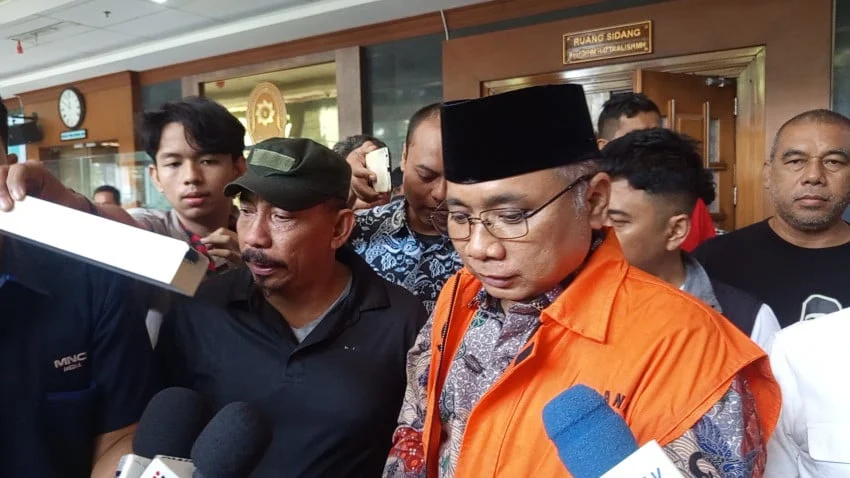
The courtroom of the Jakarta Corruption Court was filled with palpable tension on Tuesday, September 15, 2026, as former Minister of Religious Affairs, Yaqut Cholil Qoumas, confronted a former high-ranking ministry official during a high-profile hearing concerning the alleged corruption of the national Hajj quota allocation. Taking the floor to question the witness directly, the former minister issued a stern and emotionally charged reminder, stating that slander is far more cruel than murder. This dramatic exchange marks a critical juncture in an ongoing judicial process that has gripped the public’s attention, shedding light on the intricate administrative mechanisms and alleged abuses of power within the Ministry of Religious Affairs (Kemenag).
The focal point of the confrontation was Nur Arifin, the former Director of Hajj and Umrah Bina at the Ministry of Religious Affairs, who appeared before the panel of judges as a key witness. The heated dialogue between the defendant and the witness underscored the deep fissures and shifting testimonies surrounding how additional Hajj quotas were managed, distributed, and scrutinized during Yaqut’s tenure in office.
Background Context of the Hajj Quota Controversy
The corruption case centering on the Hajj quota allocation has evolved into one of the most significant legal battles involving the Ministry of Religious Affairs in recent years. At the heart of the litigation are decisions made regarding the distribution of special Hajj quotas (Penyelenggara Ibadah Haji Khusus, or PIHK), which dictate how pilgrims bypass standard, lengthy government queues through private travel operators.
Under Indonesian regulations, quota distribution must follow specific statutory frameworks to ensure transparency and fairness for the millions of citizens awaiting their turn to perform the pilgrimage in Mecca. However, investigators allege that policy deviations, unauthorized redistributions, and systemic irregularities resulted in financial losses to the state and sidelined rightful applicants.
The investigation gathered momentum over preceding months, culminating in sweeping inquiries into top-tier leadership and administrative handlers within the ministry. As the judicial proceedings unfolded through late 2025 and into 2026, prosecutors sought to map out the chain of command, attempting to establish whether administrative directives originated directly from ministerial leadership or were autonomously executed by agency bureaucrats.
Chronology of the Disputed Testimony
The courtroom confrontation on September 15, 2026, traced its roots back to a crucial piece of evidence recorded during the investigation phase: a Berita Acara Pemeriksaan (BAP)—an official police interrogation report—dating back to September 2025.
During the hearing, Yaqut Cholil Qoumas directed the court’s attention to specific statements made by Nur Arifin in the BAP. In that document, the former director testified that he had deliberately omitted the standard verification and cross-checking procedures for the names submitted by PIHK travel operators.
Reading directly from the transcript, Yaqut quoted the statement: "I did not carry out a check on the names proposed by the PIHK in accordance with the sequence because I already knew that the policy originated from Brother Isfah Abidal Aziz, alias Gus Alex, and Brother Yaqut Cholil Qoumas, alias Gus Yaqut or Gus Men."
This specific entry in the interrogation report had previously been flagged by prosecutors as an indicator of a top-down directive that bypassed routine bureaucratic oversight. By attributing the policy origin directly to the minister and his close associate, the BAP positioned the administrative failure not as a bureaucratic oversight, but as an intentional circumvention of the rules orchestrated at the ministerial level.
Seeking to challenge this narrative, Yaqut pressed the witness during the cross-examination. He demanded to know why Nur Arifin chose to bypass the fundamental verification steps, implying that shifting the blame onto political leadership was a convenient defense mechanism for career bureaucrats seeking to shield themselves from individual liability.

In response to the intense line of questioning, Nur Arifin defended his administrative record. The former director maintained that while direct, granular cross-checking of individual names might not have been executed personally in every instance, he maintained oversight through a structured delegation of authority. He argued that he had issued clear instructions and operational directives to his subordinates to manage the workflow, defending the institutional integrity of how tasks were assigned within the directorate.
Statements, Legal Strategies, and Counter-Claims
The defense teams and legal representatives associated with the former minister have consistently pushed back against the framing of the investigation. In earlier statements presented to the media and the court, representatives for Yaqut’s camp argued that the scope of the investigation has selectively targeted political appointees while failing to address systemic issues within the career civil service.
Weeks prior to the September 15 hearing, the defense highlighted that numerous individuals within the Ministry of Religious Affairs who allegedly benefited from or were directly implicated in the disputed quota allocations remain active in their positions. According to Yaqut’s legal camp, this retention of personnel points to a broader institutional practice rather than isolated criminal conspiracy orchestrated solely by the former minister.
Legal analysts observing the trial note that defense strategies in high-level corruption cases frequently pivot on deconstructing BAP testimonies. Defendants often attempt to demonstrate that statements given during initial law enforcement interrogations were made under pressure, misinterpreted, or framed in a manner that misrepresents standard bureaucratic delegation as illicit command structures.
By invoking the severe moral phrasing that "slander is more cruel than murder," Yaqut sought to elevate the discourse from a technical debate over administrative procedures to a defense of personal integrity and reputation. This rhetoric resonates deeply within the cultural and religious contexts of Indonesian public life, where accusations of corruption carry profound social and spiritual stigma.
Broader Implications for the Ministry of Religious Affairs
The ongoing trial carries wide-ranging implications for governance, administrative accountability, and public trust in religious institutions in Indonesia. The management of the annual Hajj pilgrimage is a massive logistical and financial undertaking involving billions of rupiah and affecting the religious fulfillment of citizens who wait decades for their departure.
Impact on Bureaucratic Culture
One of the most immediate systemic implications of the case is the chilling effect it has produced within the Ministry of Religious Affairs and other government bodies. Career bureaucrats and directors are now operating under heightened scrutiny, where routine policy discretions and ministerial instructions are subject to retroactive criminal investigation. This dynamic risks inducing bureaucratic paralysis, where officials become reluctant to make necessary administrative decisions or exercise discretionary authority authorized under emergency or special operational conditions.
Calls for Comprehensive Reform
Civil society watchdogs and anti-corruption organizations have seized upon the trial as evidence of the urgent need for structural overhauls in how national quotas are managed. Recommendations from transparency advocates include:
- Digitalization of Quota Allocation: Implementing transparent, algorithm-based tracking systems that eliminate human discretion in prioritizing specific travel operators or individual applicants.
- Standard Operating Procedure (SOP) Clarification: Clearly demarcating the boundaries between political policy-making by ministers and administrative execution by career civil servants.
- Independent Oversight Bodies: Establishing external monitoring committees comprising representatives from civil society, religious organizations, and anti-corruption agencies to oversee annual quota distributions.
Political Fallout
Politically, the trial serves as a high-stakes test for the accountability of former cabinet officials and the independence of the judiciary. As hearings continue through the autumn of 2026, the court’s eventual verdict will set a critical precedent regarding ministerial liability. It will determine whether top-tier executives can be held criminally responsible for administrative failures executed down the bureaucratic ladder, or if accountability must be strictly proven through an unbroken chain of documented illicit directives.
As the Jakarta Corruption Court prepares for subsequent sessions, public interest remains intense. The testimonies of witnesses like Nur Arifin and the robust defenses mounted by figures like Yaqut Cholil Qoumas will continue to shape the legal narrative of one of the most complex governance controversies in modern Indonesian history.
