
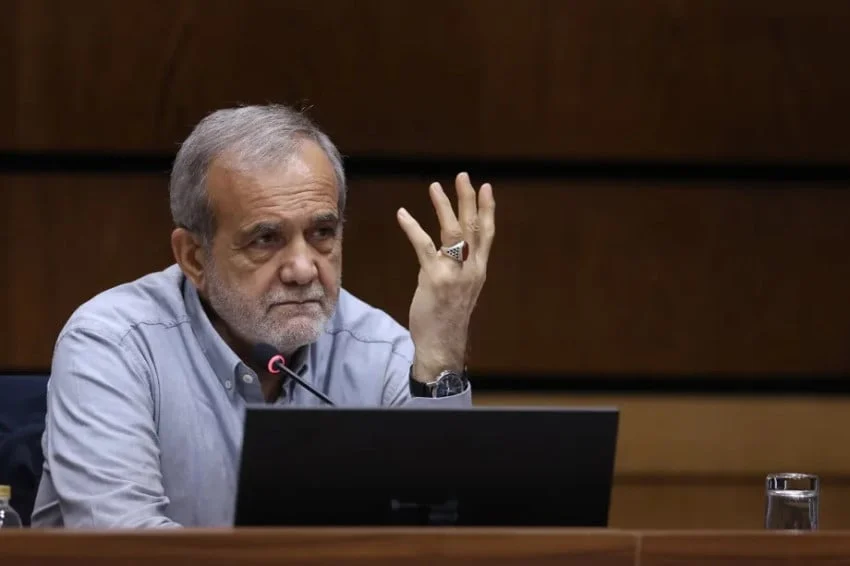
TEHRAN — In a significant policy signal regarding foreign relations and national security, Iranian President Masoud Pezeshkian stated on Friday that his administration does not support the continuation of war with the United States. Speaking during a high-level strategic meeting with university chancellors and academic leaders in Tehran, the Iranian president emphasized that while diplomatic escalation and military confrontation are not desirable outcomes for the Islamic Republic, the nation must systematically bolster its internal resilience to navigate upcoming geopolitical challenges.
The remarks, initially reported by the semi-official Mehr News Agency, arrive at a critical juncture in West Asian geopolitics. President Pezeshkian articulated a nuanced stance that balances an aversion to open-ended warfare with a pragmatic insistence on strategic self-sufficiency. According to transcripts of the address, the Iranian leader underscored that fortifying the country’s domestic infrastructure and economic foundations is essential to ensure that Tehran never enters prospective diplomatic negotiations from a position of systemic vulnerability.
The university gathering served as a platform for the executive branch to rally the nation’s intellectual capital, with Pezeshkian directly calling upon academic institutions to lend their research, expertise, and operational support to the government. By engaging the scientific and educational sectors, the administration aims to formulate calculated economic and social policies capable of withstanding external pressures without destabilizing domestic tranquility.
Geopolitical Background and Context of US-Iran Tensions
To fully contextualize President Pezeshkian’s remarks, it is necessary to examine the protracted history of hostility and diplomatic standoffs between Washington and Tehran. Decades of economic sanctions, proxy conflicts, regional rivalries, and the contentious history of Iran’s nuclear enrichment program have created a state of perpetual friction.
The modern phase of intense bilateral friction intensified dramatically in May 2018, when the United States unilaterally withdrew from the Joint Comprehensive Plan of Action (JCPOA)—commonly known as the Iran nuclear deal—and re-imposed sweeping economic sanctions under a "maximum pressure" campaign. This policy aimed to cripple Iran’s petroleum exports, isolate its banking sector, and force Tehran back to the negotiating table to secure a more restrictive agreement concerning both its nuclear ambitions and its regional missile development programs.
Over the subsequent years, tensions have frequently spilled over into direct and indirect confrontations. These include cyberattacks, maritime incidents in the Persian Gulf and the Strait of Hormuz, and kinetic engagements involving regional militias aligned with Tehran and U.S. forces stationed throughout the Middle East. The assassination of Islamic Revolutionary Guard Corps (IRGC) General Qasem Soleimani in January 2020 pushed the two nations to the brink of conventional military hostilities.
More recently, the eruption of the wider regional conflict following the October 7, 2023, attacks and subsequent Israeli military operations in Gaza and Lebanon have exponentially increased the risk of a broader regional conflagration. Iran and its "Axis of Resistance" network have engaged in calculated exchanges of fire with Israel and its Western allies, drawing direct warnings and military reinforcements from Washington. Within this volatile environment, President Pezeshkian—who assumed office in July 2024 on a platform advocating for constructive engagement with the international community and domestic economic reform—finds himself navigating a deeply polarized security landscape.
Chronology of Recent Developments
A chronological review of the events leading up to President Pezeshkian’s recent statements illustrates the rapid evolution of Iranian foreign policy and security posture:
- July 2024: Masoud Pezeshkian wins Iran’s presidential election, campaigning on a moderate platform that promises to seek the removal of crippling economic sanctions through renewed diplomatic engagement with Western powers, while maintaining the nation’s core defense strategies.
- September 2024: During the United Nations General Assembly in New York, President Pezeshkian signals Tehran’s readiness to lower regional tensions and re-engage with Western signatories of the JCPOA, provided the United States demonstrates a genuine shift in policy.
- Late 2024 to Early 2025: Escalating regional hostilities involving Israel, Lebanon, Yemen, and various regional militias prompt heightened military preparedness within Iran. Washington deploys additional naval strike groups and air defense assets to the Middle East to deter potential multi-front escalations.
- Mid-2025: Economic pressures mount inside Iran due to persistent inflation, currency devaluation, and the compounding effects of international sanctions. The administration faces mounting domestic pressure to stabilize living standards while managing external security threats.
- September 2026: President Pezeshkian delivers his address to university leaders in Tehran, explicitly stating his opposition to a prolonged war with the United States while emphasizing the necessity of absolute national preparedness and economic caution.
Economic Realities and Domestic Stability
A core component of President Pezeshkian’s address centered on the inextricable link between national security and domestic economic stability. The Iranian economy has borne the brunt of multi-layered international sanctions, leading to severe currency depreciation, high inflation rates, and challenges in the procurement of essential goods, including certain specialized pharmaceuticals.
Pezeshkian warned the academic leadership that economic policymaking cannot be conducted in a vacuum. He stressed that any measures implemented to counteract external pressures must meticulously account for existing social conditions. Uncalculated or hastily introduced economic adjustments, he cautioned, run the risk of exacerbating public hardship, alienating the populace, and ultimately undermining the very resilience the government seeks to construct.
This pragmatic approach reflects an awareness of past domestic unrest in Iran, where economic grievances frequently catalyzed widespread protests. By calling on universities to provide evidence-based policy solutions, the administration is attempting to institutionalize a more scientific, risk-managed approach to economic governance. This strategy aims to absorb external shocks without triggering internal socioeconomic fractures that adversaries could exploit.
The Strategy of Strategic Resilience and Rejection of Weakness
In his remarks, Pezeshkian elaborated on what "national resilience" entails in the context of ongoing geopolitical friction. He asserted that true deterrence is not merely a function of military hardware, but the culmination of economic stability, social cohesion, and institutional competence.
By stating that strengthening the country must not lead to a scenario where Iran is forced to negotiate from a position of weakness, Pezeshkian outlined a clear red line for future diplomacy. Tehran has long maintained that it remains open to dialogue, but rejects talks framed by coercion or ultimatums. The insistence on negotiating from strength indicates that the Iranian leadership views domestic capacity-building—ranging from technological advancement to food and energy security—as a prerequisite for any future diplomatic breakthrough with Washington or its European allies.
This posture presents a dual message to the international community. Externally, it signals that Iran cannot be easily coerced into unilateral concessions through military intimidation or economic blockades. Internally, it rallies political factions and civil society around the concept of self-reliance, framing national endurance as a collective responsibility shared by the government, academic institutions, and the broader citizenry.
Regional and International Implications
The reiteration by a high-ranking Iranian official that Tehran seeks to avoid protracted conflict carries profound implications for regional stability in the Middle East. For months, international diplomats, particularly intermediaries in Europe and the Gulf Cooperation Council (GCC), have worked frantically to prevent localized skirmishes from devolving into a catastrophic all-out war between the United States, its regional allies, and Iran.
Pezeshkian’s public reluctance to engage in extended warfare may offer a diplomatic opening for de-escalation channels. Nations such as Qatar, Oman, and Iraq—which have historically served as conduits for indirect messaging between Washington and Tehran—may interpret these remarks as a signal of strategic fatigue regarding open-ended hostility, thereby encouraging renewed behind-the-scenes diplomatic engagement.
Conversely, skepticism remains high among Western policymakers. Observers in Washington and European capitals often draw a distinction between the rhetorical output of Iran’s elected executive branch and the operational decisions of the Islamic Revolutionary Guard Corps (IRGC) and the broader security apparatus overseen by Supreme Leader Ayatollah Ali Khamenei, who retains final authority over all strategic state matters. Consequently, while Pezeshkian’s statements are noted as a positive indicator of diplomatic preference, Western defense and intelligence analysts continue to monitor Iranian military maneuvers, proxy network activities, and nuclear enrichment trajectories for tangible shifts in policy.
Broader Impacts on Global Energy Markets and Security
The perpetual tension between the United States and Iran remains a primary risk factor for global commodity markets, particularly international crude oil supplies. The Strait of Hormuz, a vital maritime chokepoint situated directly off Iran’s southern coast, handles approximately one-fifth of the world’s petroleum consumption. Any prolonged military escalation involving the U.S. and Iran invariably raises fears of shipping disruptions, driving up global energy prices and exacerbating inflationary pressures worldwide.
By publicly distancing his administration from the prospect of prolonged war, President Pezeshkian seeks to mitigate some of these systemic anxieties, reassuring regional neighbors and global markets that Tehran’s baseline preference is for strategic containment rather than uncontrolled military escalation. However, the realization of this objective depends heavily on reciprocal restraint from Washington and its regional partners, as well as the unpredictable dynamics of an increasingly militarized West Asian landscape.
As Iran prepares for the complex geopolitical developments of the coming years, the success of Pezeshkian’s strategy will be measured by the administration’s ability to translate academic research into actionable economic policy, maintain internal social stability under the weight of sanctions, and deter external aggression without stumbling into an unwanted total war.
