
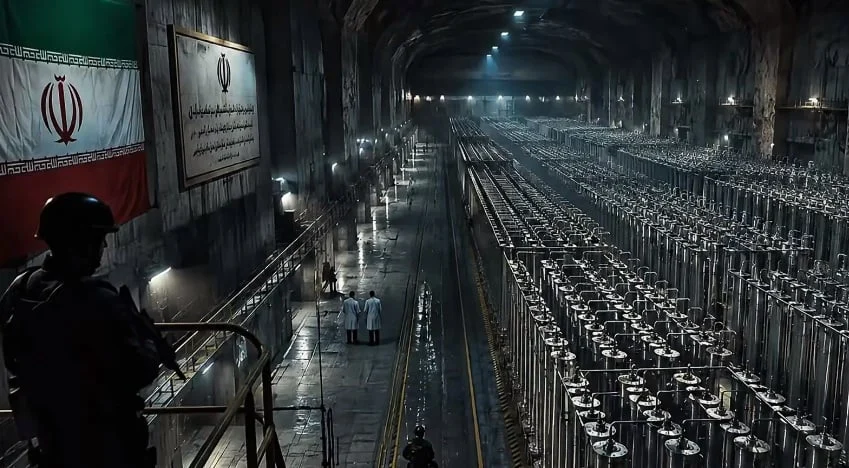
President Donald Trump has intensified his rhetoric regarding Iran’s nuclear program, signaling a potential military strike against the "Mount Pickaxe" facility, a deeply buried subterranean complex that international intelligence agencies believe houses Tehran’s most sensitive nuclear assets. The President’s statements have shifted global attention toward this secretive site, which Israeli intelligence suggests is being used to store significant portions of Iran’s enriched uranium stockpile and its most advanced enrichment centrifuges. On Tuesday, President Trump underscored the administration’s readiness to act, stating that the United States is likely to "strike that area soon" and asserting that Tehran would be powerless to prevent such an operation.
In immediate response to these assertions, the Iranian government issued a stern warning through state-controlled media outlets on Wednesday morning. Tehran officials declared that any American or allied military intervention targeting their nuclear infrastructure would be interpreted as a declaration of total war, potentially triggering a massive escalation that would engulf the entire Middle East. This exchange of threats marks a significant peak in the long-standing shadow war between Washington, Jerusalem, and Tehran, bringing the prospect of direct kinetic conflict closer than it has been in decades.
The Strategic Significance of Mount Pickaxe
The facility, known locally as Kuh-e Kolang Gaz La—which translates to Mount Pickaxe—is situated in a central, mountainous region of Iran. According to reports from the Institute for Science and International Security (ISIS) and satellite data analyzed by CNN, the site is located approximately one mile south of the Natanz uranium enrichment complex. Natanz has historically been the centerpiece of Iran’s nuclear efforts and has frequently been the target of sabotage, cyberattacks, and previous aerial bombardments by the U.S. and Israel.
Mount Pickaxe was designed specifically to rectify the vulnerabilities exposed at Natanz. While the Natanz facility is partially underground, it remains susceptible to advanced "bunker buster" munitions. In contrast, the Mount Pickaxe site is buried at an estimated depth of at least 100 meters (328 feet) beneath a massive mountain of solid rock. This depth makes it one of the most difficult targets in the world for conventional air strikes. Military analysts suggest that even the most powerful non-nuclear explosives in the U.S. arsenal, such as the GBU-57 Massive Ordnance Penetrator (MOP), would face significant challenges in completely neutralizing a facility protected by such a vast amount of overhead cover.
The construction of the facility reportedly began in late 2020. At the time, Iran informed the International Atomic Energy Agency (IAEA) that the site was intended to serve as a replacement for a centrifuge assembly workshop at Natanz that had been destroyed in an explosion earlier that year. However, Western intelligence services have long suspected that the site’s true purpose is far more expansive, potentially serving as a "fail-safe" enrichment plant that could continue to operate even under a sustained air campaign.
Engineering and Defensive Infrastructure
The mystery surrounding Mount Pickaxe is compounded by the lack of publicly available blueprints or internal schematics. Experts have had to rely almost exclusively on high-resolution satellite imagery to piece together the facility’s capabilities. These images reveal a massive logistical operation characterized by several tunnel complexes and a sprawling security perimeter.
A key feature identified by ISIS is the presence of four distinct entrances, all of which have been heavily reinforced with thick layers of specialized concrete and steel. These portals are positioned at angles designed to deflect the blast pressure from near-misses by precision-guided munitions. Furthermore, the internal tunnel system is believed to be arranged in a "zigzag" or labyrinthine pattern to prevent a single successful hit on an entrance from sending a shockwave deep into the heart of the facility.
Recent satellite data suggests that construction at Mount Pickaxe has accelerated significantly over the past twelve months. This surge in activity appears to be a direct response to a series of high-profile attacks on Iranian nuclear infrastructure in June 2025. Following those incidents, which targeted the Natanz enrichment complex and several research laboratories, Tehran reportedly diverted massive resources to Mount Pickaxe to ensure that its "crown jewels"—the advanced IR-6 and IR-9 centrifuges—could be moved to a more secure environment. While the facility is believed to be nearing completion, experts currently debate whether it has reached full operational status.
A Chronology of Nuclear Escalation
The development of Mount Pickaxe is the latest chapter in a decades-long timeline of nuclear tension:
- 2020: Iran begins excavation at Kuh-e Kolang Gaz La following a series of mysterious explosions at the Natanz facility. Tehran claims the site is for "civilian" centrifuge assembly.
- 2021-2023: Satellite imagery shows the removal of massive amounts of spoil (excavated rock), indicating the creation of a very large underground volume. The depth is estimated to exceed 100 meters, far deeper than the Fordow enrichment site.
- 2024: Intelligence reports suggest that Iran has begun installing ventilation systems and power infrastructure capable of supporting industrial-scale uranium enrichment within the mountain.
- June 2025: A coordinated wave of strikes, attributed by Tehran to the U.S. and Israel, causes significant damage to the above-ground and shallow-subsurface portions of the Natanz complex.
- Late 2025 – Present: Iran accelerates the transfer of nuclear materials and sensitive equipment to the deeper Mount Pickaxe site. President Trump begins publicly identifying the mountain as a primary target for U.S. military action.
Military Challenges and Technical Realities
The prospect of striking Mount Pickaxe presents a unique set of challenges for the U.S. Department of Defense. Standard precision-guided munitions, such as the 2,000-pound GBU-31, are ineffective against a target buried 100 meters deep. The U.S. Air Force’s primary tool for such a task would be the GBU-57 MOP, a 30,000-pound behemoth carried by B-2 Spirit or B-21 Raider stealth bombers.
However, even the MOP has its limits. If the rock of Kuh-e Kolang Gaz La is particularly dense granite, multiple successive hits on the exact same GPS coordinates would be required to "drill" through the mountain to reach the bunkers below. This would require the U.S. to maintain total air superiority over one of the most heavily defended pieces of airspace in the world for an extended period. Iran has reportedly surrounded the site with a dense network of S-300 and domestically produced Bavar-373 surface-to-air missile systems to counter such an attempt.
Beyond kinetic strikes, the U.S. and Israel have historically utilized cyber warfare, such as the famous Stuxnet virus, to disable Iranian centrifuges. However, analysts believe that the "air-gapped" nature of the Mount Pickaxe facility—meaning its internal computers are not connected to the outside internet—makes it a much more difficult target for digital sabotage than previous iterations of Iranian nuclear sites.
Official Responses and Diplomatic Fallout
The international community has reacted with a mixture of alarm and calls for restraint. The IAEA has expressed "deep concern" regarding the lack of transparency at the Mount Pickaxe site, noting that their inspectors have been denied full access to the deepest sections of the tunnels. "The absence of verifiable data regarding the equipment being installed at this location creates a vacuum of information that fuels regional instability," a spokesperson for the agency stated.
In Washington, the administration’s rhetoric has found support among some hawks in Congress who argue that allowing Iran to complete a "bomb-proof" nuclear facility would permanently shift the balance of power in the Middle East. Conversely, critics argue that a strike on Mount Pickaxe would not only fail to destroy the program entirely but would also provide Tehran with the ultimate justification to withdraw from the Non-Proliferation Treaty (NPT) and openly pursue a nuclear weapon.
Tehran’s response has been one of "strategic defiance." Iranian military commanders have suggested that any strike on their sovereign territory would result in the closure of the Strait of Hormuz, through which a significant portion of the world’s oil supply passes. "If our security is threatened, the security of the global energy market will cease to exist," a senior advisor to the Iranian Supreme Leader warned.
Broader Implications for Global Security
The standoff over Mount Pickaxe is not merely a bilateral issue between the U.S. and Iran; it has profound implications for global security and the economy. If military action is taken, the immediate ripple effects would likely include:
- Surge in Energy Prices: Any conflict in the Persian Gulf would lead to an immediate and dramatic spike in crude oil prices, potentially destabilizing the global economy.
- Regional Proxy War: Iran’s "Axis of Resistance," including Hezbollah in Lebanon, the Houthis in Yemen, and various militias in Iraq and Syria, would likely launch retaliatory strikes against U.S. bases and Israeli population centers.
- Nuclear Proliferation: A failure to stop the Mount Pickaxe facility through diplomacy or limited force might prompt neighboring states, such as Saudi Arabia, to pursue their own nuclear deterrents, leading to a nuclear arms race in the world’s most volatile region.
- Shift in Geopolitical Alliances: The crisis may force world powers like China and Russia to take a more active role in the region, potentially providing Iran with advanced air defense technology or diplomatic cover at the UN Security Council.
As the construction at Mount Pickaxe nears its final stages, the window for a diplomatic resolution appears to be closing. The "fortress under the mountain" represents more than just a nuclear site; it is a symbol of Iran’s determination to insulate its strategic capabilities from foreign interference and a testament to the escalating stakes of modern geopolitical conflict. Whether the U.S. chooses to follow through on President Trump’s threats or continues a policy of containment remains the most critical security question facing the international community today.
