
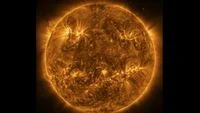
The history of our solar system is far more violent and dynamic than previously understood, according to groundbreaking research that suggests our central star may have engaged in planetary cannibalism during its formative years. A team of astronomers has uncovered compelling chemical and structural evidence indicating that the Sun swallowed a massive "Super-Earth" planet billions of years ago, a revelation that fundamentally challenges conventional models of stellar and planetary evolution.
The study, spearheaded by Professor Mutlu Yildiz of Ege University in Turkey, focuses on anomalies within the Sun’s internal composition and atmospheric makeup. Published in the peer-reviewed journal Monthly Notices of the Royal Astronomical Society, the research suggests that the early solar system once harbored a mysterious ninth planet—not the distant, hypothetical Planet Nine currently sought in the outer edges of the Kuiper Belt, but a rocky world possessing a mass five to ten times that of Earth. According to the investigation, this massive body drifted too close to the expanding young star and was eventually captured and consumed by the Sun’s immense gravitational well.
While stellar cannibalism is not an entirely foreign concept in astrophysics—astronomers frequently observe distant stars devouring orbiting material—finding definitive signatures of such an event within our own backyard offers a profound new perspective on the chaotic environment that birthed the terrestrial and gas giant planets we see today.
Unraveling the Lithium Enigma
For decades, astrophysicists have grappled with persistent discrepancies between standard theoretical models of solar evolution and empirical observations of our star. Specifically, the Sun exhibits a profound depletion of lithium on its surface, a chemical signature that has long baffled researchers. Compared to similar stars of the same age, mass, and spectral type, our Sun is remarkably starved of this light alkali metal.
Under normal stellar evolution, lithium is easily destroyed at relatively low temperatures, typically around 2.5 million degrees Celsius. In standard models, the convective zone of a star like the Sun should preserve more lithium than what is currently observed at the photosphere. This discrepancy sparked numerous hypotheses over the years, ranging from non-standard mixing processes within the solar interior to unique magnetic field interactions during the Sun’s youth.
However, Professor Yildiz and his research team approached the problem through the lens of planetary accretion and orbital decay. By running sophisticated computer simulations that modeled the physical impact of a massive rocky body plunging into the outer convective envelope of the Sun, the researchers discovered a striking correlation.
When a Super-Earth-sized planet crosses into the outer layers of a young star, the immense kinetic energy and subsequent disruption do not merely vaporize the planet; they trigger deep hydrodynamic mixing. The impact forces the star’s surface materials—including its existing lithium—downward into the deeper, hotter interior regions where temperatures far exceed the threshold required to destroy the element. Consequently, the lithium is rapidly incinerated, leaving the star’s surface notably depleted compared to theoretical predictions.
The Chronology of a Planetary Collision
To understand how such a catastrophic event could have occurred, scientists must look back approximately 4.5 billion years to the turbulent genesis of the solar system. The chronology of planetary formation is characterized by rapid accretion, gravitational instability, and widespread orbital migration.
In the nascent stages of the solar nebula, countless planetesimals and protoplanets collided, merged, or were violently ejected from the system. While the inner rocky planets—Mercury, Venus, Earth, and Mars—settled into relatively stable orbits, and the outer gas giants carved out their respective domains, the region between and around these bodies was rife with gravitational interactions.
According to the Yildiz team’s models, the sequence of events likely unfolded in the following manner:
- Formation Phase (Approx. 4.5 Billion Years Ago): Alongside the four terrestrial planets and the gas giants, additional planetary embryos formed in the inner or intermediate regions of the solar system. Among these was a Super-Earth with a mass 5 to 10 times that of our home planet.
- Orbital Instability: Due to gravitational nudges from Jupiter and Saturn—whose own migrations dramatically reshaped the early solar system—smaller worlds were frequently perturbed into eccentric or unstable orbits.
- The Inward Spiral: The theoretical Super-Earth experienced orbital decay, spiraling inward toward the proto-Sun. Tidal forces and gas drag within the dense primordial solar nebula further accelerated this inward migration.
- The Consumption Event: The planet crossed the Roche limit or directly impacted the expanding envelope of the young Sun. Although the intense heat quickly melted and vaporized the planetary body, its chemical "fingerprint" altered the star’s internal mixing profiles.
- Post-Impact Evolution: The forced relocation of surface elements into the stellar interior depleted surface lithium, creating the chemical anomaly that astronomers measure today.
Addressing the Cosmic Absence of Super-Earths
Beyond solving the lithium depletion mystery, this research provides a compelling answer to a broader astronomical puzzle. Over the past two decades, NASA’s Kepler space telescope and subsequent exoplanet-hunting missions have cataloged thousands of planetary systems throughout the Milky Way.
Statistical analyses of these distant star systems reveal a striking trend: Super-Earths—planets larger than Earth but significantly smaller than Neptune—are among the most common types of planets in the galaxy. They orbit a vast majority of Sun-like stars observed by modern observatories. Yet, despite their galactic abundance, our solar system conspicuously lacks a planet in this mass range. The inner solar system transitions directly from Earth (one Earth mass) to the gas and ice giants, leaving a notable gap.
For years, astrobiologists and planetary scientists debated whether our solar system was an anomalous formation or if something specific had cleared out the intermediate-mass worlds. The findings from Ege University suggest that our solar system may have originally possessed a Super-Earth, but it fell victim to stellar ingestion. In essence, the Sun may have cleared its own neighborhood by consuming the very class of planet that dominates the rest of the galaxy.
Contextualizing the Evidence and Methodology
It is important to note that the conclusions drawn by Yildiz and his colleagues are currently rooted in advanced computational modeling and astroseismology—the study of stellar oscillations. By observing seismic waves rippling through the Sun’s interior (measured via subtle shifts in the solar surface), scientists can map the internal structure and chemical gradients of our star with remarkable precision.
The data reveals subtle irregularities in the solar interior that align closely with the signatures predicted by a high-mass planetary ingestion event. However, because we cannot physically drill into the Sun or travel back in time, absolute verification remains a challenge. The research team readily acknowledges that while the model fits the observational data better than any previous hypothesis, it remains a theoretical reconstruction based on indirect evidence.
Future advancements in stellar physics, spectroscopic analysis of solar twins (other stars in the galaxy with identical age and chemical makeup to the Sun), and improved computer simulations will be necessary to test the robustness of the model.
Implications for Astrobiology and Planetary Science
The possibility that our Sun once swallowed a massive planet carries significant implications for the broader fields of astronomy and planetary system architecture. It reinforces the dynamic and destructive nature of planetary systems during their formative epochs, demonstrating that orbits are not permanently fixed and that stars actively interact with the material they birth.
Furthermore, this discovery refines our understanding of stellar chemistry. When astronomers analyze the elemental composition of distant stars to determine their planetary hosting capabilities—a technique known as chemical tagging—they often assume that a star’s surface composition perfectly reflects the primordial cloud of gas and dust from which it formed. If stellar consumption of planets is more common than previously thought, it suggests that a star’s chemical profile can be altered significantly over time by the ingestion of rocky or gaseous worlds. This could alter how scientists interpret the metallicities and elemental abundances of exoplanet host stars across the universe.
As research into stellar interiors and exoplanet demographics continues to accelerate, the ghost of our solar system’s lost Super-Earth serves as a reminder of the violent and transformative processes that shaped the environment we call home. While the planet itself was entirely consumed billions of years ago, its hidden legacy endures, quietly encoded within the chemical heartbeat of our Sun.
