
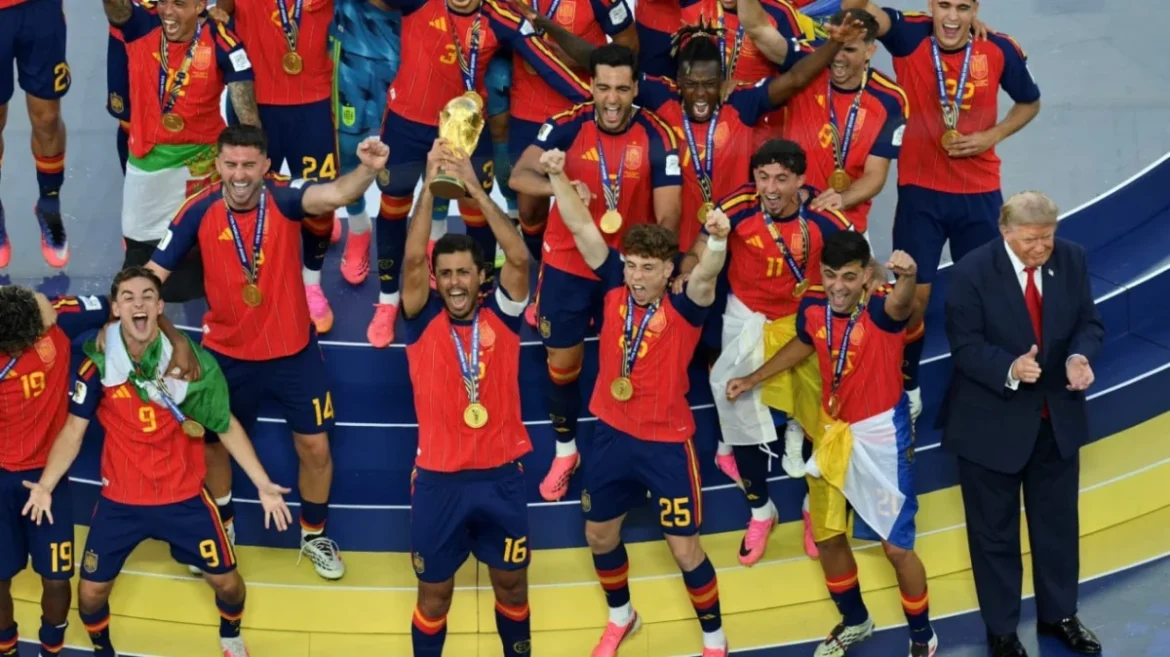
New York, NY – July 20, 2026 – The jubilant celebrations of Spain’s maiden 2026 FIFA World Cup title were overshadowed by an unexpected and widely discussed moment involving United States President Donald Trump, who opted to remain on the podium during the trophy presentation, creating a scene that drew global attention and drew comparisons to a similar incident at a previous FIFA Club World Cup final. Spain secured their historic victory over Argentina with a dramatic 1-0 win in extra time, thanks to a decisive goal from Ferran Torres, but the post-match ceremony became the focal point of media and public discourse.
The final, held at the sprawling New York New Jersey Stadium on Monday, July 20, 2026, concluded in the early hours of the morning WIB. While the football itself delivered a nail-biting encounter, the presentation of the coveted World Cup trophy became a stage for political presence that some observers found intrusive. President Trump, who had been invited to co-present the trophy alongside FIFA President Gianni Infantino, was expected to step aside to allow the Spanish players to fully embrace their championship moment. However, he remained in his position on the elevated platform.
Witnesses and broadcast footage indicated that FIFA President Infantino made subtle attempts to guide President Trump away from the central area where Captain Rodri, who also received the tournament’s Golden Ball award for best player, was about to lift the trophy. Despite these efforts, Trump remained steadfastly on the podium. In a move that further amplified the awkwardness, he was seen performing his signature "Trump dance" in front of the jubilant Spanish squad. Infantino’s visibly strained smile suggested a degree of discomfort as his attempts to facilitate the players’ moment were unsuccessful.
This situation echoed a precedent set at the FIFA Club World Cup final held at the same venue the previous year. During that event, when Chelsea emerged victorious, President Trump also remained on the podium amidst the players’ celebrations, a moment that subsequently fueled considerable discussion and criticism regarding protocol and sportsmanship.
A Divided Reception from the Stands
The presence of the US President at the World Cup final was met with a decidedly mixed reaction from the capacity crowd at the New York New Jersey Stadium. As President Trump, accompanied by FIFA President Infantino, made his way onto the field for the trophy ceremony, the stadium resonated with a cacophony of cheers and boos from different sections of the audience.
Reports from The New York Times detailed President Trump’s acknowledgment of the crowd with waves. However, when his image was broadcast on the stadium’s giant screens, the negative reactions intensified, with the jeers and whistles audibly drowning out the stadium’s ambient music. This divided reception underscored the polarized views that President Trump often elicits, even within the context of a global sporting spectacle.
President Trump arrived at the stadium via the presidential helicopter, Marine One. Throughout the match, he occupied a prominent seat in the VIP box, sharing the space with First Lady Melania Trump and FIFA President Gianni Infantino. The security detail surrounding their presence was notably stringent, reflecting the high-profile nature of the attendees and the event itself.
Pre-Match Predictions and Post-Match Compliance
Prior to the commencement of the final, President Trump had publicly expressed his inclination towards Argentina, citing the formidable presence of Lionel Messi and his reportedly close relationship with Argentinian President Javier Milei as contributing factors. Despite this pre-match leaning, he dutifully participated in the trophy presentation ceremony following Spain’s triumph, adhering to the established protocol of awarding the cup to the victorious team.
The article on the following page, accessible via a link, delves into further details of the event and potential implications. It indicates that President Trump’s presence was a significant aspect of the final, with his pre-match comments and post-match actions generating considerable commentary.
Historical Context of World Cup Finals and Political Involvement
The FIFA World Cup, a quadrennial tournament that captures the imagination of billions worldwide, has historically been a stage where sport and culture intersect, often drawing political figures and dignitaries. The tradition of world leaders or their representatives attending and participating in the trophy presentation is a long-standing one, symbolizing the global reach and unifying power of football. However, the extent of their direct involvement in the celebratory moments of the winning team has sometimes been a subject of debate.
The 2026 FIFA World Cup, co-hosted by the United States, Canada, and Mexico, represented a significant logistical and cultural undertaking. The final’s placement in New York amplified its visibility, drawing unprecedented attention to the event and its associated personalities. The decision to have the US President participate in the trophy ceremony was likely intended to underscore the host nation’s commitment to the event and its international appeal.
Analysis of the Trump Podium Incident
The incident involving President Trump at the 2026 World Cup final raises several points for consideration within the realms of sports protocol, political symbolism, and media narrative.
Sports Protocol and Player Experience: The primary objective of a trophy presentation ceremony is to honor the athletes and their monumental achievement. Any action that detracts from this focus, or inadvertently overshadows the players’ moment, can be viewed as problematic within the sporting context. FIFA, as the governing body, aims to ensure that these ceremonies are seamless and player-centric. President Trump’s decision to remain on the podium, despite apparent cues from FIFA President Infantino, arguably disrupted this intended focus.
Political Messaging and Public Perception: For political figures, participation in major international events offers an opportunity for public engagement and symbolic representation. President Trump’s actions, particularly his "Trump dance," can be interpreted as an attempt to assert his presence and project a certain image of confidence and engagement. However, the divided reception from the crowd suggests that this messaging was not universally received positively. The "Trump dance" itself has become a recognizable gesture associated with his persona, and its deployment in this context likely resonated differently with various segments of the audience.
Media Narrative and Amplification: The global nature of the World Cup ensures that such moments are instantly disseminated and analyzed across various media platforms. The incident provided fodder for news cycles, social media discussions, and political commentary, further amplifying its significance beyond the immediate sporting event. The comparison to the previous Club World Cup incident indicates a pattern of behavior that media outlets are likely to highlight.
FIFA’s Role and Future Considerations: FIFA, tasked with the organization and governance of the World Cup, faces the delicate challenge of balancing its relationship with host nations and political leaders while upholding the integrity and player-centric nature of its events. The awkwardness experienced by President Infantino highlights the complexities of managing high-profile political figures within the structured environment of a sporting ceremony. Future World Cup final ceremonies might see a more defined protocol regarding the exact positioning and duration of political dignitaries on the podium.
Broader Implications for Sports Diplomacy
The 2026 World Cup final, while celebrating athletic prowess, also inadvertently illuminated the intersection of sport, politics, and public opinion. The incident involving President Trump serves as a reminder that major sporting events, by their very nature, attract a wide array of stakeholders, each with their own agendas and perceptions.
The performance of the Spanish team, marked by their resilience and tactical acumen, culminating in their first World Cup title, deserves recognition. Their victory represents a significant achievement for Spanish football, building upon a history of strong performances in international tournaments. The goal by Ferran Torres, a product of Spain’s youth development systems, symbolizes the nation’s footballing legacy.
However, the lingering images of the trophy presentation, with the visible tension and the President’s extended presence, will likely remain a part of the narrative surrounding this particular World Cup final. It underscores the ongoing challenge of navigating the complex dynamics between the global spectacle of sport and the ever-present influence of politics and public personalities. As the world moves forward, the 2026 World Cup final will be remembered not only for Spain’s triumph but also for the unforgettable, and for many, awkward, moment on the podium.
