
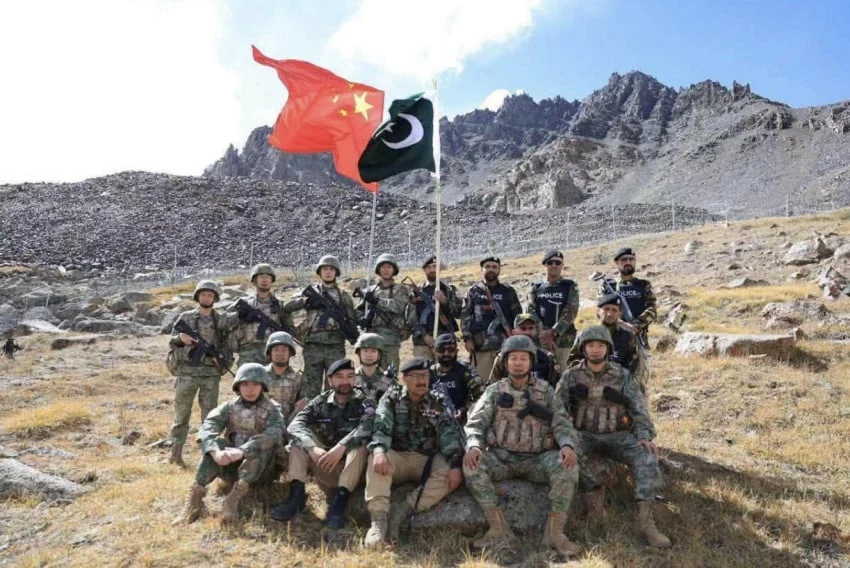
The geopolitical landscape of the Himalayas has shifted following a recent diplomatic and territorial maneuver between Islamabad and Beijing. Last week, Pakistan and China officially formalized a border demarcation agreement in a remote, highly contested section of the Himalayan mountain range. The move centers around the signing of the Pakistan-China Joint Border Commission agreement, a development hailed by Pakistani officials as a historic milestone designed to bolster trade, enhance connectivity, and streamline border management between the two regional rivals of India. However, the development has triggered severe diplomatic pushback from New Delhi, which views the pact as an aggressive infringement on its sovereignty and a clear indicator of Pakistan acting as a strategic proxy for China.
The timing of this agreement is particularly sensitive. It occurs precisely as India and China have been attempting to thaw bilateral relations and stabilize a tense military standoff along the Line of Actual Control (LAC). The LAC serves as the de facto border separating Indian and Chinese military forces across the broader Himalayan frontier. While Beijing engages in diplomatic talks with New Delhi to ease border tensions, its simultaneous deepening of administrative and territorial coordination with Islamabad along disputed Himalayan corridors has intensified strategic anxiety in the Indian capital.
At the heart of the controversy is the inclusion of the Shaksgam Valley within the scope of the newly formed joint commission. Spanning approximately 5,180 square kilometers, the Shaksgam Valley is a rugged, high-altitude territory that Pakistan formally ceded to China under a provisional boundary agreement in 1963. India maintains an unwavering claim over the entire region, insisting that the valley constitutes an integral part of the former princely state of Jammu and Kashmir. According to New Delhi, the territory was illegally occupied by Pakistan before being transferred to China through a pact that India has consistently rejected as legally void.
Chronology of a Territorial Dispute
To understand the gravity of the recent border commission agreement, it is necessary to examine the historical trajectory that forged this trilateral friction. The roots of the dispute extend back to the partition of British India in 1947 and the subsequent wars over the princely state of Jammu and Kashmir.
- October 1947: The Maharaja of Jammu and Kashmir signs the Instrument of Accession to India, leading to the First Kashmir War and the partitioning of the region into areas administered by India and Pakistan.
- 1950s–1960s: Sino-Indian relations deteriorate over competing territorial claims along the Aksai Chin and the Himalayan frontier, culminating in the 1962 Sino-Indian War.
- March 1963: Seeking to secure its northern flank and resolve boundary issues, Pakistan and China sign a provisional boundary agreement, in which Islamabad cedes the Shaksgam Valley to Beijing. New Delhi immediately denounces the pact, asserting that Pakistan has no legal authority to negotiate territory belonging to India.
- 1984–1999: Military conflicts and standoffs, such as the Siachen Glacier conflict and the Kargil War, further militarize the region, cementing the adversarial triangular dynamic between India, Pakistan, and China.
- 2020: Lethal clashes erupt between Indian and Chinese troops in the Galwan Valley along the Ladakh frontier, plunging bilateral ties to their lowest point in decades and prompting massive military buildups by both nuclear-armed states.
- Present Day: Pakistan and China formalize the Joint Border Commission to institutionalize border management, prompting fierce diplomatic protests from New Delhi.
Official Responses and Diplomatic Fallout
The reaction from the Indian government was swift and uncompromising. Randhir Jaiswal, the official spokesperson for India’s Ministry of External Affairs, issued a strongly worded condemnation during a weekly press briefing, rejecting the legitimacy of the entire arrangement.
"There is no such thing as a Pakistan-China border. We reject the so-called Joint Commission, which possesses no legal validity whatsoever," Jaiswal stated. He reiterated India’s historical position, emphasizing that Pakistan lacks the locus standi to enter into any agreements concerning Indian territory under its forced and illegal occupation. "Pakistan has no legal standing to make arrangements regarding Indian territory under its occupation," he added.
Conversely, Islamabad defended the legality of the agreement. Pakistani diplomatic and foreign policy representatives argued that Jammu and Kashmir remains a internationally recognized disputed territory under United Nations resolutions, thereby invalidating India’s objections. Islamabad maintains that the 1963 boundary agreement with Beijing was conducted within the bounds of sovereign rights and that India has no legal ground to challenge a settled bilateral frontier.
Strategic Implications and the Proxy Dimension
The formalization of the Pakistan-China border mechanism carries profound strategic implications for South Asia, reinforcing the long-held perception in New Delhi that Pakistan is increasingly functioning as a geopolitical proxy for Chinese ambitions.
For decades, security analysts in India have warned of a "two-front war" scenario, wherein India would be forced to simultaneously defend its borders against coordinated military pressure from both Pakistan and China. The latest diplomatic and administrative coordination over the Shaksgam Valley suggests a deepening of the China-Pakistan Economic Corridor (CPEC)—a flagship project of Beijing’s Belt and Road Initiative (BRI) that passes through Pakistan-administered Kashmir, much to India’s chagrin.
By consolidating control and administrative connectivity in areas claimed by India, China not only secures its western strategic corridors, particularly routes connecting Xinjiang to Tibet and Pakistan, but also exerts continuous pressure on India’s strategic bandwidth. This forces New Delhi to maintain high troop deployments along both the western border with Pakistan and the northern frontier with China, draining significant economic and military resources.
Furthermore, the pact complicates ongoing diplomatic efforts between New Delhi and Beijing. Even as senior diplomats and military commanders from India and China engage in painstaking negotiations to disengage troops and patrol disputed sectors of the LAC, Beijing’s willingness to advance border integration with Islamabad in overlapping territorial claims demonstrates a dual-track strategy. China continues to project economic and diplomatic dominance through its junior partner, Pakistan, while managing its immediate tactical friction with India.
Economic and Infrastructure Dimensions
Beyond military strategy, the Pakistan-China Joint Border Commission aims to streamline commerce, infrastructure development, and logistical connectivity across difficult terrain. The high-altitude border regions, characterized by extreme weather and treacherous topography, have historically presented immense logistical challenges for civilian and military movement.
By enhancing institutional cooperation on border management, Beijing and Islamabad seek to upgrade roads, communication networks, and trade posts. This connectivity directly serves China’s broader geoeconomic objectives in Central and South Asia, providing Beijing with reliable access to warm-water ports via the Arabian Sea through the Gwadar Port in Pakistan’s Balochistan province. For Pakistan, heavily reliant on Chinese financial bailouts and infrastructure investments, the agreement symbolizes a deepening security umbrella that reinforces its position vis-à-vis India.
Conclusion
The activation of the Pakistan-China Joint Border Commission and the inclusion of the disputed Shaksgam Valley mark a critical juncture in Himalayan geopolitics. By formalizing boundaries in territory claimed by New Delhi, Islamabad and Beijing have not only bypassed Indian objections but have also cemented a strategic axis that leaves India increasingly diplomatically and militarily hemmed in. As India continues to protest the legality of these actions on international platforms, the evolving partnership between its two primary adversaries guarantees that the Himalayan frontier will remain one of the world’s most volatile and strategically contested zones for the foreseeable future.
