
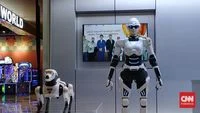
Jakarta, CNN Indonesia — Artificial intelligence and advanced robotics firm AiMOGA Robotics has officially launched its commercial operations in Indonesia, introducing a sophisticated suite of humanoid and quadruped robotic systems tailored for both consumer and enterprise deployment. The market entry was marked by the grand opening of the company’s premier experience store in Jakarta, signaling a strategic push into Southeast Asia’s largest digital economy.
The launch event highlighted two flagship models designed to act as functional assistants and companions: the humanoid robot Mornine and the quadruped robotic companion Argos. With pricing structures starting at approximately Rp50 million for the canine-inspired robotic units and scaling from Rp800 million to Rp1 billion for the advanced humanoid platform, AiMOGA is positioning its products to capture a diverse spectrum of the emerging Indonesian automation market, spanning retail, healthcare, public services, and residential sectors.
Strategic Market Entry and the Jakarta Flagship Launch
The debut of AiMOGA Robotics in Indonesia represents a calculated milestone in the company’s broader global expansion strategy. By establishing a physical experience store in Jakarta, the company aims to bridge the gap between abstract technological concepts and tangible consumer interaction. Industry analysts note that Indonesia’s rapid digital transformation, characterized by a tech-savvy urban population and growing adoption of artificial intelligence across commercial enterprises, makes it an ideal testing ground for high-end robotics.
During the launch proceedings, AiMOGA executives demonstrated the practical capabilities of both Mornine and Argos, emphasizing that the deployment of these machines is intended to augment human labor rather than replace it entirely. The company’s localized launch strategy includes providing hands-on demonstrations for prospective enterprise clients, ranging from hospital administrators and hospitality managers to educational institution heads and security firm directors.
Anatomy and Capabilities of the Mornine Humanoid Platform
Standing at 167 centimeters and maintaining a physical weight of 70 kilograms, the Mornine humanoid robot is engineered to mirror human dimensions while housing a robust architecture of computational hardware. Globally priced around 285,800 yuan, the unit translates to a local retail range of Rp800 million to Rp1 billion when factoring in import logistics, compliance adaptations, and local customer support infrastructure.
At the core of Mornine’s operational intelligence is an advanced multimodal artificial intelligence integration powered by Large Language Models (LLMs). This cognitive backbone is supported by a comprehensive sensor array comprising high-definition optical cameras, precision spatial microphones, and sophisticated 3D LiDAR systems that enable autonomous navigation in dynamic, crowded environments.
According to AiMOGA’s deployment specifications, Mornine is capable of real-time environmental comprehension, allowing it to engage in natural, context-aware interactions with human interlocutors. Its operational utility is structured around roles that demand consistent information delivery and guest reception. Consequently, prime target environments for Mornine include corporate lobbies, shopping mall concourses, museum reception areas, and healthcare reception desks.
Sales and Development Manager Winny Cinthya elaborated on the operational philosophy governing the humanoid’s deployment, characterizing it strictly as a collaborative assistant. "It is more of a human assistant, designed to handle repetitive or mundane tasks that do not necessarily require human cognitive intervention," Cinthya explained during the launch event. "The objective is not to replace human workers, but rather to optimize operational efficiency and assist human personnel in their daily duties."
Versatility Across Industries and Regulatory Compliance
The versatility of the Mornine platform extends across multiple verticals, including public service administration, healthcare assistance, educational instruction, industrial guidance, and security monitoring. In healthcare settings, for instance, the humanoid can streamline patient check-in procedures and direct visitors to specific departments, thereby reducing administrative bottlenecks at reception desks. In educational environments, it can serve as an interactive assistant for presentations and guided facility tours.
To facilitate international deployment and secure enterprise confidence, AiMOGA has subjected its humanoid systems to rigorous international certification protocols. The Mornine platform has successfully attained compliance with the European Union’s Machinery Safety Directive (CE-MD), the EN 18031 standard governing cybersecurity and data protection, and the Radio Equipment Directive (CE-RED). Additionally, the unit has secured Federal Communications Commission (FCC) certification from the United States, underscoring its adherence to global safety, data privacy, and electromagnetic compatibility standards.
Argos: The Quadruped Robotic Companion for Daily Life
Complementing the industrial and commercial focus of the humanoid lineup is AiMOGA’s quadruped robotic system, commercially designated as Argos. Priced globally at approximately 15,800 yuan and localized in Indonesia at roughly Rp50 million, the robotic dog is engineered for versatility in domestic and semi-public environments.
Argos is equipped with an integrated suite of sensors, including high-definition cameras, directional microphones, advanced radar systems, built-in speakers, and environmental illumination lamps. The quadruped is programmed to respond intuitively to both voice commands and tactile inputs, allowing for seamless integration into household routines.
The intended use cases for Argos range from recreational companionship and outdoor walking assistance to home security monitoring, child supervision, and assisting users with carrying light parcels. Its ability to navigate uneven terrain and respond to owner cues positions it within the growing consumer robotics segment, which has experienced rising demand globally as pet-robotics technology matures.
Global Footprint and Proven Deployment Scenarios
The introduction of AiMOGA’s products to Indonesia builds upon an established global operational footprint. Prior to its Indonesian market entry, AiMOGA had successfully manufactured and shipped more than 2,000 robotic units worldwide. The company’s hardware and software ecosystems currently operate across more than 60 countries, encompassing hundreds of real-world deployment scenarios.
These deployments span diverse, high-demand sectors such as automotive manufacturing plants, where robotic assistants aid in logistics and guided tours; medical service facilities, where they manage patient inquiries and material transport; and various commercial enterprises utilizing automated guidance systems. This extensive operational history provides a reliable performance baseline as the company introduces its technology to the Indonesian market.
Broader Implications for the Indonesian Economy and Workforce
The entry of advanced humanoid and quadruped robotics into Indonesia arrives at a critical juncture for the nation’s labor market and digital economy. As Indonesia pursues its "Golden Indonesia 2045" vision—which aims to elevate the country into a top-tier global economy through technological innovation and industrial modernization—the adoption of artificial intelligence and robotics is expected to accelerate.
Economists and labor experts note that while the introduction of service robotics raises initial questions regarding automation and job displacement, products positioned explicitly as assistants, such as Mornine, tend to ease the transition toward human-machine collaboration. By absorbing routine, repetitive tasks, such systems can potentially allow human workers to focus on higher-value activities requiring complex problem-solving, empathy, and strategic decision-making.
Furthermore, the presence of physical experience stores like AiMOGA’s new Jakarta hub democratizes public exposure to advanced automation technologies, demystifying artificial intelligence for local businesses and consumers alike. As local enterprises evaluate the cost-benefit ratios of adopting Rp50 million quadruped units for security and companionship or Rp1 billion humanoid platforms for corporate service delivery, Indonesia’s broader service sector stands poised to undergo a measured evolution in operational efficiency and technological integration.
