
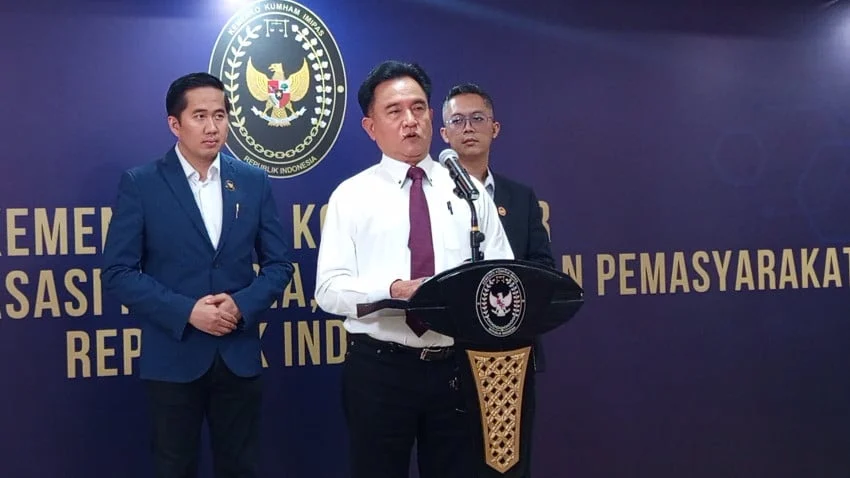
JAKARTA – Indonesian authorities have definitively stated that Abdul Karim Raeq Miqdad, a foreign national from Palestine apprehended by the National Police, is not a religious scholar as has been suggested in some circles. Instead, Miqdad is identified as a fugitive wanted by NCB Interpol Nicosia in connection with terrorism-related offenses. This clarification comes from the Coordinating Minister for Law, Human Rights, Immigration, and Correctional Facilities (Menko Kumham Imipas), Yusril Ihza Mahendra, who provided a detailed account of the situation on Wednesday, July 22, 2026.
"Based on the data we possess, including passport information and other records, Abdul Karim Miqdad is currently 41 years old. It can be definitively confirmed that he is not a cleric in the way we understand the term here," Minister Yusril stated, directly addressing concerns and misinformation circulating regarding Miqdad’s identity and alleged status.
Further elaborating on the findings, Minister Yusril also refuted claims that Miqdad was a Palestinian humanitarian activist. Investigations revealed that Miqdad had been residing in Indonesia for three years. Crucially, he has been unable to provide any evidence to substantiate claims of engaging in humanitarian activities in the Gaza Strip, Palestine.
"We have been unable to find any proof that the individual in question is a humanitarian activist in the Gaza Strip, contrary to the opinions that have been circulating among the public," Yusril added, highlighting the discrepancy between public perception and official findings.
The Arrest and International Cooperation
The apprehension of Abdul Karim Raeq Miqdad was carried out by the Indonesian National Police, acting on intelligence and requests from international law enforcement agencies. The Interpol Red Notice issued by Nicosia indicates that Miqdad is a person of interest in a significant criminal investigation involving acts of terror.
While the specific details of the alleged terrorism offenses remain under review by the Indonesian authorities in coordination with Interpol, the confirmation of his fugitive status underscores the gravity of the situation. The Indonesian government’s stance is to uphold international legal obligations and cooperate with global efforts to combat terrorism and bring perpetrators to justice.
Minister Yusril also revealed that he had been in communication with the Ambassador of Cyprus to Indonesia, Nikos Panayiotou. During this dialogue, Ambassador Panayiotou reiterated the Cypriot government’s unwavering commitment to adhering to Interpol statutes. He assured Minister Yusril that Cyprus would not seek to extradite Miqdad to any other nation, implying a clear understanding and agreement regarding the legal process and jurisdiction. This communication aims to preempt any potential diplomatic complexities and ensure a transparent handling of the case.
Background Context: The Interpol Red Notice
An Interpol Red Notice is a request to law enforcement worldwide to locate and provisionally arrest an individual pending extradition, surrender, or similar legal action. It is not an arrest warrant itself, but it does signal that a judicial or administrative authority in a member country has issued an arrest warrant or court order for the individual.
The issuance of a Red Notice by NCB Interpol Nicosia signifies that Cypriot authorities have formally identified Miqdad as a suspect or wanted person in a criminal investigation. The nature of the alleged terrorism offenses, while not fully disclosed publicly at this stage, is understood to be serious enough to warrant international law enforcement attention.
The presence of Miqdad in Indonesia for an extended period, coupled with his alleged involvement in terrorism-related activities, raises questions about his activities during his stay and how he managed to evade international scrutiny until his apprehension in Indonesia. Indonesian immigration and security agencies are reportedly reviewing his entry and activities within the country.
Chronology of Events
While a precise timeline is still being pieced together by authorities, the following is a general reconstruction of key events leading to the public statement:
- Early 2020s (Estimated): Abdul Karim Raeq Miqdad reportedly arrives in Indonesia.
- Unspecified Date: NCB Interpol Nicosia issues a Red Notice for Abdul Karim Raeq Miqdad in connection with terrorism-related offenses.
- Prior to July 22, 2026: Indonesian National Police receive intelligence and/or a formal request from international law enforcement regarding Miqdad’s whereabouts.
- On or before July 22, 2026: Indonesian National Police successfully apprehend Abdul Karim Raeq Miqdad.
- July 22, 2026: Coordinating Minister Yusril Ihza Mahendra issues a formal statement to the press clarifying Miqdad’s identity and status, refuting claims of him being a cleric or humanitarian activist.
- July 22, 2026 (Evening): Minister Yusril is reported to have visited the Indonesian Ulema Council (MUI) to provide further clarification on the case. This visit, as indicated in related reporting, aims to address any potential misunderstandings or concerns within religious communities.
Supporting Data and Legal Framework
Indonesia, as a member of Interpol, is obligated to cooperate with international requests for the apprehension of fugitives. The legal framework for such cooperation is typically governed by bilateral extradition treaties and international conventions against terrorism. The Directorate General of Immigration, under the Ministry of Law and Human Rights, plays a crucial role in managing the entry and exit of foreign nationals and enforcing immigration laws.
The Ministry of Law and Human Rights, headed by Minister Yusril Ihza Mahendra, is the primary government body responsible for legal matters, human rights, immigration, and correctional facilities. Its mandate includes ensuring national security and fulfilling international legal commitments. The statement from Minister Yusril signifies a coordinated effort between various Indonesian government agencies, including the National Police and the Ministry of Foreign Affairs, in handling this international law enforcement matter.
The age of the individual, 41 years, is a factual detail provided by Minister Yusril, likely derived from official identification documents. The duration of his stay in Indonesia, three years, is also a significant piece of information that suggests a period of established presence, which would have been subject to immigration regulations.
Reactions and Broader Implications
The clarification from Minister Yusril is expected to quell speculation and potential diplomatic sensitivities that might arise from the mischaracterization of Miqdad’s identity. The initial perception of him being a respected religious or humanitarian figure could have led to public sympathy or political pressure, potentially complicating the legal process.
The Indonesian Ulema Council (MUI), a prominent Islamic organization in Indonesia, is likely to have received a briefing from Minister Yusril. Such engagements are crucial for maintaining transparency and trust between the government and religious institutions, especially when cases involve individuals from Muslim-majority countries. By addressing the MUI, the government aims to ensure that religious leaders and their followers have accurate information.
The commitment from the Cypriot government, as conveyed by Ambassador Panayiotou, to abide by Interpol statutes and not extradite Miqdad elsewhere is a critical development. It suggests that Cyprus is likely pursuing its own legal proceedings and wishes to handle the case directly with Indonesia. This could indicate a complex legal process unfolding in Cyprus, where Miqdad is a wanted individual.
The implications of this case extend to Indonesia’s role in international counter-terrorism efforts. By successfully apprehending an Interpol fugitive, Indonesia demonstrates its capacity and willingness to contribute to global security. However, it also highlights the ongoing challenge of identifying and tracking individuals involved in illicit activities who may be residing within its borders.
This incident underscores the importance of robust intelligence sharing and law enforcement cooperation between nations. The Indonesian government’s proactive approach in clarifying the facts and engaging with relevant stakeholders reflects a commitment to transparency and due process in handling a sensitive international security matter. The ongoing legal proceedings, both in Indonesia and potentially in Cyprus, will be closely watched as they unfold.
