
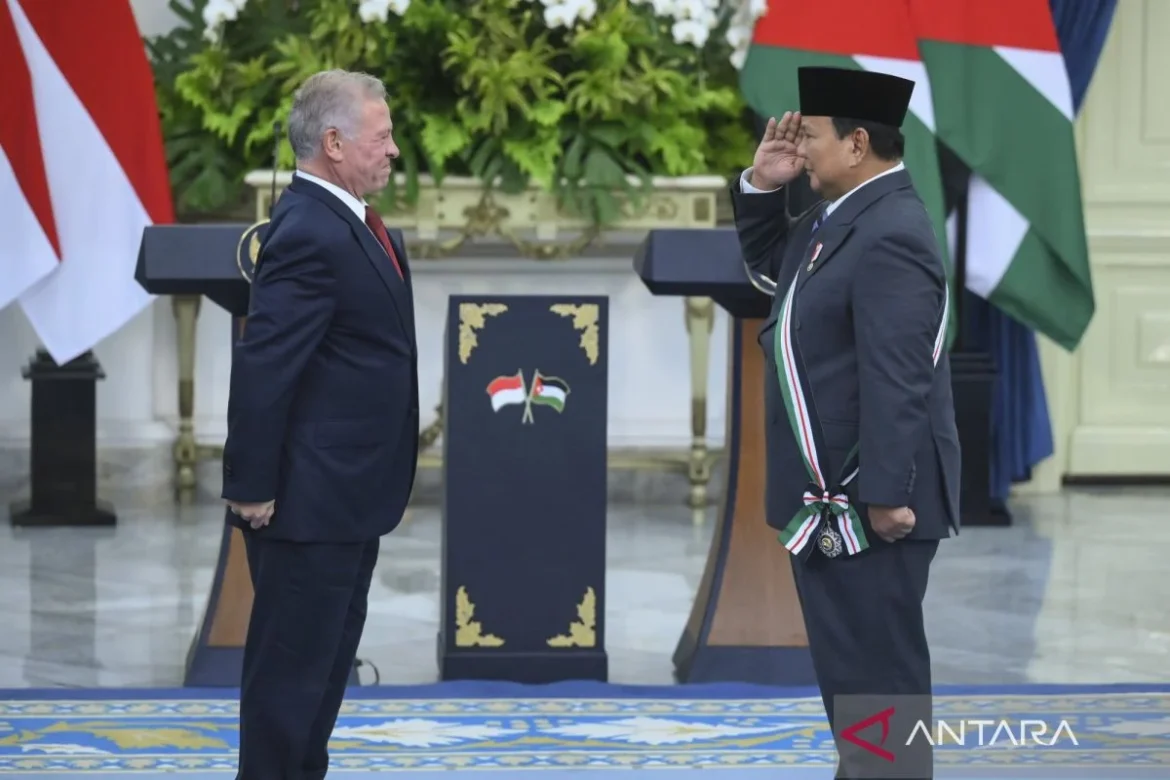
Jakarta, Indonesia – King Abdullah II bin Al-Hussein of the Hashemite Kingdom of Jordan commenced a significant state visit to Indonesia on Friday afternoon, October 17, 2025, marking a crucial juncture in the diplomatic relations between the two nations. The Jordanian monarch’s arrival in Jakarta underscores a concerted effort to deepen strategic partnerships, particularly across economic, defense, and geopolitical spheres, with Indonesia, a prominent leader in Southeast Asia and a key voice in the Muslim world. The visit features a high-level meeting with Indonesian President Prabowo Subianto, followed by discussions with representatives from Danantara Indonesia, an entity central to the anticipated bilateral economic agreements. A highlight of the visit will be the witnessing of the signing of several memoranda of understanding (MoUs) aimed at solidifying the frameworks for future cooperation.
A Broader Diplomatic Offensive Across Asia
King Abdullah II’s stop in Indonesia is part of an extensive diplomatic tour across Asia, demonstrating Jordan’s commitment to fostering stronger ties beyond its immediate region. Prior to his arrival in Jakarta, the King’s itinerary included strategic visits to Japan, Vietnam, Singapore, and Pakistan. This multi-country tour is indicative of Jordan’s proactive foreign policy, seeking to diversify its partnerships, enhance economic opportunities, and garner support for its positions on regional and international issues, particularly those concerning peace and stability in the Middle East. Each leg of this Asian journey is meticulously designed to reinforce Jordan’s standing as a stable and influential actor, promoting dialogue and cooperation on a global scale. The choice of Indonesia as a key destination highlights Jakarta’s growing geopolitical importance and its shared values with Amman, particularly in advocating for peace and religious tolerance.
Preceding Engagements and Deep-Rooted Personal Ties
The current state visit by King Abdullah II follows a preparatory engagement earlier in the year when President Prabowo Subianto made his own official visit to Jordan on April 14, 2025. During his trip, President Prabowo held a private, one-on-one meeting with King Abdullah II at the majestic Al Husseiniya Palace in Amman, on the second day of his stay. This reciprocal exchange of high-level visits within a relatively short period underscores the mutual commitment of both leaders to elevate their bilateral relationship.
Beyond the formal diplomatic protocols, the bond between King Abdullah II and President Prabowo Subianto is notably bolstered by a long-standing personal friendship, cultivated since their younger years. Both leaders share a distinguished military background, having both attended the esteemed United States Army training institution at Fort Benning. This shared experience in military training and the formative years spent in service have forged a unique connection, providing a solid foundation for trust and understanding that often transcends the complexities of international diplomacy. This personal rapport is expected to facilitate more candid and productive discussions, paving the way for more impactful bilateral initiatives. The commonality in their professional origins, rooted in military discipline and leadership, offers a unique lens through which to approach strategic issues, from defense cooperation to regional security challenges.
Economic Dimensions: The Strategic Role of Phosphates
A significant focus of King Abdullah II’s visit revolves around economic cooperation, specifically highlighting the potential for collaboration in the phosphate sector. The scheduled meeting with representatives from Danantara Indonesia signals a serious intent to explore and formalize partnerships in this vital industry. Jordan is globally recognized as one of the largest producers and exporters of phosphates, a critical raw material essential for various industries, most notably agriculture, where it is a primary component in the production of fertilizers.
Indonesia, with its vast agricultural sector and growing population, has a substantial and increasing demand for phosphate-based fertilizers to ensure food security and enhance agricultural productivity. Currently, Indonesia imports a significant portion of its phosphate requirements. A direct, formalized partnership with Jordan could offer Indonesia a stable and potentially more cost-effective supply chain for phosphates, reducing reliance on volatile global markets and strengthening its agricultural backbone. This collaboration could extend beyond raw material supply to include joint ventures in processing, research and development for advanced fertilizers, and sustainable mining practices. The global phosphate market is valued at billions of dollars annually, with projections for continued growth driven by global food demand. Jordan’s proven reserves are among the world’s largest, making it an indispensable partner for countries seeking long-term supply stability. For Jordan, diversifying its export markets and strengthening economic ties with dynamic economies like Indonesia supports its economic resilience and development goals.
Broader Bilateral Cooperation: Beyond Economics
While economic ties, particularly in phosphates, are a focal point, the state visit aims to broaden the scope of cooperation across multiple sectors.
- Defense and Security: Given the shared military backgrounds of King Abdullah II and President Prabowo, discussions on defense cooperation are anticipated. This could encompass military training exchanges, intelligence sharing, counter-terrorism strategies, and potential cooperation in defense equipment or technology. Both nations face common security challenges, including the threat of radicalism and regional instability, making collaboration in this area strategically valuable. Jordan’s advanced military capabilities and experience in counter-insurgency operations, coupled with Indonesia’s robust defense industry and regional security leadership, present a fertile ground for mutual learning and operational synergy.
- Political and Diplomatic Alignment: Both Jordan and Indonesia are significant Muslim-majority nations that advocate for moderation, interfaith dialogue, and peaceful resolution of conflicts. They often find common ground on international platforms such as the United Nations and the Organization of Islamic Cooperation (OIC), particularly concerning the Palestinian question. The visit provides an opportunity to coordinate diplomatic efforts on critical global and regional issues, reinforcing their shared commitment to multilateralism and international law. Jordan’s historical role as custodian of Islamic and Christian holy sites in Jerusalem, alongside Indonesia’s strong advocacy for Palestinian rights, creates a powerful alignment in their foreign policy stances.
- Cultural and Educational Exchange: People-to-people connections are vital for long-term bilateral relations. Expanding cultural exchange programs, student scholarships, and academic collaborations between universities in Jordan and Indonesia could foster deeper understanding and mutual appreciation. This includes promoting tourism, given both countries’ rich historical and natural heritage.
Profile of King Abdullah II: A Visionary Monarch
King Abdullah II bin Al-Hussein, born in Amman, Jordan, on January 30, 1962, is the eldest son of the late King Hussein bin Talal and Princess Muna Al Hussein. He holds the unique distinction of being a 41st-generation direct descendant of Prophet Muhammad (PBUH), a lineage that bestows upon him significant spiritual and historical legitimacy within the Islamic world.
His educational journey reflects a commitment to both traditional Islamic values and modern global leadership. He began his schooling at the Islamic Educational College in Amman before continuing his studies abroad at St. Edmund’s School in Surrey, England. He then completed his secondary education at Deerfield Academy in the United States, providing him with early exposure to diverse cultural and educational systems. His military and higher education further solidified his international perspective and leadership capabilities. He attended the prestigious Royal Military Academy Sandhurst in England in 1980, a world-renowned institution for officer training. Subsequently, he pursued studies at Pembroke College, University of Oxford, England, in 1982, and later at Georgetown University in the United States from 1987 to 1989, where he focused on international relations.
King Abdullah II’s career path was deeply rooted in military service. He served with distinction in the Royal Jordanian Army from 1981 to 1993, gaining practical leadership experience and a profound understanding of defense matters. His ascent through the ranks saw him assume critical command positions, including Deputy Commander of the Jordanian Special Forces from 1993 to 1994, and subsequently, Commander of the Jordanian Special Forces from 1994 to 1999. These roles honed his strategic thinking, operational command skills, and a deep appreciation for the well-being of his troops.
In 1999, following the passing of his revered father, King Hussein, King Abdullah II ascended to the throne of Jordan. His reign has been characterized by a forward-looking vision for modernization, economic reform, and a steadfast commitment to regional peace and stability. He has been a consistent advocate for a two-state solution to the Israeli-Palestinian conflict and has played a crucial role in international efforts against terrorism and extremism.
He is married to Queen Rania Al Abdullah, a prominent global advocate for education, health, and cross-cultural dialogue, since June 10, 1993. Together, they have four children: two sons, Crown Prince Hussein and Prince Hashem, and two daughters, Princess Iman and Princess Salma.
Beyond his royal duties, King Abdullah II is known for his diverse hobbies, which reflect his adventurous spirit and precision. A qualified pilot and a skilled parachutist, he also enjoys car racing and collecting antique weapons. These pursuits not only provide personal recreation but also subtly underscore aspects of his character—a blend of modern dynamism and a deep respect for history and tradition.
Implications and Future Outlook
The state visit of King Abdullah II to Indonesia is poised to yield significant implications for both nations. Economically, the anticipated agreements, particularly concerning phosphates, could establish a robust and reliable supply chain for Indonesia’s agricultural sector, enhancing food security and potentially leading to cost efficiencies for farmers. For Jordan, it represents a diversification of its export markets and a strengthening of ties with a major Asian economy, contributing to its economic stability.
Geopolitically, the visit reinforces the strategic alignment between an influential Middle Eastern kingdom and a leading Southeast Asian democracy. This strengthened partnership could lead to more coordinated diplomatic efforts on pressing global issues, from promoting peace in the Middle East to combating climate change and fostering interfaith harmony. The shared commitment to moderation and stability positions both nations as important voices in the global discourse.
In terms of defense and security, the personal rapport between the leaders, combined with their military backgrounds, creates a conducive environment for enhanced cooperation. This could translate into practical benefits through intelligence sharing, joint training exercises, and collaborative approaches to regional security challenges.
Overall, King Abdullah II’s state visit to Indonesia is more than a ceremonial exchange; it is a strategic endeavor designed to deepen multifaceted cooperation, leverage existing strengths, and address shared challenges in an increasingly complex global landscape. The long-standing personal friendship between the two leaders serves as a powerful catalyst, promising a trajectory of robust and mutually beneficial relations for years to come. The outcomes of this visit are expected to solidify a comprehensive partnership that will contribute to the prosperity and stability of both the Hashemite Kingdom of Jordan and the Republic of Indonesia.
