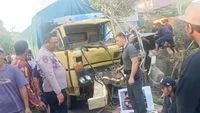
A joyous wedding celebration in Dusun Sidomakmur, Gucialit Village, Lumajang Regency, East Java, transformed into a scene of carnage this past Thursday, September 17, when a runaway truck plowed through a crowd of guests and parked vehicles. The accident, which resulted from a catastrophic brake failure, claimed the lives of two individuals and left nine others suffering from various injuries, ranging from severe fractures to trauma-induced complications. The incident has sent shockwaves through the local community, sparking a renewed dialogue regarding vehicle safety standards for heavy transport vehicles operating on the challenging, high-gradient topography characteristic of the Lumajang highlands.
Chronology of the Incident
The incident unfolded mid-afternoon at approximately 15:00 WIB. According to official reports provided by the Lumajang Police, a yellow Mitsubishi truck (N 8187 YH) was navigating the descent through Gucialit when the driver, identified as a 69-year-old resident of Sukodono known by the initials KSM, experienced a complete loss of braking power.
The topography of the Gucialit region is notorious for its steep inclines and sharp turns, which demand rigorous vehicle maintenance and specialized braking systems. As the heavy vehicle gained momentum on the descent, the driver was unable to decelerate. The truck first impacted a Suzuki Carry pickup truck (L 8060 AA) traveling in the same direction. The force of the collision was so significant that the pickup was propelled forward, striking a group of 11 pedestrians who were attending the wedding festivities nearby.
The momentum of the runaway truck did not dissipate following the initial collision. It continued its eastward trajectory, striking a parked Mitsubishi L300 pickup (N 8157 YA) before careening into a row of five motorcycles—two Honda Scoopy units, a Honda Beat, and two Honda Vario models—that were parked along the roadside. The sequence of destruction concluded only after the truck struck the wedding’s sound system equipment, effectively bringing the vehicle to a halt.
Medical Impact and Casualties
The human toll of the disaster was immediate and severe. Emergency response teams rushed the victims to the Gucialit Puskesmas and the Dr. Haryoto General Hospital. Among the 11 pedestrians directly impacted, two individuals succumbed to their injuries. MRN (46), a resident of Probolinggo, was pronounced dead shortly after arrival at the local health center due to severe blunt force trauma to the head. AMV (20), who had initially been stabilized, later passed away at Dr. Haryoto General Hospital due to the severity of their internal injuries.
The remaining nine victims, identified as TR (40), YAI (29), SMY (63), YDR (30), MST (63), MSH (39), MDC (49), and DM (31), suffered a spectrum of injuries, including deep lacerations, facial contusions, and compound fractures of the limbs. The driver of the truck, KSM, also sustained abdominal injuries and remains under medical supervision. The Gakkum Unit of the Lumajang Traffic Police (Satlantas) has since taken custody of the vehicle and the driver for further interrogation.
Technical and Safety Implications
Preliminary investigations by the authorities point toward mechanical failure as the primary catalyst. In Indonesia, the "rem blong" (brake failure) phenomenon is a frequent contributor to traffic fatalities, particularly in mountainous regions like East Java. Experts in automotive engineering suggest that such failures in heavy transport vehicles are often the result of "brake fade," a condition where heat buildup in the brake drums and linings—caused by prolonged or improper use of brakes on long descents—renders the system ineffective.
The reliance on heavy-duty vehicles for logistics in rural areas, combined with the often-overlooked necessity for frequent, rigorous inspections of brake lines and air-pressure systems, remains a systemic issue. Following this tragedy, local traffic authorities have indicated that they will intensify inspections of heavy vehicles traversing the Gucialit route to ensure compliance with road-worthiness standards.
The incident also highlights the risks associated with hosting large-scale events, such as weddings, along high-traffic rural corridors. While community gatherings are a staple of cultural life in East Java, the lack of designated parking facilities or buffer zones between the roadway and event venues often leaves guests vulnerable to errant vehicles.
Broader Context and Official Response
Ipda Suprapto, the Public Relations Officer of the Lumajang Police, confirmed that the case is being handled with high priority. "We are currently gathering statements from witnesses and the driver to determine if there was any element of criminal negligence regarding the maintenance of the vehicle," Suprapto stated.
The local government and the regional Transportation Agency (Dishub) are expected to review the traffic signage and safety warnings along the Gucialit descent. In similar cases, authorities have often responded by installing runaway truck ramps or additional speed-calming measures, such as rumble strips or speed bumps, to force heavy vehicle drivers to reduce gear and speed before entering hazardous segments of the road.
Beyond the mechanical investigation, the psychological impact on the Gucialit community is profound. Weddings in this region are significant social events that foster communal cohesion. The sudden transformation of such a celebration into a mourning site has left the villagers in a state of profound grief. Local leaders have called for a moment of reflection regarding road safety and the collective responsibility of vehicle owners to ensure that their livelihoods do not become a source of community suffering.
Legal and Investigative Path Forward
As the investigation proceeds, the police will likely focus on three critical areas:
- Mechanical Analysis: A forensic examination of the truck’s braking system to verify if the failure was due to lack of maintenance, driver error, or a sudden, unforeseeable technical defect.
- Regulatory Compliance: Verification of the driver’s licensing status and the truck’s operational permit (KIR).
- Liability Assessment: Determining the legal liability of the driver and the vehicle owner in the context of the Traffic and Road Transportation Law.
Under Indonesian law, accidents resulting in death due to negligence can carry significant prison sentences. The authorities have emphasized that while the driver is currently hospitalized, his eventual cooperation will be crucial in finalizing the investigation file, which will then be handed over to the public prosecutor’s office.
Conclusion
The tragedy at Gucialit serves as a sobering reminder of the fragile balance between infrastructure, human activity, and heavy industrial transport in rural Indonesia. While the immediate focus remains on the medical recovery of the survivors and the judicial process for the victims’ families, the broader lesson is clear: the modernization of logistical transport must be accompanied by stricter enforcement of road safety protocols. As the residents of Lumajang mourn those lost in the incident, the call for improved traffic management and vehicle safety has never been more urgent. The incident stands as a somber case study in the risks inherent in rural transit and the critical need for constant vigilance on the road.