
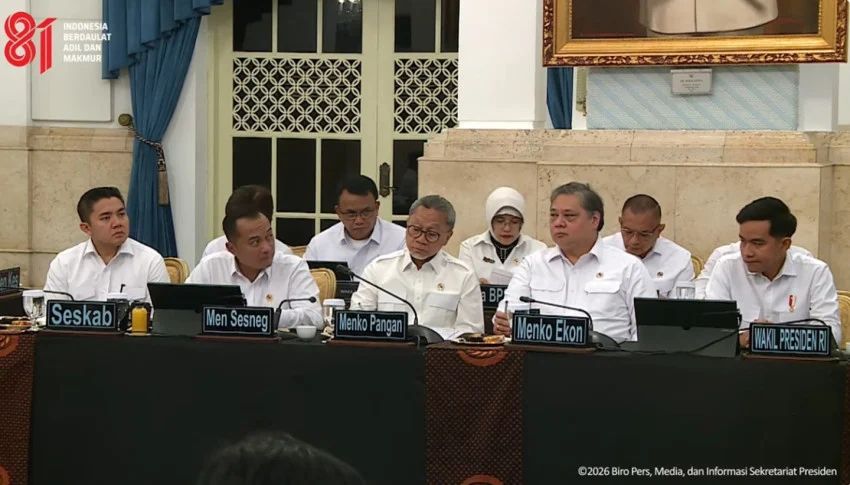
JAKARTA – A notable alteration in the seating protocol for Vice President Gibran Rakabuming Raka during the Plenary Cabinet Session on Monday, July 20, 2026, has drawn attention and prompted an official response from the Presidential Palace. Unlike previous sessions where the Vice President occupied a seat adjacent to President Prabowo Subianto, in this instance, Vice President Gibran was positioned alongside other cabinet ministers. This shift in arrangement, observed in photographs and widely reported, has ignited discussions regarding its potential implications and the underlying rationale.
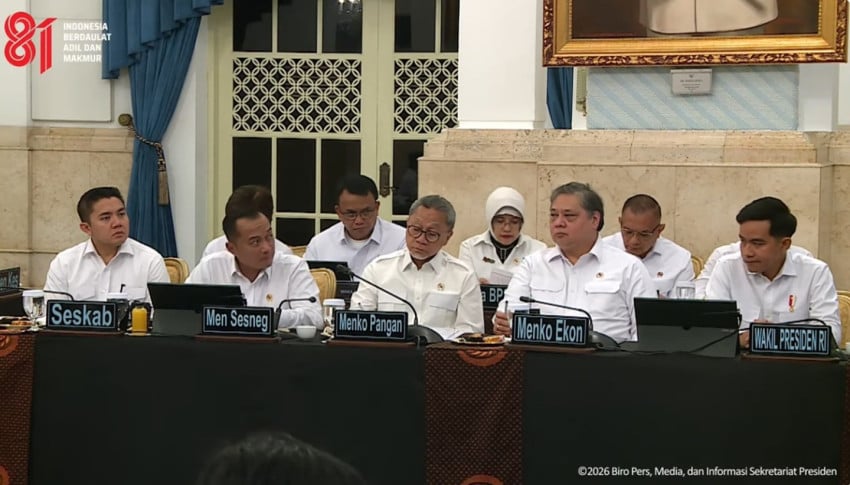
The visual evidence from the session held at the State Palace clearly indicated that Vice President Gibran’s chair was placed on the right side of President Prabowo’s, at the same level as other senior ministers. These included Coordinating Minister for Economic Affairs Airlangga Hartarto, Coordinating Minister for Food Zulkifli Hasan, Minister of State Secretary Prasetyo Hadi, and Cabinet Secretary Teddy Indra Wijaya. This arrangement stood in contrast to a previous Plenary Cabinet Session on Friday, March 13, 2036, held in the same venue. During that earlier meeting, Vice President Gibran, clad in a white shirt, was seated directly beside President Prabowo, who wore a brown safari suit. The juxtaposition of these two seating arrangements has become the focal point of the current discourse.
Background: The Significance of Seating Arrangements in Governmental Protocol
In governmental and diplomatic settings, seating arrangements are rarely arbitrary. They often carry symbolic weight and reflect hierarchical structures, established protocols, and the specific nature of the meeting. The proximity of individuals in formal gatherings can signify their level of authority, their direct reporting lines, or their integral role in decision-making processes. For the Vice President, a position inherently linked to the President and often seen as the second highest executive office, a seat adjacent to the Head of State typically underscores this unique relationship and the shared responsibility of governance.
The shift observed on July 20, 2026, therefore, naturally invites scrutiny. It raises questions about whether this was a deliberate change in protocol, a practical adjustment due to logistical constraints, or a subtle indicator of evolving dynamics within the executive branch. Understanding the historical context of such arrangements within the Indonesian administration provides further depth to this analysis. Traditionally, the Vice President’s seating has been a consistent marker of their co-equal standing with the President in many ceremonial and deliberative contexts, short of the ultimate executive power vested in the President.
Chronology of Observed Seating Protocols
To fully appreciate the significance of the recent change, it is beneficial to establish a timeline of observed seating arrangements for the Vice President during Plenary Cabinet Sessions:
-
Friday, March 13, 2036: In a Plenary Cabinet Session at the State Palace, Vice President Gibran Rakabuming Raka was seated directly beside President Prabowo Subianto. This arrangement visually reinforced the close working relationship between the two leaders.
-
Monday, July 20, 2026: During another Plenary Cabinet Session at the State Palace, Vice President Gibran Rakabuming Raka was seated at the front right of President Prabowo, at the same level as Coordinating Ministers and other senior state officials. This marked a departure from the previously observed protocol.
The interval between these two specific sessions, approximately four months, highlights that the change was not a minor, one-off adjustment but a noticeable alteration in how the Vice President’s presence is physically represented within the cabinet’s highest deliberative forum.
Official Response and Clarification
In response to the public and media attention surrounding the seating arrangement, the Presidential Palace has provided an official explanation. Minister of State Secretary Prasetyo Hadi, himself seated in the vicinity of the Vice President during the July 20 session, addressed the matter. According to the statement, the shift in seating was not intended to signify any change in the Vice President’s status or his integral role within the government.
"The arrangement on Monday was a logistical consideration," Minister Hadi stated, as reported by presidential press sources. "The layout of the room for the Plenary Cabinet Session is dynamic and can be adjusted based on the specific agenda and the number of participants required for optimal discussion and interaction. On this occasion, the arrangement facilitated the presence and active participation of all relevant ministers and officials who needed to be seated in close proximity to present their reports and engage in discussions."
He further elaborated that the primary objective of the Plenary Cabinet Session is to foster a collaborative environment for effective policy-making and oversight. Therefore, seating arrangements are often adapted to ensure that all key stakeholders can contribute efficiently. The Minister emphasized that the Vice President’s position within the cabinet remains as constitutionally defined and that his contributions to national governance are unwavering and highly valued.
Supporting Data and Broader Context
While the official explanation points to logistical considerations, the timing and nature of such shifts in high-level governmental protocol can still be subject to broader analysis. The Indonesian government, under President Prabowo and Vice President Gibran, has been in office for a significant period by July 2026, having navigated numerous policy initiatives and faced various national challenges.
The Plenary Cabinet Session is a crucial forum where the President convenes his entire cabinet to discuss critical national issues, review government performance, and formulate strategic policies. The attendees typically include ministers, heads of non-ministerial government agencies, and other high-ranking officials. The agenda of the July 20 session, though not explicitly detailed in the initial reports, would have dictated the presence and seating of specific individuals. If the session involved extensive presentations from multiple ministries or focused on specific sectors requiring the input of numerous ministers simultaneously, a rearranged seating chart might indeed be a practical necessity to ensure everyone has a clear line of sight and can engage without undue obstruction.
For instance, if the session focused heavily on economic development and food security, as suggested by the presence of the Coordinating Ministers for these sectors, the layout might have been optimized to allow these ministers to present their data and strategic plans directly to the President and other key decision-makers, with the Vice President positioned to facilitate or oversee these discussions.
Analysis of Potential Implications
Despite the official clarification, the incident offers an opportunity to reflect on the subtle nuances of political signaling and public perception in governmental affairs.
Public Perception and Political Signaling
In a democratic system, the visual representation of power and hierarchy can significantly influence public perception. The seating arrangement of the Vice President, particularly when it deviates from established norms, can be interpreted in various ways by the public, political analysts, and even other government officials. Without official clarification, such a change could be misconstrued as a signal of a shift in the power dynamics between the President and Vice President, or a subtle indication of the Vice President’s evolving role. However, the official statement aims to preempt such interpretations by framing the change as a functional adjustment.
Operational Efficiency and Cabinet Functionality
The explanation emphasizing logistical considerations and operational efficiency holds weight. Effective cabinet functioning relies on clear communication and the ability of all members to participate actively. If the seating arrangement on July 20 genuinely facilitated better interaction and presentation of information, then it served its intended purpose of enhancing cabinet performance. The presence of ministers like Airlangga Hartarto and Zulkifli Hasan in prominent positions might indicate that the session was indeed focused on key economic and food security strategies, requiring their direct and immediate engagement.
Precedent and Future Protocols
The clarification provided by the Minister of State Secretary is crucial in setting a precedent for future sessions. By explicitly stating that such adjustments are based on functional needs, the administration can avoid unnecessary speculation. It also suggests that flexibility in seating arrangements, based on the specific requirements of each session, is a potential aspect of the current government’s operational style. This approach, if consistently applied and clearly communicated, can lead to more efficient and focused cabinet meetings.
The Role of the Vice Presidency
The Vice Presidency in Indonesia, as in many other countries, is a position of significant influence and responsibility, often serving as a bridge between the President and the broader government machinery. Vice President Gibran’s active participation in cabinet sessions is vital for the effective implementation of government policies. The visual representation of his role, whether seated beside the President or among ministers, should ultimately reflect his substantive contribution to governance. The official explanation seeks to reaffirm that his contributions remain central, regardless of his physical placement in a particular session.
Conclusion
The change in Vice President Gibran Rakabuming Raka’s seating arrangement during the Plenary Cabinet Session on July 20, 2026, has served as a catalyst for a discussion on governmental protocol and public perception. The Presidential Palace, through the Minister of State Secretary, has provided a clear explanation, attributing the adjustment to logistical considerations aimed at optimizing the session’s functionality and participant interaction. This official clarification is essential in dispelling potential misinterpretations and reinforcing the established roles and contributions of the Vice President within the executive branch. As the government continues its mandate, transparency and clear communication regarding such procedural matters will remain paramount in fostering public trust and ensuring the smooth functioning of the administration. The incident underscores the delicate balance between maintaining established traditions and adapting operational protocols to meet the evolving demands of effective governance.
