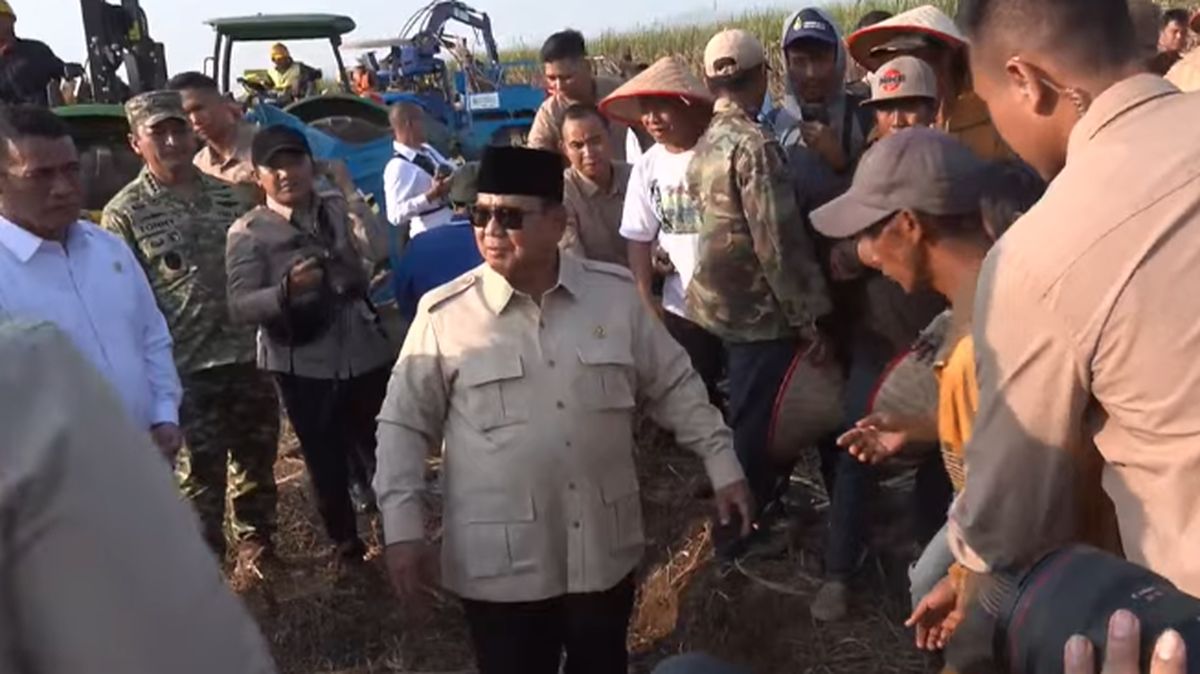
Jakarta, Indonesia – President Prabowo Subianto, during a recent harvest festival in Malang, East Java, on Friday, July 17, delivered a lighthearted remark concerning the Indonesian National Police (Polri) not being under the purview of the Ministry of Defense (Kemenhan), unlike the Indonesian National Armed Forces (TNI). The comment, made in the presence of high-ranking officials including Chief of Polri General Listyo Sigit Prabowo, Commander of TNI General Agus Subiyanto, and Minister of Defense Sjafrie Sjamsoeddin, provided a moment of levity while subtly highlighting the distinct institutional frameworks governing Indonesia’s primary security forces. The event, a "panen raya" (grand harvest) activity, underscored the TNI’s broader involvement in national development initiatives, including food security, a role that often sees military personnel engaged in civilian-oriented projects.
A Moment of Levity at the Harvest Festival
The President’s humorous observation arose during a narrative about his tenure as Minister of Defense under the seventh President of Indonesia, Joko Widodo. Prabowo recounted being presented with the option to procure either foreign-made or domestically produced vehicles for the TNI. Specifically, he was offered the "Maung" jeep, a tactical vehicle manufactured by PT Pindad, Indonesia’s state-owned defense industry company. It was in this context that he playfully quipped about Polri’s institutional independence. "When I was the Minister of Defense, I was presented with an option, ‘Sir, for the TNI,’ at that time I was the Minister of Defense, so I couldn’t handle Polri, sorry, the police don’t want to be under the Minister of Defense, you see," Prabowo stated, eliciting laughter from the audience and himself.
His anecdote continued, detailing the choice he faced: a foreign-made jeep, which was cheaper and of good quality, or the Maung, a slightly more expensive but nationally produced alternative. Prabowo emphasized his decision to prioritize national industry. "So, I chose the expensive one, a bit more expensive, but made by Indonesian children themselves, namely the Maung. Which is now used by our officers, now they use the Maung," he affirmed. This decision not only showcased his commitment to bolstering domestic defense capabilities but also provided the backdrop for his jocular comment on Polri’s autonomous status. The presence of key figures from both the military and police at such an event is indicative of the collaborative spirit fostered between these crucial institutions, despite their differing command structures.
The Maung Jeep: A Testament to National Defense Industry
The Maung tactical vehicle, central to President Prabowo’s anecdote, represents a significant stride in Indonesia’s journey towards defense self-reliance. Produced by PT Pindad (Persero), a state-owned enterprise specializing in military and commercial products, the Maung (meaning ‘tiger’ in Sundanese) is designed as a light tactical vehicle capable of various operational roles, from reconnaissance to personnel transport in challenging terrains. Its development aligns with the government’s long-term strategy to reduce dependence on foreign defense procurement, enhance local manufacturing capabilities, and create employment opportunities within the defense sector.
PT Pindad, established in 1808 as a Dutch colonial arms factory and nationalized in 1950, has a rich history in supplying the TNI and Polri with various armaments and vehicles. The Maung, first unveiled to the public in 2020, gained particular prominence when then-Minister of Defense Prabowo Subianto personally oversaw its testing and subsequent adoption by the TNI. The vehicle boasts a 2.5-liter turbo-diesel engine, four-wheel drive, and a robust chassis, making it suitable for military operations across Indonesia’s diverse geographical landscape. Its modular design also allows for various configurations, including command vehicles, reconnaissance units, and light weapon platforms. The decision to invest in and procure the Maung, even at a higher initial cost, reflects a strategic commitment to strengthening the domestic defense industrial base, fostering technological independence, and ensuring that security forces are equipped with tailor-made solutions for national defense and security needs. This policy not only stimulates the local economy but also enhances national pride and strategic autonomy.
Deconstructing Indonesia’s Security Architecture: TNI and Polri
President Prabowo’s remark, while humorous, brings to the fore a fundamental aspect of Indonesia’s post-Reformasi security architecture: the distinct separation of the TNI and Polri. This separation is a cornerstone of democratic reforms initiated following the fall of the New Order regime in 1998, which sought to redefine the roles of the military and police to ensure civilian supremacy and prevent the abuse of power.
Historically, during the New Order era under President Suharto, both the military (ABRI, now TNI) and the police (Polri) were integrated under a single command structure. ABRI, with its "Dwi Fungsi" (Dual Function) doctrine, held significant political and socio-economic roles beyond national defense, often blurring the lines between military, political, and police functions. This integration allowed the regime to exert extensive control over all aspects of national life, leading to concerns about human rights abuses and the lack of civilian oversight.
The Reformasi movement brought about a radical restructuring. In 1999, Polri was formally separated from the TNI and placed directly under the President. This institutional divorce aimed to transform Polri into a professional, civilian law enforcement agency focused solely on internal security, crime prevention, and maintaining public order. The TNI, on the other hand, retained its mandate for external defense, sovereignty protection, and national security from external threats.
This separation is enshrined in Indonesian law and reflected in their respective command structures and administrative oversight. The TNI, comprising the Army (TNI AD), Navy (TNI AL), and Air Force (TNI AU), falls under the administrative and budgetary supervision of the Ministry of Defense. While the President is the supreme commander of the TNI, the Kemenhan plays a crucial role in policy formulation, strategic planning, resource allocation, and administrative management. This arrangement ensures that the military operates under civilian political leadership, a key principle of democratic governance.
In contrast, Polri, as Prabowo humorously noted, does not report to the Ministry of Defense. Instead, it operates directly under the President, with its budget and policies administered through its own headquarters, accountable to the executive branch and, ultimately, to the public through the President. This direct reporting line emphasizes Polri’s role as a civilian institution, distinct from the military, and reinforces its focus on law enforcement and public safety without military interference. This clear division of labor and authority is designed to prevent the concentration of power in any single security apparatus and to ensure that both institutions adhere to their specialized mandates.
Historical Evolution of Institutional Roles
The journey to this distinct separation was long and complex. Prior to 1999, the police force was an integral part of ABRI, leading to a situation where military doctrine often influenced police operations, and military personnel could be deployed for internal security matters, sometimes with problematic outcomes. The post-Reformasi period saw intense debates and legislative efforts to disentangle these roles. Law No. 2 of 2002 on the Indonesian National Police explicitly defines Polri as a professional and independent law enforcement agency, with its duties distinct from those of the military. Similarly, Law No. 34 of 2004 on the Indonesian National Armed Forces outlines the TNI’s primary role in national defense, unequivocally placing it under the Ministry of Defense for administrative, strategic, and budgetary purposes.
This structural reform was not merely administrative; it represented a fundamental shift in the nation’s approach to security. It aimed to foster professionalism, accountability, and adherence to human rights within both institutions. For the TNI, it meant a return to barracks and a focus on external threats, while for Polri, it meant strengthening its capacity as a civilian police force capable of tackling complex internal security challenges, including terrorism, organized crime, and maintaining public order, through legal and investigative means rather than military force.
The transition, while largely successful, has not been without its challenges. Issues of inter-agency coordination, overlapping jurisdictions in certain areas (e.g., counter-terrorism), and the continuous need for professional development remain ongoing areas of focus. However, the foundational principle of separate command structures, with civilian oversight for the military and direct presidential accountability for the police, has largely been upheld and forms a critical pillar of Indonesia’s democratic consolidation.
Prabowo’s Vision for National Defense and Self-Reliance
Prabowo Subianto’s ascent to the presidency comes after a distinguished career that includes military service, a prominent role as Minister of Defense, and multiple presidential bids. His tenure as Minister of Defense under President Jokowi was marked by a strong emphasis on defense modernization and the promotion of the domestic defense industry. His decision to prioritize the Maung jeep, as recounted, is a clear manifestation of this commitment. He consistently advocated for increased investment in local production capabilities, technology transfer, and research and development to reduce Indonesia’s reliance on foreign military hardware.
This vision aligns with the broader national agenda of achieving strategic autonomy and fostering economic growth through local industries. As President, Prabowo is expected to continue this trajectory, likely pushing for even greater allocation of resources towards PT Pindad and other state-owned defense companies. His presidency is anticipated to champion policies that not only enhance the capabilities of the TNI but also stimulate the growth of a robust, innovative, and self-sufficient defense industrial complex, thereby creating jobs, fostering technological expertise, and ensuring national security from a position of strength. This commitment to self-reliance is not just about military hardware; it also extends to human resources, training, and strategic doctrine.
Interpreting the President’s Remarks
The President’s humorous remark about Polri’s autonomy can be interpreted in several ways. On one level, it was a simple, lighthearted acknowledgment of an established institutional reality, delivered in a casual setting. Prabowo is known for his direct and often informal communication style, and such a comment might be seen as characteristic of his public persona. The laughter it drew from the audience suggests it was well-received as a joke, rather than a controversial statement.
However, beyond the humor, the remark subtly underscores the significant political and structural reforms that have shaped modern Indonesia. It serves as a reminder of the clear delineation of roles between the military and the police, a separation that is fundamental to Indonesia’s democratic framework. For some observers, it might even be seen as a reaffirmation of the principle of civilian supremacy over both institutions. By jokingly stating his inability to "handle" Polri as Minister of Defense, Prabowo implicitly acknowledged and respected the distinct chains of command and the civilian nature of the police force.
There could also be a subtle undercurrent of a long-standing discourse within Indonesia regarding the optimal structure for its security forces. While the separation is widely accepted, occasional discussions arise about coordination mechanisms, especially in areas like counter-terrorism, where TNI and Polri sometimes operate in overlapping spaces. However, the President’s tone strongly suggests an acceptance of the current structure, merely using it as a humorous aside to contextualize his decision-making process as former Minister of Defense. It is highly unlikely to signal any intention to alter the established order, which would represent a significant reversal of democratic reforms.
Broader Implications for Governance and Security
The event and President Prabowo’s remarks, however lighthearted, carry broader implications for governance and security in Indonesia. Firstly, it reinforces the principle of democratic civilian control over the armed forces. The placement of the TNI under the Ministry of Defense, headed by a civilian (or a retired military officer acting in a civilian capacity, as Sjafrie Sjamsoeddin currently does), ensures that military policy and operations are ultimately subject to political direction. This is crucial for preventing the military from becoming an independent political actor, a concern that plagued Indonesia for decades.
Secondly, the distinct status of Polri as a civilian law enforcement agency directly accountable to the President is vital for maintaining internal security through legal means and upholding human rights. It ensures that policing functions are not militarized and that the focus remains on crime prevention, investigation, and public order, rather than military-style suppression. This distinction is paramount in a democratic society where the state’s monopoly on force must be exercised responsibly and within the bounds of law.
Thirdly, the emphasis on domestic defense production, as exemplified by the Maung jeep, highlights Indonesia’s strategic imperative to build a self-reliant defense industry. This not only bolsters national security by ensuring a steady supply of military equipment tailored to local conditions but also contributes to economic development, technological advancement, and job creation. President Prabowo’s consistent advocacy for local production signals a sustained commitment to this policy, which will likely see increased investment and support for companies like PT Pindad.
Finally, the presence of the top brass from both TNI and Polri at the "panen raya" event signifies ongoing inter-agency cooperation and a unified approach to national development and security. While their institutional structures are distinct, their ultimate goals converge on ensuring the stability, prosperity, and security of the Indonesian nation. Events like these provide platforms for fostering goodwill, understanding, and collaborative efforts on issues of national importance, such as food security, which often require multi-sectoral engagement.
Conclusion: Balancing Tradition and Modernity
President Prabowo Subianto’s humorous observation regarding Polri’s independent status, made amidst a discussion on national defense industry, encapsulates several key aspects of contemporary Indonesia. It highlights the enduring legacy of democratic reforms that reshaped the nation’s security architecture, separating the military and police into distinct, professional bodies under civilian oversight. It also underscores the government’s steadfast commitment to fostering a robust domestic defense industry, exemplified by the adoption of vehicles like the Maung jeep, to achieve strategic autonomy and economic growth. While delivered with a touch of humor, the President’s words implicitly reaffirm the delicate balance between maintaining effective security forces and upholding democratic principles of civilian supremacy and institutional professionalism. As Indonesia moves forward under its new leadership, these foundational principles will continue to guide its defense and security policies, ensuring a stable and prosperous future for the archipelago nation.