
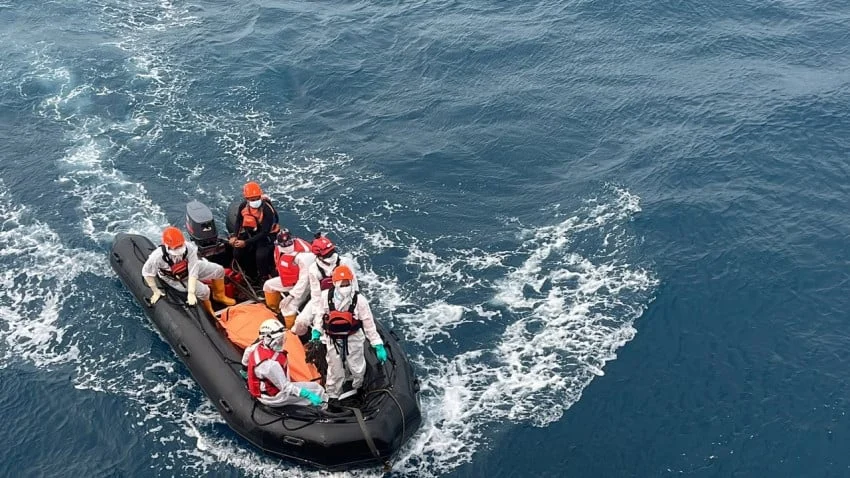
JAKARTA — The Joint Search and Rescue (SAR) team has intensified its ongoing operations in the Java Sea following the tragic maritime incident involving the passenger vessel Virgo Transport 8. As of Friday, September 25, 2026, rescue efforts remain at their peak, mobilizing personnel, vessels, and aircraft from multiple agencies to locate remaining survivors and recover victims. The incident has drawn significant national attention, prompting rigorous investigations, humanitarian responses, and discussions surrounding maritime safety regulations across Indonesian waters.
According to official updates provided by the Head of the National Search and Rescue Agency (Basarnas), Marshal Madya TNI M. Syafii, the scale of the operation is vast, covering extensive maritime sectors where debris and victims have been scattered due to prevailing ocean currents and weather conditions. With a total of 243 individuals recorded on the ship’s official manifest, the search and rescue deployment involves coordinated efforts between Basarnas, the Indonesian Navy (TNI AL), the National Police, and local volunteer organizations.
Current Statistics and Evacuation Updates
As of 12:00 Central Indonesia Time (Wita) on Friday, September 25, 2026, the Joint SAR Team has successfully accounted for 160 individuals out of the 243 people registered on the manifest. The breakdown of the casualties and survivors highlights both the urgency of the ongoing mission and the heavy toll of the disaster.
Marshal M. Syafii detailed the latest figures during a press briefing: "Out of the total recorded passengers and crew, 108 individuals have been found alive, while 52 souls have tragically lost their lives. Meanwhile, search operations continue vigorously for the remaining 83 individuals who are still unaccounted for."
Recent tactical developments in the operation saw the Joint Diving Team from Basarnas successfully evacuate five additional victims from the submerged or drifting sections of the disaster area. These retrieved individuals were immediately transferred to the rescue vessel KN SAR Kamajaya and the Indonesian Navy warship KRI Gusti Ngurah Rai for preliminary medical triage and identification procedures.
To expedite medical care and transport, authorities utilized an HR-3601 helicopter to airlift priority victims from the naval vessels directly to the Syamsudin Noor Air Force Base in Banjarmasin, South Kalimantan. From there, coordinated ground ambulance teams transferred them to regional medical facilities equipped to handle trauma and emergency care.
Concurrently, search teams operating along coastal perimeters and river mouths reported further discoveries. Three victims were recovered near the estuary of Sungai Cabang within the PT Kumai Sentosa concession area in Sukamara Regency, Central Kalimantan. Additionally, two more victims were located along the shoreline of Sandurian in the neighboring Seruyan Regency. These bodies were initially taken to the Sukamara Regional General Hospital (RSUD Sukamara) for identification before being scheduled for transfer to the Bhayangkara Police Hospital in Banjarmasin for comprehensive forensic examination and family handovers.
Background Context of the Virgo Transport 8 Incident
The sinking or distress event involving the Virgo Transport 8 has sent shockwaves through Indonesia’s transportation sector. Operating as a routine commercial maritime route connecting major regional hubs, the vessel was carrying passengers and cargo across the Java Sea when it encountered catastrophic difficulties. While preliminary meteorological reports indicated moderate to rough sea conditions typical of transitional weather patterns in the region, investigators have yet to pinpoint the exact sequence of mechanical, environmental, or human factors that led to the disaster.
Maritime transport remains a vital lifeline in the Indonesian archipelago, serving millions of citizens who rely on ferries and commercial vessels to traverse vast oceanic distances. However, incidents of this magnitude starkly highlight the persistent vulnerabilities within maritime logistics, passenger manifest verification, and safety compliance. The Java Sea, known for its busy shipping lanes and unpredictable tropical weather squalls, has historically been the site of several high-profile maritime incidents, prompting continuous calls for enhanced regulatory oversight.
Chronology of the Search and Rescue Operation
The timeline of the Virgo Transport 8 disaster has unfolded across several critical phases since distress signals were first received by maritime authorities.
- Initial Distress and Alert Phase: Upon receiving emergency notifications from the vessel, Basarnas coordinated with regional marine communication centers to establish the last known position of the Virgo Transport 8 in the Java Sea. Immediate alerts were broadcast to nearby commercial vessels to initiate initial spotter and rescue maneuvers.
- Deployment of the Joint SAR Task Force: Within hours of the alert, Basarnas mobilized a multi-agency task force comprising naval assets, coast guard units, and specialized diving teams. Command posts were established in strategic coastal districts across Central Kalimantan and Java to manage logistics, family inquiries, and media briefings.
- First Wave of Rescues: During the initial days of the operation, fast response boats and helicopter sweeps managed to pull dozens of survivors from life rafts and floating debris fields. Medical stations were set up in ports receiving the rescued passengers to provide immediate warmth, hydration, and psychological first aid.
- Expansion of Search Grids: As surface currents pushed debris and victims over wider areas, the search grid was expanded significantly. Aircraft equipped with thermal imaging and maritime patrol capabilities were deployed alongside underwater sonar scanning teams to map wreckage sites and locate trapped compartments within the vessel.
- Current Operations (Day of the Update): The operation on Friday, September 25, 2026, marked a crucial intensification phase, focusing on both deep-water diving recoveries by Basarnas specialists and shoreline sweeps conducted by local search units along the coasts of Sukamara and Seruyan.
Official Responses and Legal Implications
The magnitude of the Virgo Transport 8 disaster has triggered immediate legal and administrative scrutiny. Transport authorities, regulatory bodies, and legal experts have emphasized that victims and their families retain extensive legal rights under Indonesian maritime law.
Legal analysts and consumer protection advocates have pointed out that passengers aboard commercial transport vessels are fully entitled to seek legal recourse and financial compensation if investigations reveal negligence, overloading, safety equipment failures, or regulatory non-compliance by the vessel operator or management company. Insurance claims, carrier liability frameworks, and governmental compensation schemes are currently being reviewed by legal aid organizations offering pro bono assistance to affected families.
Furthermore, the Ministry of Transportation and the National Transportation Safety Committee (KNKT) have launched comprehensive investigations into the operational standards of the shipping line operating the Virgo Transport 8. Audits are being conducted on ticketing systems, manifest accuracy protocols, and pre-departure safety checks to determine whether all regulatory mandates were strictly observed prior to the vessel’s departure.
Broader Impact and Implications for Indonesian Maritime Safety
The ongoing tragedy involving the Virgo Transport 8 serves as a sobering reminder of the challenges facing Indonesia’s maritime transportation infrastructure. Beyond the immediate humanitarian crisis of rescuing survivors and comforting grieving families, the incident is expected to catalyze systemic reforms within the domestic shipping industry.
Key areas under review by policymakers and maritime experts include:
- Manifest Transparency: Addressing discrepancies between actual passengers on board and official manifests, a recurring challenge in regional maritime operations that complicates search and rescue calculations.
- Weather Monitoring and Departure Restrictions: Enhancing real-time meteorological coordination between port authorities and maritime operators to prevent vessels from navigating during hazardous sea states.
- Emergency Preparedness and Onboard Safety Gear: Ensuring that all commercial vessels maintain fully functional life rafts, personal flotation devices, and emergency radio beacons that meet international safety standards.
- Accountability and Law Enforcement: Strengthening penalties for operators found in violation of safety protocols, ensuring justice for victims and deterring future negligence.
As the Joint SAR Team continues its relentless pursuit in the Java Sea, the nation watches with bated breath, hoping for the safe recovery of the remaining 83 individuals while demanding lasting changes to ensure such a catastrophe never happens again.
