
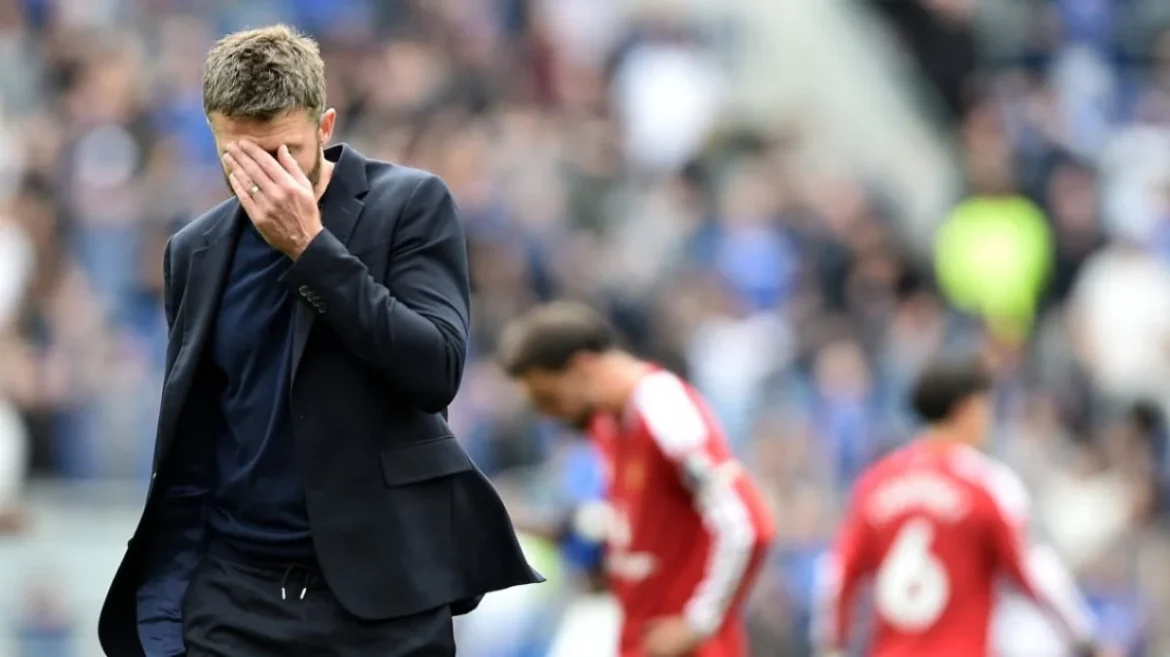
Manchester United’s turbulent journey through the modern era of English football has taken yet another fascinating turn as former manager Jose Mourinho has stepped forward to publicly voice his unwavering support for current boss Michael Carrick. The endorsement comes at a delicate juncture for the Red Devils, who are currently navigating a turbulent start to the 2026/2027 Premier League campaign. Despite a setback in the fierce Manchester derby against arch-rivals Manchester City at Old Trafford, the backing of a seasoned tactician like Mourinho provides a psychological boost to a relatively inexperienced manager attempting to steer one of the most scrutinized clubs in world football.
The context of Carrick’s tenure at Old Trafford is rooted in resilience and rapid transformation. Appointed initially as an interim manager in January following the departure of Ruben Amorim, Carrick breathed new life into a struggling squad. Under his stewardship, Manchester United orchestrated a remarkable turnaround in form, stringing together vital results that culminated in a stellar third-place finish in the Premier League table at the conclusion of the previous season. This achievement not only restored a sense of pride and stability to the club but also secured coveted qualification for the prestigious UEFA Champions League, a milestone that significantly altered the club’s financial and sporting trajectory for the year.
Recognizing this impressive stabilization, INEOS—the group overseeing sporting operations at Manchester United—rewarded Carrick with a permanent two-year contract. His statistics from that interim period underscored his tactical acumen and ability to manage a high-pressure dressing room, registering 11 victories, three draws, and only two defeats across his matches in charge. Having previously worked alongside Mourinho during the Portuguese manager’s tenure at Old Trafford—first as a reliable midfielder and later as a transition coach—Carrick absorbed elements of pragmatic management that have seemingly translated well into his managerial philosophy.
However, football is a relentless sport where past glories are quickly overshadowed by present challenges. The opening weeks of the 2026/2027 Premier League season have proven to be a rigorous test of Carrick’s tactical adaptability and squad depth. Manchester United have managed to collect a meager four points from their opening four league fixtures, highlighting lingering inconsistencies in attack and vulnerabilities in defensive transition.

The latest obstacle in their path arrived on Sunday, September 13, 2026, when Manchester United hosted Manchester City at Old Trafford. In a tense and dramatic encounter, the reigning champions secured a narrow 1-0 victory over the Red Devils. The match was filled with high-stakes drama, notably featuring Manchester City claiming all three points despite playing with ten men for a significant portion of the game following a 23rd-minute red card shown to Phil Foden. The inability of Carrick’s side to capitalize on the numerical advantage reignited questions regarding their killer instinct in big matches, placing the manager under early-season scrutiny from the media and portions of the fanbase.
Amid the mounting pressure, Mourinho—currently managing Real Madrid—offered a calming perspective during an interview with Sky Sports. Reflecting on his former player and colleague, the Portuguese coach emphasized his confidence in Carrick’s temperament and capability to weather the storm.
“Michael is fine, his condition is good. I am happy with that,” Mourinho stated, dismissing external panic and reinforcing the bond forged during their shared years at Old Trafford.
Mourinho’s own history with Manchester United remains a defining chapter in the post-Sir Alex Ferguson era. Taking the helm in May 2016 until his departure in December 2018, Mourinho managed the club across 144 matches. During his turbulent yet trophy-laden reign, he successfully guided the Red Devils to three major honors: the FA Community Shield, the UEFA Europa League, and the English League Cup. His tenure is often remembered for its defensive solidity, pragmatic approach to high-profile matches, and his candid assessments of the club’s internal structural challenges.
True to his characteristic demeanor, Mourinho refused to delve deeply into an extensive analysis of his own historical legacy or offer unsolicited commentary on the current operational dynamics within Manchester United’s boardroom and training ground. He firmly believes in a personal code of conduct regarding clubs he has previously managed.

“However, as I always do, or try to do, when I leave a club, I close the door and then I do not make comments. I do not analyze externally what happens,” Mourinho explained. “One door closes and another door opens. That is what happens when I go. The history stays there, the numbers stay there, three medals come back home, and that is it.”
The wider implications of Carrick’s current situation at Manchester United extend far beyond a single defeat to Manchester City. For INEOS, backing Carrick was a calculated decision to move away from the cycle of high-profile, short-term managerial appointments that characterized the post-Ferguson decade. The leadership group envisioned a project built on cultural alignment, continuity, and the gradual integration of modern tactical frameworks. Carrick embodies this vision, having deep institutional knowledge of what it means to wear the red shirt and succeed in the Premier League.
Yet, the demands of managing Manchester United leave little room for prolonged periods of adjustment. With the UEFA Champions League campaign on the horizon and domestic rivals strengthening their squads, Carrick faces the immediate task of re-energizing his attacking unit and finding tactical consistency. The integration of new signings, the management of player fatigue, and the psychological recovery from the derby defeat will dictate whether United can climb back into the upper echelons of the league table in the coming weeks.
As the season progresses, the backing of respected footballing figures like Mourinho serves as a reminder of the resilience required in the dugout at Old Trafford. While the early-season stumble has prompted inevitable concerns, Carrick’s proven ability to organize a squad and respond to adversity will be tested to its absolute limits. Whether Manchester United can transform this current period of turbulence into a foundation for long-term success remains one of the most compelling storylines of the 2026/2027 English football season.
