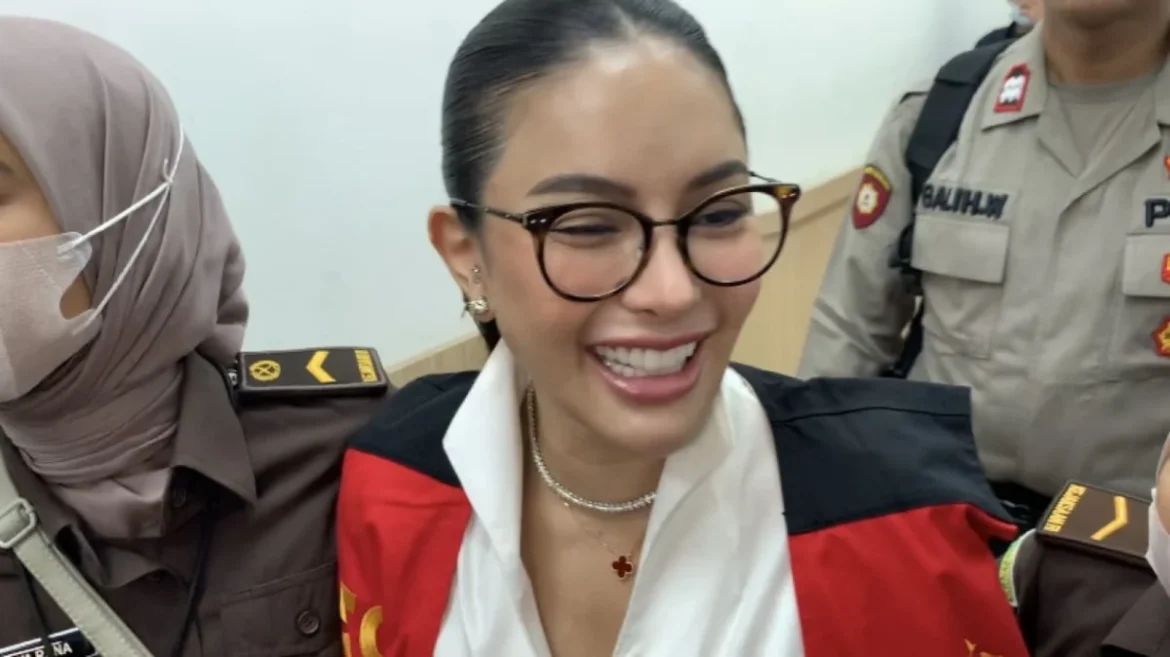
The legal journey of prominent Indonesian actress and public figure Nikita Mirzani has reached a critical juncture following a definitive ruling by the Supreme Court of Indonesia (Mahkamah Agung or MA). The highest judicial institution officially rejected the extraordinary legal remedy, known as Peninjauan Kembali (PK) or judicial review, submitted by Mirzani’s legal representation. With this rejection, the final legal architecture of the case stands firm, cementing a six-year prison sentence previously handed down by appellate judges.
The developments surrounding Mirzani’s case have continuously dominated public attention, given her status as a high-profile celebrity frequently embroiled in public controversies. However, the most recent chapter of her legal saga has introduced an unexpected dynamic: a public display of solidarity from an individual previously recognized as one of her fiercest adversaries, social media personality Tengku Zanzabella. This reconciliation of sorts, paired with a complex timeline of judicial proceedings, has catalyzed widespread discussions regarding the boundaries of celebrity rivalry, the intricacies of Indonesian criminal law, and the remaining avenues available for convicted high-profile figures.
Chronology of Legal Proceedings: From Initial Charges to Supreme Court Rejection
The genesis of Mirzani’s legal troubles stems from a formal police report filed by aesthetic doctor and entrepreneur Reza Gladys. The initial altercation and subsequent legal complaints snowballed into a formal criminal proceeding handled by the South Jakarta District Court. During the initial trial phase, the district court delivered a verdict finding Mirzani guilty of specific charges, sentencing her to four years of imprisonment alongside a mandatory fine of Rp1 billion, with an auxiliary provision of a three-month subsidiary confinement in lieu of payment.
Dissatisfied with the initial verdict, the public prosecutor’s office pursued an appeal through the Jakarta High Court. The appellate tier introduced a significantly harsher legal evaluation of the evidence and charges presented. The Jakarta High Court notably expanded the scope of Mirzani’s criminal liability by ruling that she was legally proven to have committed Money Laundering (Tindak Pidana Pencucian Dunia or TPPU)—a severe charge that the primary court had previously ruled as unproven. Consequently, the appellate judges adjusted the penalty upwards, extending Mirzani’s total prison sentence to six years.
Seeking to overturn the stringent appellate ruling, Mirzani’s defense team elevated the case to the Supreme Court via a formal cassation (kasasi) petition. Nevertheless, the Supreme Court justices reviewed the case files and ultimately rejected the cassation, leaving the six-year sentence intact. Refusing to exhaust all legal remedies without a fight, Mirzani’s legal counsels initiated an extraordinary legal avenue via a Judicial Review (PK). Under Indonesian criminal procedural law, a PK requires the submission of newly discovered evidence (novum) or the identification of a blatant judicial error (maきて decision manifest error) in previous rulings. Once again, the Supreme Court scrutinized the petition and reached a firm decision to dismiss the PK, thereby rendering the six-year incarceration term legally absolute and final under ordinary and extraordinary judicial pathways.
An Unlikely Display of Support From Tengku Zanzabella
Amid the fallout of the Supreme Court’s definitive ruling, public discourse shifted momentarily toward an unexpected reaction from Tengku Zanzabella, a social media influencer with whom Mirzani had previously engaged in prolonged and highly publicized digital feuds. In the past, both figures routinely exchanged sharp criticisms and public rebukes across various social media platforms, capturing the intense scrutiny of online tabloids and digital audiences alike.
Upon learning that the Supreme Court had dismissed Mirzani’s final judicial review petition, Zanzabella utilized her personal social media channels to address the development. Breaking the mold of typical adversary behavior—which often involves public schadenfreude or antagonistic commentary—Zanzabella opted for a conciliatory and supportive tone.
“Stay healthy, Nyai (Nikita),” Zanzabella wrote in a public post, utilizing Mirzani’s popular moniker. Furthermore, the influencer offered practical, albeit informal, advice regarding the management of a long-term prison sentence, suggesting that the actress explore opportunities for sentence reduction through standard correctional mechanisms. “The most [viable option] is to try and secure a remission,” she added, before concluding with an encouraging remark: “Keep your spirits up, Nik.”
This mature response quickly circulated across digital networks, drawing positive engagement from netizens who praised Zanzabella for prioritizing human empathy over past grievances during a moment of profound personal crisis for her former rival.
Remaining Legal Avenues: The Presidential Prerogative of Grasi
With all judicial mechanisms—ranging from district court trials, high court appeals, Supreme Court cassations, to judicial reviews—fully exhausted, legal experts emphasize that the judicial branch has completed its evaluation of the case. However, the Indonesian legal system retains a constitutional mechanism outside the purview of the courts: the presidential pardon, formally known as Grasi (clemency).
Prominent legal practitioner Ricky Sitohang, speaking to members of the media following the Supreme Court’s announcement, elucidated the operational reality of Mirzani’s current legal standing. Sitohang pointed out that because the judicial review has been conclusively rejected by the Supreme Court, the singular remaining structural path available to alter the sentence lies in a direct petition to the President of the Republic of Indonesia.
“If it is like this now, so be it; if the judicial review there has been rejected, there is only one left: to submit a clemency petition (grasi) to the President,” Sitohang explained to journalists.
Under Indonesian Law No. 22 of 2002 concerning Clemency, as amended by Law No. 5 of 2010, grasi is defined as a presidential prerogative granting a pardon in the form of a change, commutation, reduction, or abolition of a criminal execution bestowed upon a convicted individual. The law permits a convict or their legal representative to submit a grasi application to the President, who exercises this authority after receiving considerations from the Supreme Court. However, legal analysts routinely stress that the granting of clemency is entirely discretionary and rests solely upon the executive judgment of the head of state, rather than operating as an automatic right of the convicted party.
Sitohang further emphasized that while the legal framework provides this ultimate safety valve, the initiation of such a step remains a personal and strategic decision for Mirzani and her internal advisory team. “However, the decision to take that step rests entirely in Nikita’s hands,” Sitohang concluded.
Broader Socio-Legal Implications and Public Discourse
The finalization of Nikita Mirzani’s legal case serves as a notable case study within the broader landscape of Indonesian jurisprudence, particularly concerning the prosecution of white-collar and financial crimes involving public figures. The transition from initial assault or defamation-related complaints originating from private disputes—such as the initial report by Dr. Reza Gladys—into severe financial charges such as Money Laundering highlights the aggressive posture adopted by prosecutors and appellate judges in penalizing complex criminal activities.
Furthermore, the case underscores the stringent thresholds required to successfully overturn convictions via extraordinary legal remedies in Indonesia. The Supreme Court’s consistent rejection of both cassation and judicial review petitions reinforces the principle of legal certainty, signaling the judiciary’s reluctance to dismantle appellate decisions absent overwhelmingly compelling new evidence.
As Mirzani prepares to serve the remainder of her six-year sentence within the correctional system, attention will likely shift toward her legal team’s next move regarding the potential submission of a presidential clemency petition. Simultaneously, the surprising public empathy demonstrated by Tengku Zanzabella remains a poignant reminder of the fluid nature of public relationships in the age of digital media, where personal conflicts can occasionally give way to shared humanity in the face of insurmountable legal realities.