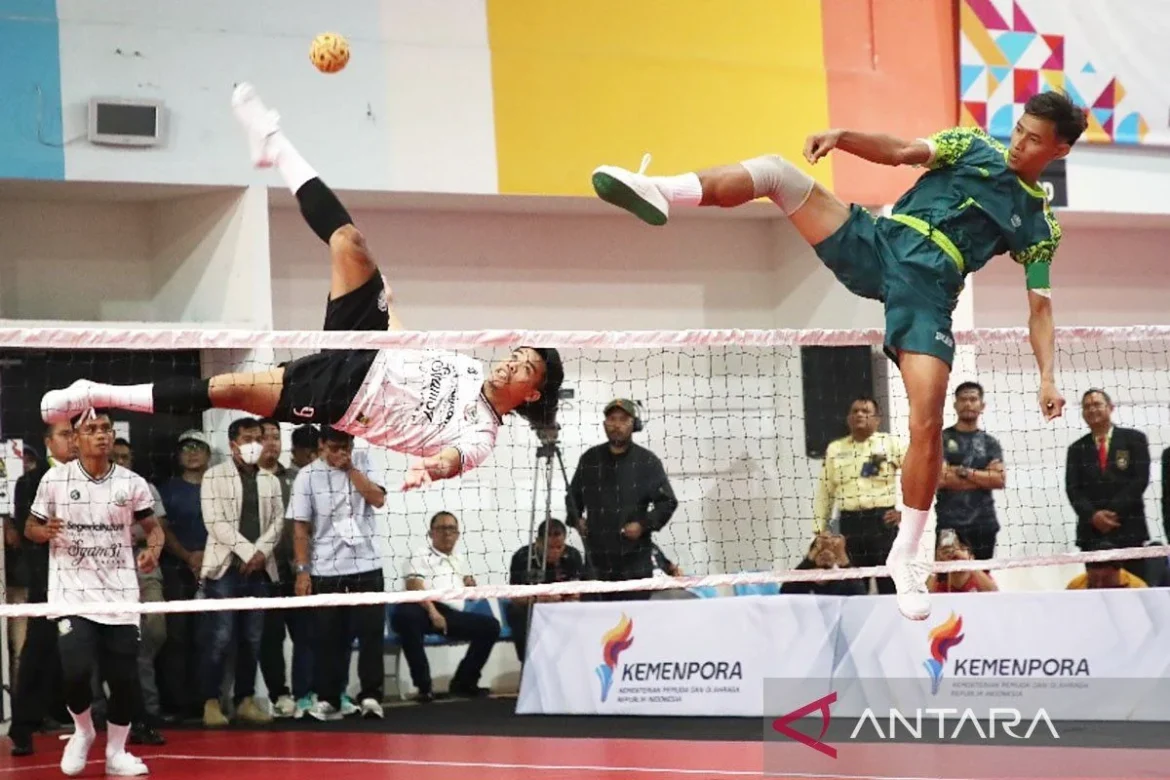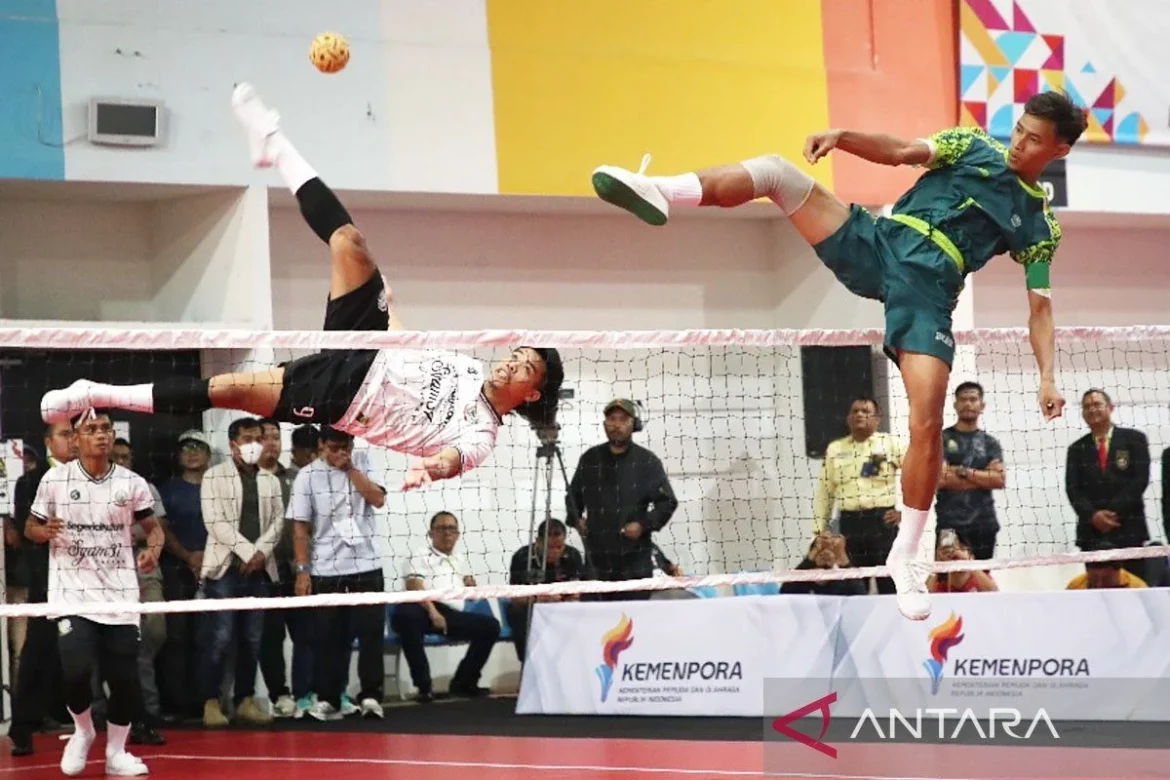
Sepak Takraw, a captivating traditional sport originating from Southeast Asia, is gaining international recognition for its breathtaking display of athleticism. This unique game, often described as a fusion of volleyball’s aerial dynamics and football’s acrobatic kicking prowess, is played without the use of hands, demanding exceptional agility, precision, and teamwork from its athletes. While its roots run deep in regional culture, Sepak Takraw is steadily carving out a niche in the global sporting landscape, captivating audiences with its spectacular moves and intricate strategies.
The name "Sepak Takraw" itself is a linguistic tapestry, woven from two distinct languages. "Sepak," derived from the Malay language, directly translates to "kick," signifying the sport’s fundamental action. Complementing this is "Takraw," a word originating from Thai, which refers to the distinctive woven rattan ball used in the game. Thus, Sepak Takraw literally means "to kick the rattan ball," a concise yet evocative descriptor of its core gameplay. This nomenclature was officially recognized following a notable match between Malaysia and Thailand in Kuala Lumpur in 1960, solidifying its identity on the international stage.
Prior to its formal naming, the sport bore different appellations across its regions of origin. In Malaysia, it was widely known as "Sepak Raga Jaring." The addition of the term "jaring" (meaning net) is credited to Hamid Mydin, widely regarded as a pivotal figure in the sport’s development. In Penang around 1945, Mydin introduced the net, thereby differentiating it from the earlier, traditional "Sepak Raga" which was played without one. This adaptation marked a significant evolution in the sport’s gameplay, introducing a vertical challenge and a more structured competitive environment.
Often dubbed "Kick Volleyball" or "Foot Volleyball," Sepak Takraw is a team-based sport typically contested by two to four players per side. The playing court bears a striking resemblance to that of a badminton court, a compact arena that amplifies the intensity of the rallies. The sport’s rules strictly prohibit the use of hands and arms. Instead, players are permitted to utilize their feet, knees, shoulders, chest, and head to strike and control the ball. This restriction on hand usage is what draws the most direct parallels to volleyball, as players must artfully manoeuvre the ball over a net to their opponent’s side, aiming to score points.
Internationally, the governance of Sepak Takraw falls under the purview of the International Sepaktakraw Federation (ISTAF), established in 1988. ISTAF plays a crucial role in standardizing rules, organizing global tournaments, and promoting the sport worldwide. The sport is not monolithic in its regional nomenclature; it is known by various local names, reflecting its widespread presence and cultural integration. These include "Sepak Raga" in Indonesia, Brunei, Malaysia, and Singapore; "Sipa" in the Philippines; "Chinlone" in Myanmar; and "Takraw" in Thailand, among other variations across Asian countries. This linguistic diversity underscores its deep-seated presence within the cultural fabric of Southeast Asia.
The Ancient Roots and Evolution of Sepak Takraw
The historical trajectory of Sepak Takraw suggests its origins can be traced back approximately 500 years to Malaysia, where it enjoyed considerable popularity within royal courts as early as the 15th century. This esteemed status within the aristocracy likely contributed to its initial dissemination. By the 16th century, the game had found its way to Indonesia, where it was known as Sepak Raga, further embedding itself in the region’s sporting heritage.
The 1940s marked a significant period for Sepak Takraw, as formal rules and regulations began to take shape, leading to its burgeoning popularity across Southeast Asia. A pivotal moment in its formalization occurred in 1945 with the first official competition held in Penang, then under the banner of "Sepak Raga Jaring." This event laid the groundwork for structured competition and further development of the sport.
The establishment of the Malaysian Sepak Raga Federation in Penang in 1960 represented another crucial step in its organized progression. Its inclusion in the Southeast Asian Peninsular Games (SEAP Games) in 1965 was a landmark achievement, elevating its profile and solidifying its status as a major regional sport. It was during this significant event that the sport was officially christened "Sepak Takraw," a name that has since become its international identifier.
Intriguingly, some historical accounts suggest that Sepak Takraw’s lineage may extend even further back, with influences from ancient Chinese games. It is theorized that the sport might have evolved from "Cuju," a traditional Chinese game recognized by FIFA as an early precursor to modern football. Cuju was an ancient military exercise where soldiers would kick a leather ball, with the objective of keeping it airborne for as long as possible. This historical connection to ball-kicking traditions, even if indirect, highlights the enduring human fascination with manipulating a ball using one’s feet and body. This potential link to Cuju suggests a deep ancestral connection to ball games that have spanned millennia and continents, showcasing the universal appeal of skillful ball manipulation.
Core Mechanics and Gameplay of Sepak Takraw
Sepak Takraw is played on a rectangular court, typically measuring 13.4 meters (44 feet) in length and 6.1 meters (20 feet) in width, divided by a net that stands 1.52 meters (5 feet) high. The court dimensions are similar to those used for badminton, contributing to the fast-paced, agile nature of the game.
The game involves two teams, each consisting of three players. These players are strategically positioned on the court: one "Tekong" (server), one "Feeder," and one "Killer." The Tekong is responsible for initiating the play with a serve, a crucial role that sets the tone for the rally. The Feeder’s role is to set up scoring opportunities for the Killer, who aims to deliver powerful, precise shots to win the point.
The Serve: The game commences with a serve initiated by the Tekong. The Tekong must stand within a designated service circle. Before kicking the ball, the Tekong tosses it up from their hand. The serve must successfully cross the net and land within the opponent’s court. The right to serve first is typically determined by a coin toss, with the winning team having the option to serve or receive.
Rally Progression: Once the serve is in play, a rally ensues. Teams alternate in kicking, heading, or using other permitted body parts (excluding hands) to keep the ball in play and direct it towards the opponent’s side. The objective is to force an error from the opposing team or to score directly by making the ball land in their court. The intricate coordination between the Feeder and Killer is paramount in executing effective offensive plays. The Feeder’s precise passes create openings for the Killer to unleash powerful spikes, often executed with astonishing aerial acrobatics, including bicycle kicks and somersaults.
Scoring System: Points are awarded when the ball lands on the opponent’s side of the court, goes out of bounds after being touched by an opponent, or when an opponent commits a fault (such as touching the ball with their hand or arm). A standard set in Sepak Takraw is played to 21 points. A team must win a set by a margin of at least two points. A match is typically a best-of-three sets format, meaning the first team to win two sets secures the victory. This scoring system ensures that matches are often closely contested and require sustained performance and strategic adaptation.
International Governance and Growing Popularity
The International Sepaktakraw Federation (ISTAF) has been instrumental in promoting the sport globally. Established in 1988, ISTAF has worked tirelessly to standardize rules, organize major international tournaments, and foster the growth of Sepak Takraw in non-traditional regions. The ISTAF World Cup and the Asian Games are among the premier events that showcase the highest level of Sepak Takraw competition.
The sport’s inclusion in major multi-sport events like the Asian Games has significantly boosted its visibility. In recent years, there has been a discernible increase in interest and participation from countries outside of Southeast Asia, including Japan, South Korea, India, and even parts of Europe and North America. This global expansion is a testament to the sport’s inherent excitement and the dedication of federations and athletes worldwide.
Recent developments within national federations, such as the resolution of dualistic leadership issues in Indonesian Sepak Takraw, signal a maturing organizational structure that is crucial for sustained growth. As reported by ANTARA, the resolution of these internal disputes has been met with positive reception from international bodies like ISTAF, indicating a unified front that can better advocate for and develop the sport. This internal stability is a prerequisite for robust development, allowing national federations to focus on athlete training, infrastructure development, and broader promotional activities.
Broader Implications and Future Outlook
The growing popularity of Sepak Takraw carries several broader implications. Firstly, it offers a unique sporting spectacle that appeals to a wide audience, blending the grace of gymnastics with the intensity of a competitive sport. The acrobatic maneuvers performed by players are not only visually stunning but also represent the pinnacle of human physical conditioning and coordination.
Secondly, Sepak Takraw contributes to the preservation and promotion of traditional Southeast Asian culture. As a sport deeply rooted in the region’s history, its international success helps to showcase and celebrate the rich heritage of its origin countries. This cultural exchange is invaluable in fostering cross-cultural understanding and appreciation.
Furthermore, the sport’s accessibility, requiring relatively minimal equipment and space compared to some other sports, makes it a viable option for grassroots development. The focus on agility and skill rather than sheer physical power can also make it an inclusive sport for a diverse range of athletes.
The future of Sepak Takraw appears promising. With continued efforts from ISTAF and national federations to promote the sport, increase media coverage, and develop professional leagues, it is poised for further international growth. The recent positive developments in governance within key nations like Indonesia are indicative of a maturing sporting ecosystem ready to embrace new challenges and opportunities. As more people discover the thrill of watching and playing Sepak Takraw, its unique blend of athleticism, strategy, and cultural heritage is sure to captivate hearts and minds across the globe. The potential for Sepak Takraw to become a mainstream international sport, akin to volleyball or badminton, is a tangible prospect, driven by its inherent dynamism and the unwavering passion of its players and supporters. The continued evolution of its strategies, training methodologies, and global outreach will undoubtedly shape its trajectory in the coming decades.