
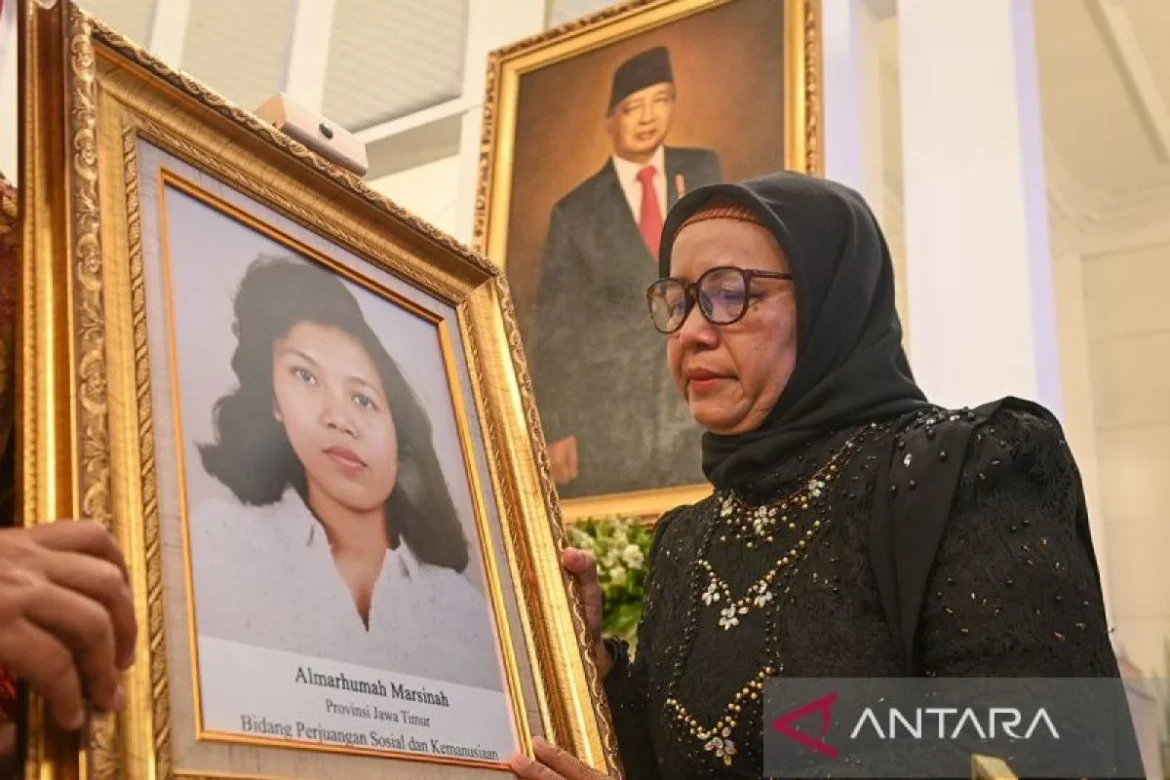
Jakarta (ANTARA) – President Prabowo Subianto, on the solemn occasion of National Heroes’ Day, Monday, November 10, 2025, officially conferred the prestigious title of National Hero upon Marsinah at the State Palace in Jakarta. Marsinah, a revered labor activist known for her unwavering courage in advocating for workers’ rights, posthumously received this highest honor, solidifying her place in Indonesia’s pantheon of national figures. Her recognition is a powerful testament to her enduring spirit and the sacrifices made in the struggle against social inequality and oppressive treatment that plagued workers, particularly during the authoritarian New Order era.
The conferment was formalized through Presidential Decree (Keppres) Number 116/TK/Tahun 2025, which also designated nine other prominent individuals as National Heroes this year. This collective acknowledgment underscores the nation’s commitment to honoring those who have made significant contributions to the welfare and rights of the Indonesian people, with a particular emphasis on the often-marginalized working class. Marsinah’s story, one of defiance and ultimate sacrifice, has resonated deeply within Indonesian society for decades, symbolizing the relentless pursuit of justice in the face of daunting adversity. Her elevation to National Hero status represents not merely a historical rectification but also a renewed call for vigilance in safeguarding human rights and upholding the dignity of labor.
The Enduring Legacy of Marsinah: A Symbol of Resistance
Marsinah’s narrative transcends a mere personal tragedy; it encapsulates the broader struggle of Indonesian workers under a highly centralized and often repressive political system. During the New Order period (1966-1998) led by President Soeharto, Indonesia underwent rapid economic development and industrialization. While this era brought about significant improvements in infrastructure and some sectors of the economy, it was often characterized by a strong authoritarian grip on civil society, including strict controls over labor movements. Independent trade unions were largely suppressed, and the government-sanctioned All-Indonesia Workers Union (Serikat Pekerja Seluruh Indonesia or SPSI) often failed to genuinely represent workers’ interests, frequently aligning with employers and state objectives.
Workers faced immense challenges, including meager wages, poor working conditions, and a lack of effective legal recourse against exploitative practices. Strikes and protests were frequently met with intimidation, coercion, and even violence, often involving the military (ABRI, now TNI) which had an extensive reach into civilian affairs through its territorial command structure, such as the Kodim (District Military Command). In this climate, Marsinah emerged as an extraordinary figure. Her decision to actively lead and participate in protests against unfair labor practices was a profoundly courageous act, as it directly challenged the established order and risked severe repercussions. She became a beacon of hope for many, her defiance serving as a stark reminder of the human cost of unchecked power and the indomitable spirit of those who dared to speak truth to power.
A Life Dedicated to Justice: Marsinah’s Early Years and Awakening
Marsinah’s journey began far from the political spotlight, rooted in the humble surroundings of rural East Java. Born on April 10, 1969, in Desa Nglundo, Kecamatan Sukomoro, Nganjuk, East Java, she grew up in a modest family. Her early life was shaped by the challenges of economic hardship, being raised primarily by her grandmother and aunt. Despite these limitations, Marsinah displayed an early tenacity and independent spirit. As the second of three children to Mastin and Sumiani, she contributed to her family’s meager income by selling snacks during her childhood, demonstrating a strong work ethic from a young age.
Her formal education began at SD Negeri Karangasem 189, followed by SMP Negeri 5 Nganjuk. She also spent some time studying at Pondok Pesantren Muhammadiyah, a testament to her family’s values and her pursuit of knowledge. However, like many from impoverished backgrounds, her aspirations for higher education were curtailed by financial constraints, forcing her to seek employment immediately after completing her secondary schooling. This early exposure to economic struggle undoubtedly sharpened her awareness of social disparities and laid the groundwork for her future activism.
In 1989, seeking better opportunities, Marsinah made the significant decision to move to Surabaya, a bustling industrial hub. She resided with her elder sister, Marsini, and diligently sought employment. Her initial job was at SKW plastic factory in the Rungkut industrial area. A year later, in 1990, she secured a position at PT Catur Putra Surya (CPS), a watch factory located in Porong, Sidoarjo. It was at PT CPS that Marsinah’s inherent sense of justice truly ignited. She witnessed firsthand the pervasive injustices faced by her fellow workers – low wages, arbitrary dismissals, and a lack of basic protections. These experiences fueled her growing awareness of labor rights and cemented her resolve to advocate for change, transforming her from an ordinary factory worker into a nascent but determined activist.
The Porong Strike of 1993: A Bold Stand for Wages and Rights
The events of May 1993 at PT Catur Putra Surya (CPS) marked the critical juncture in Marsinah’s life and cemented her role as a labor rights icon. The catalyst for the industrial action was East Java Governor Soelarso’s Circular No. 50/Th.1992, which mandated a 20 percent increase in workers’ wages. Despite this official directive, the management of PT CPS, like many companies at the time, refused to implement the wage hike, exacerbating an already tense situation characterized by low pay and poor working conditions. This blatant disregard for a government policy ignited widespread discontent among the factory’s workforce, culminating in a planned strike.
From May 3 to May 4, 1993, Marsinah, along with twelve other prominent workers, bravely led a major strike at PT CPS. The workers’ demands were clear and urgent: they sought the mandated wage increase and called for the dissolution of the factory-level SPSI (All-Indonesia Workers Union), which they perceived as ineffective and unrepresentative of their interests. The striking workers articulated a list of grievances, demanding fair treatment and improved welfare. Remarkably, their collective action initially yielded a significant victory; the management agreed to eleven of their twelve demands, signaling a momentary triumph for worker solidarity and persistence.
However, this apparent victory was short-lived and soon turned into a tragic prelude. The very next day, the situation took a drastic turn. Thirteen workers, including those who had been at the forefront of the strike, were summoned to the Kodim Sidoarjo (District Military Command). Under immense pressure and duress, they were coerced into signing letters of resignation. This military intervention, a common tactic during the New Order to suppress labor unrest, was a clear violation of workers’ rights and an act of intimidation. Upon learning of this grave injustice, Marsinah, demonstrating extraordinary courage and an unyielding commitment to her fellow workers, went to the Kodim herself. Her intention was to obtain copies of the forced resignation letters, hoping to find a way to challenge the arbitrary dismissals and clarify the fate of her colleagues. This act of seeking accountability, knowing the risks involved in confronting military authorities, underscored her fearless dedication to justice. It was after this visit that Marsinah disappeared.
Disappearance and Tragic Discovery: The Unresolved Mystery
Following her courageous, yet perilous, visit to the Kodim Sidoarjo, Marsinah vanished. Her disappearance sparked immediate concern among her family and fellow activists, who understood the grave dangers associated with challenging the authorities during that era. The uncertainty surrounding her whereabouts cast a dark shadow over the nascent victory achieved by the workers’ strike.
On May 8, 1993, a mere four days after the successful strike and her subsequent disappearance, Marsinah’s body was discovered in a remote hut in Desa Jegong, Kecamatan Wilangan, Nganjuk, approximately 200 kilometers from Sidoarjo. The scene was horrifying: her body bore extensive signs of brutal torture and severe violence, indicating a merciless and prolonged assault. The discovery sent shockwaves across Indonesia, instantly transforming her case into a national symbol of the extreme repression faced by labor activists and the pervasive human rights abuses under the New Order regime. The brutality of her death served as a stark warning to anyone daring to challenge the status quo.
The ensuing investigation into Marsinah’s murder was fraught with controversy and suspicion. Public outcry, amplified by human rights organizations such as the Legal Aid Institute (LBH) and later KontraS (Commission for Missing Persons and Victims of Violence), demanded thorough and transparent justice. Under immense pressure, authorities launched an investigation, which led to the arrest of several individuals, including members of the management of PT CPS. However, the subsequent trials were widely criticized for their lack of credibility. Allegations of forced confessions, procedural irregularities, and a failure to identify the true masterminds behind the murder plagued the process. Many believed that the investigations were deliberately steered away from implicating powerful military or political figures, leaving a deep sense of injustice. Despite convictions and later acquittals, the pervasive perception remains that the actual perpetrators and those who ordered her torture and murder were never truly brought to justice. The mystery surrounding Marsinah’s killing persists to this day, making it one of Indonesia’s most emblematic unsolved human rights cases and a painful reminder of the impunity that often characterized abuses of power during the New Order.
Official Recognition: A Landmark Decision
The conferment of the National Hero title upon Marsinah by President Prabowo Subianto, through Presidential Decree No. 116/TK/Tahun 2025, represents a landmark decision with profound implications for Indonesia’s historical narrative and its ongoing commitment to human rights. This recognition, coming decades after her tragic death, acknowledges that her struggle and ultimate sacrifice were not in vain. It formally inscribes her name into the national memory as a champion of justice, a beacon of courage, and a martyr for the cause of labor rights. The fact that this decree was part of a larger initiative to honor ten distinguished figures underscores the government’s broader effort to acknowledge significant contributions to the nation, particularly those that have been overlooked or suppressed in the past.
The reactions to this long-awaited recognition have been largely positive, though often tinged with the bittersweet knowledge that full justice for Marsinah’s murder remains elusive. Labor unions, such as the Confederation of Indonesian Trade Unions (KSPI), have hailed the decision as a significant moral victory for the labor movement. Said KSPI President Said Iqbal, "The title of National Hero for Marsinah is not just an award for an individual; it is a profound acknowledgment from the state to all workers in Indonesia. It validates the struggles, sacrifices, and unwavering spirit of those who fight for dignified labor. This recognition will undoubtedly inspire future generations of labor activists." They view it as a vindication of the sacrifices made by countless labor activists who have fought, and continue to fight, for better wages, safer working conditions, and the right to organize.
Human rights organizations have also welcomed the move, albeit with a cautious optimism. While acknowledging the symbolic importance of the title in terms of historical reconciliation and state recognition of past abuses, they emphasize that it should not overshadow the urgent need for a complete resolution of her murder case. "Marsinah’s recognition as a National Hero is a commendable step towards rectifying historical injustices," stated a representative from the Commission for Missing Persons and Victims of Violence (KontraS). "However, the quest for truth and accountability for her brutal murder must continue. This honor should serve as a renewed impetus to reopen unresolved human rights cases and ensure that perpetrators are brought to justice, regardless of how much time has passed."
For Marsinah’s surviving family members, the news has evoked a complex mix of pride, relief, and enduring sorrow. Her sister, Marsini, has often expressed a deep sense of pride in Marsinah’s courage and the impact of her struggle. While the National Hero title brings official validation, the pain of losing Marsinah under such brutal circumstances and the unresolved questions surrounding her death remain. This recognition offers a measure of closure regarding her historical standing, but the yearning for complete legal justice continues. From the government’s perspective, President Prabowo’s administration is signaling a commitment to honoring figures who have fought for social justice, even those whose struggles were sensitive during previous political eras. This move can be interpreted as an effort to bridge historical divides and acknowledge the diverse contributions to Indonesia’s nation-building process.
Broader Implications and Enduring Significance
Marsinah’s conferment as a National Hero carries several profound implications for Indonesian society, reaching far beyond the symbolic. Firstly, it represents a significant step towards historical reconciliation. By officially recognizing Marsinah, the Indonesian state implicitly acknowledges the dark chapters of its past, particularly the human rights abuses and suppression of dissent that characterized the New Order era. This acknowledgment is crucial for healing national wounds and fostering a more honest understanding of Indonesia’s modern history.
Secondly, the honor serves as a powerful empowerment for the labor movement. It strengthens the morale and legitimacy of labor unions and activists across the archipelago, signaling that their vital role in advocating for workers’ rights is now officially sanctioned and celebrated by the state. This could potentially foster a more robust and confident labor sector, encouraging greater participation in advocating for fair wages, improved working conditions, and the right to collective bargaining without fear of reprisal. In an era where global supply chains often put pressure on labor standards, Marsinah’s story becomes a timeless reminder of the foundational importance of workers’ rights.
Thirdly, while symbolic, the title implicitly re-emphasizes the importance of the rule of law and the pursuit of justice. The ongoing demand for accountability for Marsinah’s murder continues to highlight the need for a robust legal system capable of addressing past and present human rights violations. This recognition could spur renewed calls for a review of other unresolved human rights cases, contributing to a culture of accountability and preventing future abuses. The fact that her murder remains unsolved underscores the persistent challenges in achieving full justice, even as her legacy is celebrated.
Finally, Marsinah’s story, now officially enshrined in the national narrative, will play a crucial educational role. It will serve as an inspiration for future generations, teaching them about the courage required to stand up for justice, the importance of human dignity, and the historical struggles that underpin the freedoms and rights enjoyed today. Her life and sacrifice will be integrated into the fabric of national identity, ensuring that the lessons learned from her struggle are never forgotten. Marsinah’s enduring spirit continues to resonate as a powerful call for a society where justice, dignity, and human rights are not just ideals, but lived realities for all.
Marsinah’s posthumous recognition as a National Hero is more than just an award; it is a reaffirmation of the values for which she bravely fought. Her name will forever be synonymous with courage, resistance, and the unwavering pursuit of justice for the working class. As Indonesia moves forward, Marsinah’s legacy will continue to inspire activists, workers, and all citizens to uphold the principles of human rights and social equity, ensuring that her sacrifice was a catalyst for lasting positive change in the nation. Her story, once a painful scar, is now etched as an indelible mark of honor and a perpetual reminder of the vigilance required to protect the fundamental rights of every Indonesian.
