
German football legend Thomas Muller has once again ignited a fierce debate within the global football community, reigniting a long-standing discussion about referee impartiality and the perceived influence of superstar players like Lionel Messi. His recent comments, made shortly after Argentina’s narrow 0-1 defeat to Spain in the 2026 FIFA World Cup final, have thrust a controversial moment from the 2010 World Cup back into the spotlight, alongside broader criticisms of officiating throughout the most recent tournament. Muller’s pointed remarks, implying that Messi’s presence might sway crucial refereeing decisions, have gone viral, prompting widespread discussion among fans, pundits, and former officials.
The immediate catalyst for Muller’s statement was the conclusion of the 2026 World Cup, a tournament that, despite its thrilling moments, concluded with Argentina’s loss in the final but was shadowed by a torrent of criticism regarding several contentious refereeing decisions that many observers believed disproportionately favored the South American powerhouse throughout their campaign. While Argentina ultimately fell short in the final, their path through the knockout stages was undeniably marked by incidents that sparked intense polemics and fueled accusations of a biased officiating environment. It was against this backdrop of lingering controversy that Muller chose to speak, linking the recent events to a personal experience from over a decade ago.
The Catalyst: Muller’s Provocative Statement
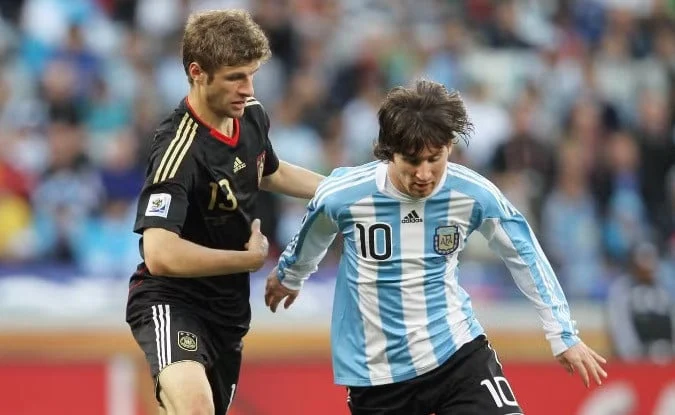
Muller’s comments directly referenced a specific incident from the 2010 FIFA World Cup quarter-final match between Germany and Argentina, a game Germany famously dominated with a resounding 4-0 victory. During that match, Muller received a yellow card for a handball, a decision that carried significant weight as it meant he would be suspended for Germany’s crucial semi-final clash against Spain. It is this particular moment that Muller has now revisited with a distinct insinuation.
"We were already leading against Argentina, and Lionel Messi was standing right next to me," Muller recounted, detailing the sequence of events. "The ball bounced off the ground and then hit my hand, which was in this position," he explained, presumably demonstrating a natural arm position close to his body. "The referee immediately showed me a yellow card. I felt the reason was simple: because Messi was standing next to me. I felt Messi looked at the referee as if to say, ‘we are losing, please help us a little.’"
This direct quote, shared widely across social media platforms, immediately resonated with a segment of the football public who have long harbored suspicions about the treatment afforded to globally recognized figures in high-stakes matches. The implication that Messi, through his mere presence or perhaps an unspoken gesture, could influence a referee’s judgment is a potent one, touching upon the delicate balance of power, reputation, and objective decision-making in professional sports. The resurfacing of the 2010 incident, complete with old video clips circulating online, has reignited a debate that extends far beyond a single yellow card.
A Tournament Marred by Controversy: The 2026 World Cup Narrative
The timing of Muller’s remarks is crucial, coming as they did in the immediate aftermath of a 2026 World Cup final where Argentina’s journey to the decisive match was already under intense scrutiny. While the specifics of the 2026 controversies are still being dissected, the general sentiment among many analysts and fans pointed to a series of calls in the group stage and particularly in the knockout rounds that seemed to consistently break in Argentina’s favor. These incidents ranged from debatable penalty awards, overlooked fouls against Argentine players, to questionable decisions regarding offsides or disciplinary actions against their opponents.
Such criticisms are not new in football, especially when a team featuring a global icon like Messi progresses deep into a major tournament. The narrative of "big team bias" or "star player favoritism" is a persistent one, often fueled by the immense pressure on referees in high-stakes matches and the global media attention that scrutinizes every call. The introduction of technologies like Video Assistant Referee (VAR) was intended to mitigate these human errors and biases, yet even with VAR, subjective interpretations and controversial outcomes continue to plague the sport, leaving room for accusations like Muller’s. The 2026 tournament, despite its technological advancements, evidently failed to fully dispel these concerns, particularly for a team that carried the hopes of an entire nation and the weight of a legendary player’s final World Cup quest.
Historical Echoes: The 2010 World Cup Quarter-Final
To fully appreciate the weight of Muller’s recent comments, one must delve deeper into the 2010 World Cup quarter-final encounter between Germany and Argentina. The match, played on July 3, 2010, at the Cape Town Stadium, was a highly anticipated clash between two footballing giants. Germany, under Joachim Löw, was a vibrant, youthful side, while Argentina, coached by the enigmatic Diego Maradona, boasted an attacking lineup led by Messi, then in the prime of his career but still seeking his first World Cup triumph.
Germany delivered a masterclass performance, ultimately triumphing 4-0. Muller opened the scoring in the 3rd minute. However, the incident he refers to occurred later in the match. His yellow card, issued by Uzbek referee Ravshan Irmatov, was for a handball. The rule regarding handball has always been a contentious one, often relying on the referee’s interpretation of intent and whether the hand was in an "unnatural position." Muller’s claim suggests that his hand was in a natural position, leading him to believe the card was unduly influenced.
The immediate consequence of that yellow card was significant: it was Muller’s second of the tournament, triggering an automatic one-match suspension. This meant he missed Germany’s semi-final match against Spain, which they subsequently lost 1-0, denying them a chance at the final. For a young, burgeoning star like Muller, missing such a pivotal match was a bitter blow, and it is evident that the memory of that suspension, and the perceived injustice behind it, has lingered for over a decade. The fact that he chose to vocalize this perceived injustice now, in the context of renewed scrutiny on refereeing decisions involving Messi, underscores the depth of his conviction regarding the incident.
The Allegation of Influence: Messi’s Stature and Referee Perceptions
Muller’s remarks tap into a broader psychological aspect of refereeing in elite sports: the inherent difficulty of remaining entirely immune to the stature and pressure exerted by global icons. Lionel Messi, widely regarded as one of the greatest footballers of all time, carries an unparalleled aura on the pitch. His presence commands attention, not just from opponents and teammates, but also from officials.
The argument often put forward is that referees, consciously or subconsciously, might be less inclined to make a call against a player of Messi’s caliber, particularly one that could drastically alter the course of a match or tournament. This is not to suggest malicious intent, but rather a human tendency to err on the side of caution or to be swayed by the prevailing narrative or the sheer weight of expectation surrounding such a figure. Critics argue that this can manifest in various ways: a quicker whistle for fouls committed against Messi, a slower one for fouls he commits, or even, as Muller suggests, an expedited disciplinary action against an opponent when Messi is nearby, creating a perceived imbalance in officiating.
While there is no definitive statistical evidence to prove a systematic bias towards Messi over his entire career, anecdotal observations and the perception of many fans and players persist. Messi’s disciplinary record is notably clean for a player of his attacking prowess, often lauded for his fair play. However, this could also be interpreted as a consequence of referees being more lenient towards him, rather than a definitive sign that he never commits fouls worthy of stricter punishment. This nuanced debate is precisely what Muller’s comments have brought back to the fore, challenging the notion of complete refereeing objectivity in the face of unparalleled celebrity.
Reactions Across the Football World
Muller’s statement rapidly went viral, sparking a wide range of reactions across social media and traditional sports media outlets. Many fans, particularly those whose teams have been on the receiving end of controversial decisions involving Messi’s teams, expressed agreement, sharing their own anecdotes and frustrations. Others, however, vehemently defended Messi, dismissing Muller’s comments as sour grapes or an attempt to deflect from his team’s performance.
Football analysts and former referees have also weighed in. Some have acknowledged the psychological pressure on officials when dealing with superstar players, admitting that it is an undeniable factor, even if unintentional. They argue that the sheer volume of global attention on Messi means that any decision involving him is magnified, creating an environment where referees are under immense scrutiny. Conversely, other experts have defended referee integrity, emphasizing the professional training and impartiality expected of officials at the highest level, suggesting that such claims undermine the sport’s fundamental principles. The debate has been particularly lively in Argentina, where Messi is revered, and in Germany, where Muller is a national hero, highlighting the nationalistic undertones that often color these discussions.
The Broader Debate on Refereeing Integrity and VAR
The enduring nature of this controversy, spanning from 2010 to 2026, underscores a deeper, systemic issue within football: the ongoing struggle for consistent and universally accepted refereeing integrity. The introduction of VAR was heralded as a revolutionary step towards eliminating clear and obvious errors, thereby reducing controversy. Yet, as the 2026 World Cup and countless league matches have demonstrated, VAR itself has become a source of contention. Its application is often inconsistent, the criteria for intervention can seem opaque, and the ultimate decision still rests with human interpretation, albeit with technological assistance.
Muller’s comments, therefore, are not just about Messi or a single yellow card; they are symptomatic of a broader dissatisfaction with the human element in refereeing, even when aided by technology. The demand for flawless officiating in a fast-paced, highly subjective sport like football often clashes with the reality of human fallibility. The incident raises critical questions: How much influence do player reputations truly have? Can technology ever fully remove subjective bias? And how can football ensure that the game is decided purely by skill and strategy, rather than by the perceived or actual impact of officiating decisions?
Muller’s Motivation and Legacy
For Thomas Muller, a player known for his forthrightness and tactical intelligence, revisiting this incident after so many years is unlikely to be a casual remark. It suggests a deeply held belief about an injustice that affected his World Cup journey. Muller, a serial winner with Bayern Munich and a World Cup champion with Germany in 2014, has little to gain personally from such comments now, other than perhaps seeking vindication for a moment that clearly still bothers him. His motivation could be seen as an appeal for greater fairness in the game, a call for referees to be truly immune to external pressures, regardless of the player involved.
His willingness to speak out also adds another layer to his legacy. Beyond his incredible goal-scoring record and unique playing style, Muller has often been a voice for the players, unafraid to express his views on the state of the game. This recent intervention solidifies his position as a figure who, even in the twilight of his career, remains deeply invested in the integrity and future of football.
Implications for the Future of Football
The implications of Muller’s comments, particularly coming after a World Cup marred by officiating controversies, are significant. They contribute to a growing chorus of voices demanding greater transparency and consistency in refereeing. This renewed debate could put increased pressure on FIFA and other governing bodies to re-evaluate referee training, VAR protocols, and the psychological support provided to officials who operate under immense global scrutiny. It might also lead to further discussions about the composition of refereeing teams, the role of former players or independent bodies in reviewing decisions, and even the potential for fully autonomous officiating systems in the distant future.
Ultimately, Thomas Muller’s recent foray into this long-standing debate serves as a potent reminder that while football celebrates its superstars, the integrity of the game rests on the perception of fair play and objective decision-making. As the dust settles on the 2026 World Cup, and as football continues to evolve, the challenge of ensuring unbiased officiating in a sport driven by passion, national pride, and the colossal influence of its greatest legends, remains one of its most complex and enduring dilemmas. The conversation Muller has reignited will undoubtedly continue to shape discussions about the beautiful game for years to come.
