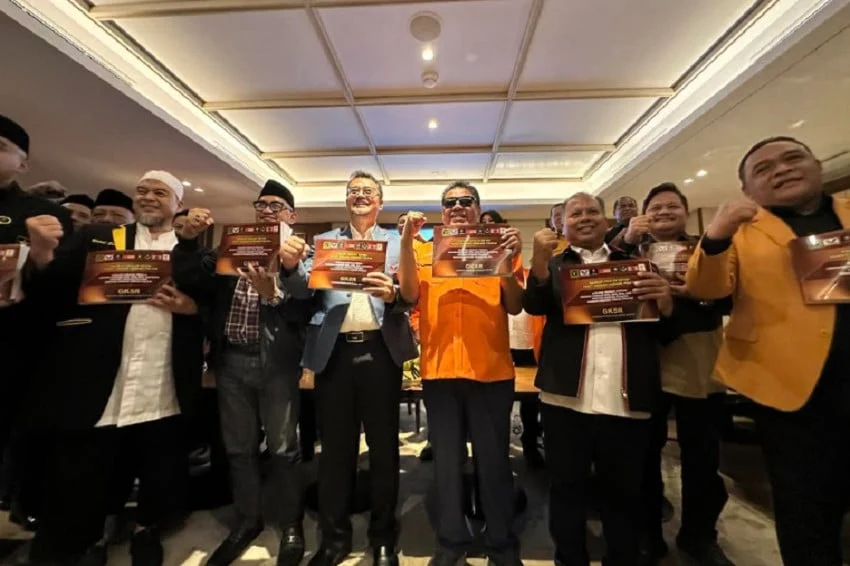
JAKARTA — The political landscape leading up to the upcoming legislative elections has entered a critical phase of debate, centered primarily on the revision of the nation’s core election regulations. Amid ongoing deliberations regarding the structure of future national contests, the Gerakan Kedaulatan Suara Rakyat (GKSR), an alliance comprising various non-parliamentary political parties, has formally proposed that the parliamentary threshold be established at precisely 1 percent. This pivotal stance was articulated by GKSR General Chair Said Iqbal during the movement’s first-anniversary commemoration, held at a prominent venue in Central Jakarta on Saturday, September 26, 2026.
The proposal challenges prevailing discussions among major political factions currently seated in the House of Representatives (DPR), who have historically favored higher thresholds to consolidate party representation. By advocating for a significantly lower barrier to entry for legislative seats, the coalition aims to foster a more inclusive political ecosystem that ensures broader representation for minority and emerging political entities within the national parliament.
Foundational Rationale and Scientific Justification for the 1 Percent Threshold
During his keynote address to members, supporters, and media representatives, Said Iqbal elaborated on the theoretical and empirical foundations underpinning the alliance’s recommendation. He emphasized that the proposed 1 percent figure is not an arbitrary political figure, but rather the result of rigorous academic research concerning electoral systems, governance models, and proportional representation frameworks.
Specifically, Said pointed to the application of the Taagepera formula—a widely recognized political science methodology developed by academic Rein Taagepera used to calculate optimal assembly sizes and threshold levels based on district magnitudes and total seat allocations. According to the coalition’s interpretation of these academic models, setting the threshold at 1 percent strikes an optimal balance between legislative stability and democratic inclusivity, preventing the excessive waste of valid votes cast by citizens for smaller parties.
Furthermore, the proposal incorporates structural mechanisms such as the allowance of joint factions at the national level within the DPR. This would enable smaller parties that successfully cross the 1 percent threshold to pool their resources and legislative capacities. Additionally, the coalition advocates for the implementation of a "stembus accoord"—an electoral pact or pre-election vote-pooling arrangement established prior to the voting process rather than retroactively. This mechanism would allow allied parties to aggregate their remaining or surplus votes to secure seats that might otherwise be lost under a strictly isolated calculation model.
Said firmly asserted that the threshold figure should remain anchored in objective electoral science rather than being subjected to arbitrary adjustments driven by the short-term political interests of major parties currently entrenched in the national legislature. He warned against the manipulation of electoral rules for partisan advantage, arguing that continuous escalation of the threshold disenfranchises millions of voters and undermines the pluralistic foundation of the republic.
Disparities in Verification Requirements for Political Contenders
Beyond the parliamentary threshold, the GKSR platform introduces comprehensive recommendations regarding the administrative burden of party verification for future elections. The coalition has put forward a tiered verification framework designed to streamline the process for established participants while maintaining appropriate regulatory oversight for new political organizations.
Under this proposed model, non-parliamentary political parties that have already undergone and successfully passed comprehensive administrative and factual verification processes during previous electoral cycles should be granted a streamlined path. Specifically, these experienced organizations would only be required to complete administrative verification for subsequent elections, thereby reducing unnecessary bureaucratic redundancies and financial strains.
Conversely, new political parties participating in a national election for the very first time would still be mandated to undergo the rigorous dual-verification process—encompassing both administrative scrutiny and on-the-ground factual verification. This distinction, the coalition argues, ensures administrative efficiency without compromising the integrity and legitimacy of new entrants wishing to contest legislative seats.
Controversy Surrounding Treatment of Parliamentary Incumbents
In a sharp critique of existing legislative privileges, Said Iqbal raised concerns regarding what he characterized as a double standard in how political parties are treated under current election law revisions. He strongly criticized the eight political parties currently represented in the DPR, arguing that there is no justification for incumbent parliamentary parties to continually alter statutory thresholds and requirements to shield themselves from electoral competition.
As part of the GKSR proposal, the coalition demands that political parties currently holding seats in the national parliament should only be required to complete standard registration procedures. Said argued that established parliamentary parties should be entirely exempt from both administrative verification (vermin) and factual verification (verfak) processes, given their continuous existence, proven organizational infrastructure, and ongoing representation in governance.
"There is no valid reason for the eight parliamentary parties in the DPR to manipulate numbers for tactical maneuvers," Said stated during the anniversary event. "GKSR requests that within this revision of the Election Law, parliamentary parties simply need to register. They do not need administrative verification and they do not need factual verification."
Background and Context of the Election Law Revision
The ongoing debate over the revision of the Election Law is part of a recurring legislative cycle that typically takes place between election periods in the world’s third-largest democracy. These revisions frequently ignite intense negotiations between major political parties—which generally benefit from higher parliamentary thresholds designed to weed out smaller competitors—and smaller, non-parliamentary parties striving for institutional survival and broader representation.
Historically, the parliamentary threshold has experienced a steady upward trajectory in Indonesia since its introduction in the post-Suharto democratic era. In the 2009 legislative election, the threshold was set at 2.5 percent, before being raised to 3.5 percent for the 2014 election, and subsequently elevated to 4 percent for the 2019 and 2024 elections. Each incremental increase has historically eliminated several minor parties from securing seats, concentrating legislative power among a smaller group of major national parties and leading to concerns regarding the marginalization of diverse political viewpoints.
The formation of coalitions like GKSR reflects a growing counter-movement among marginalized political entities seeking to influence the legislative drafting process before the rules are finalized by the DPR and the government. By organizing collective advocacy efforts, these non-parliamentary actors aim to exert public pressure and leverage academic findings to shape the trajectory of electoral reform.
Implications of the 1 Percent Threshold on the Political Landscape
The proposal to lower the parliamentary threshold to 1 percent carries profound implications for the future architecture of Indonesian democracy. If adopted by lawmakers, such a reduction could significantly alter the composition of the national parliament by facilitating the entry of multiple smaller factions. While proponents argue this enhances representation and gives voice to specialized constituencies, critics often contend that lower thresholds can lead to a fragmented legislative body, potentially complicating coalition-building and slowing down the policymaking process.
Political analysts note that the debate highlights an inherent tension between governability and representation. Higher thresholds promote a streamlined, majoritarian parliament where consensus is theoretically easier to achieve among a consolidated group of large parties. Conversely, lower thresholds ensure that the legislature more accurately reflects the multifaceted preferences of a diverse electorate, reducing the proportion of "wasted votes" cast for parties that fall just short of the cutoff.
The stance taken by GKSR also underscores the ongoing friction regarding the administrative barriers to entry for political organizations. The cost of complying with complex, nationwide verification procedures has long been cited by smaller parties as a major financial and logistical hurdle. By pushing for simplified verification rules for established non-parliamentary contenders and registration-only pathways for parliamentary incumbents, the movement aims to level the playing field.
Outlook and Legislative Roadmap
As the revision process of the Election Law continues within parliamentary commissions and academic circles, the demands voiced by GKSR are expected to fuel further debate among lawmakers, civil society organizations, and constitutional experts. While major parties in the DPR maintain significant legislative leverage, the pressure from coalitions representing non-parliamentary actors introduces an important dynamic to the public discourse.
The success or failure of these proposals will ultimately depend on the political negotiations between parliamentary factions and the government as the draft bill moves through subsequent stages of review. Whether lawmakers will heed the call for a more inclusive 1 percent threshold and streamlined verification procedures remains one of the most closely watched aspects of the ongoing electoral reform agenda in Jakarta.